- Table of Contents
- How to compare gasoline vs electric vs hybrid cars
- A Quick Decision Guide
- Start With Charging and Refueling Access
- Home Charging Changes the EV Experience
- Public Charging Requires Route-Specific Research
- Gasoline Still Offers Maximum Refueling Flexibility
- Compare Range Using Your Most Demanding Normal Day
- Calculate Total Ownership Cost, Not Just Purchase Price
- Maintenance: Fewer Components Does Not Mean No Maintenance
- Driving Experience and Everyday Comfort
- Match the Powertrain to Your Real-World Use
- City Commuting
- Long-Distance Highway Travel
- Family Driving
- Rural Roads and Remote Areas
- Towing and Heavy Loads
- Environmental Impact Is More Than the Tailpipe
- Safety Depends on the Whole Vehicle
- Buying Used: Powertrain-Specific Checks
- A Five-Step Framework for Making the Final Choice
- 1. Record a Typical Month
- 2. Confirm Energy Access
- 3. Price the Same Class of Vehicle
- 4. Build a Multi-Year Cost Estimate
- 5. Test the Inconvenient Scenario
- Common Buying Mistakes to Avoid
- Frequently Asked Questions
- Is an electric car cheaper to own than a gasoline car?
- Is a hybrid worth it if I mostly drive on highways?
- Do plug-in hybrids need to be charged?
- How much EV range do I need?
- Are electric cars suitable for cold climates?
- Which powertrain is best for someone without home charging?
- Choose the Car That Fits Your Routine
Choosing among gasoline, electric, and hybrid cars is no longer a simple question of fuel economy. A practical gasoline vs electric vs hybrid comparison must consider how you refuel or recharge, plan long trips, handle maintenance, and calculate ownership costs. The right choice depends less on which technology appears most advanced and more on where you drive, where you park, how far you travel, and how long you expect to keep the vehicle.
For many buyers, the gasoline vs electric vs hybrid decision becomes clearer after answering one practical question: Which type of car creates the fewest compromises in my normal week? An electric vehicle may be highly convenient with reliable home charging, while a gasoline model may work better for frequent remote travel. A hybrid can reduce fuel use without requiring a charger, and a plug-in hybrid may suit drivers whose routine trips are short but who still take occasional long journeys.
Table of Contents
How to compare gasoline vs electric vs hybrid cars
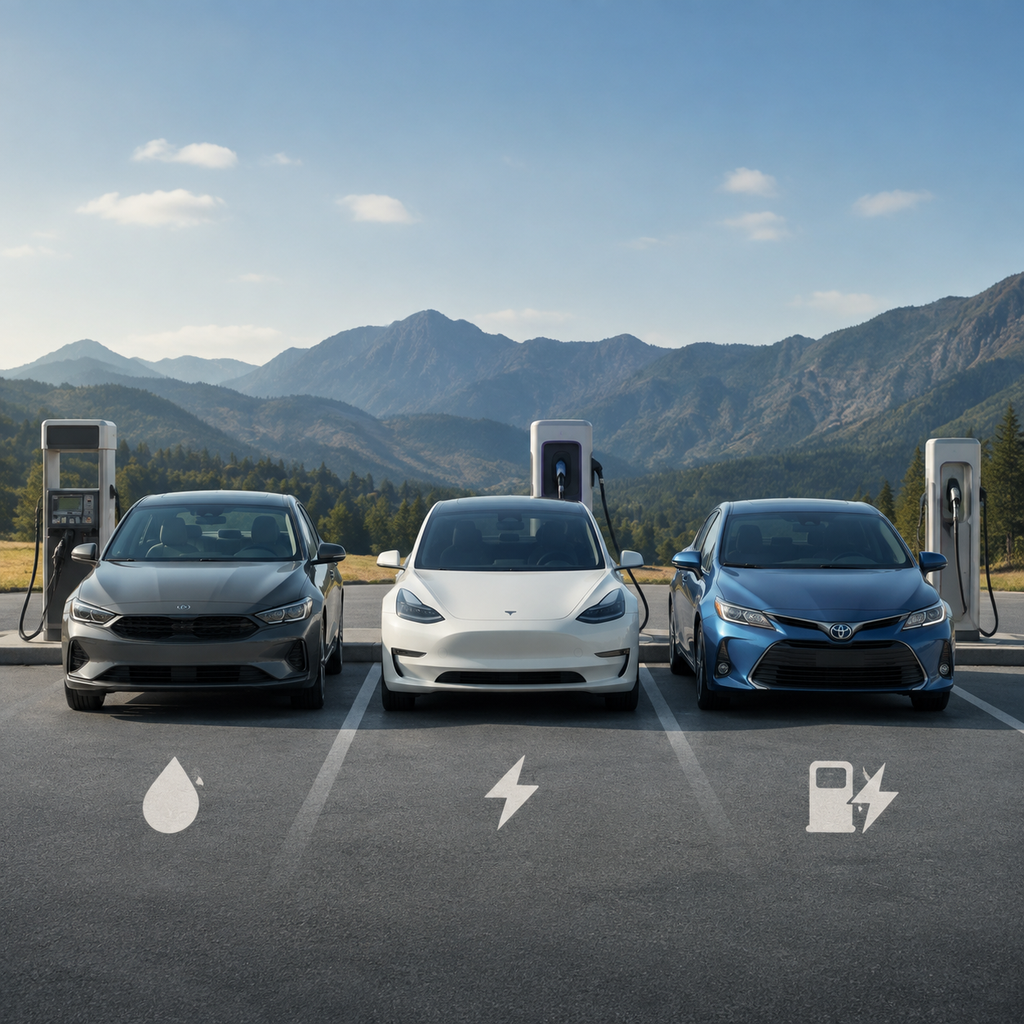
Before making a gasoline vs electric vs hybrid comparison based on costs and use cases, it helps to understand what each system requires from its owner.
Gasoline Cars
A gasoline car uses an internal combustion engine and carries liquid fuel in a tank. Refueling is generally quick, and filling stations are widely available across the United States and Europe. In a gasoline vs electric vs hybrid evaluation, this established refueling network remains a major advantage.
Gasoline vehicles also offer a broad selection of body styles, price points, performance levels, and used models. Their drawbacks include tailpipe emissions, exposure to changing fuel prices, and engine-related maintenance such as oil changes.
Battery-Electric Cars
A battery-electric vehicle, commonly called an EV, runs only on electricity stored in a large traction battery. It has no gasoline engine, fuel tank, or tailpipe. This makes charging access central to any gasoline vs electric vs hybrid assessment.
EVs are typically charged at home, at work, or at public charging stations. They provide smooth acceleration, quiet operation, and no tailpipe emissions. Their suitability depends heavily on charging access, expected range, climate, towing requirements, and the quality of charging infrastructure along regular routes.
Conventional Hybrids
A conventional hybrid combines a gasoline engine with one or more electric motors and a relatively small battery. The battery is charged through regenerative braking and the engine, so the driver does not plug in the car. This no-plug convenience often makes a conventional hybrid the middle ground in a gasoline vs electric vs hybrid comparison.
The electric motor can assist the engine and, depending on the design and conditions, may propel the vehicle for limited periods. Hybrids are particularly effective in stop-and-go driving, where regenerative braking can recover energy that would otherwise be lost as heat.
Plug-In Hybrids
A plug-in hybrid electric vehicle, or PHEV, sits between a conventional hybrid and a fully electric car. It has a gasoline engine, electric motor, and a battery that can be charged externally. The gasoline vs electric vs hybrid choice therefore includes a fourth practical option for buyers who can charge regularly.
A PHEV can complete some journeys using electricity alone, then continue on gasoline after the battery’s usable electric charge is depleted. This flexibility is valuable only when the owner charges regularly. A plug-in hybrid driven mostly without charging carries extra battery hardware without taking full advantage of it.
A Quick Decision Guide
The broad gasoline vs electric vs hybrid decision can be summarized this way:
- Choose gasoline if rapid refueling, maximum route flexibility, towing, remote travel, or a lower purchase price matters more than minimizing fuel use.
- Choose an EV if you can charge reliably where you park, your regular mileage fits comfortably within its real-world range, and you want quiet driving with fewer routine powertrain service items.
- Choose a conventional hybrid if you want lower fuel consumption without changing your refueling habits or depending on charging infrastructure.
- Choose a plug-in hybrid if you can charge frequently, drive mostly shorter trips, and still need gasoline flexibility for longer journeys.
These gasoline vs electric vs hybrid guidelines are starting points, not fixed rules. Vehicle size, efficiency, local energy prices, insurance, incentives, depreciation, and individual model quality can outweigh the powertrain label.
Start With Charging and Refueling Access
Charging access is often the most important dividing line in the gasoline vs electric vs hybrid comparison.
Home Charging Changes the EV Experience
An EV is usually easiest to own when it can charge overnight in a private driveway, garage, or assigned parking space. The driver can begin most mornings with sufficient energy for normal travel and may rarely need a public charger during routine use. Reliable home charging can therefore shift a gasoline vs electric vs hybrid decision strongly toward an EV.
A suitable electrical supply and charging equipment may require installation work. Buyers should confirm the condition and capacity of the property’s electrical system, installation permissions, parking arrangement, and total setup cost before purchasing the vehicle.
Apartment residents face different constraints. Shared chargers can be useful, but availability, access rules, billing, and repair responsibility matter. Relying exclusively on public charging may reduce convenience and can change the cost calculation significantly.
Public Charging Requires Route-Specific Research
For an accurate gasoline vs electric vs hybrid comparison, do not judge an EV solely by the number of charging stations shown on a national map. Examine the exact routes and places relevant to you:
- Are chargers available near home, work, and frequent destinations?
- Are they compatible with the vehicle?
- What charging speeds can the car accept?
- Are there multiple charging sites along long-distance routes?
- Can a trailer access the charging bays if you tow?
- Are alternative stations available when one location is busy or unavailable?
Charging speed also varies during a session. A vehicle may reach its highest rate only under suitable battery, temperature, and charger conditions. Advertised peak charging power should not be treated as the rate delivered continuously from nearly empty to full.
Gasoline Still Offers Maximum Refueling Flexibility
Gasoline vehicles are straightforward for drivers who cover unpredictable distances, lack dedicated parking, or regularly travel through sparsely served regions. A conventional hybrid preserves that flexibility while usually consuming less fuel, especially in urban and mixed driving. These practical differences can matter more than efficiency figures in a gasoline vs electric vs hybrid review.
For some households, convenience matters more than the theoretical lowest energy cost. A powertrain that fits existing routines is more likely to deliver its intended benefits.
Compare Range Using Your Most Demanding Normal Day
A useful gasoline vs electric vs hybrid range comparison should begin with your longest common day, not your average daily mileage. The vehicle should comfortably handle ordinary use without requiring constant planning.
For example, include the commute, school drop-off, shopping, an evening appointment, and any unplanned detours. Then allow a sensible reserve for cold weather, congestion, road closures, battery aging, and reduced efficiency at higher speeds.
Why Published EV Range Is Not a Guarantee
EV range changes with driving and environmental conditions, which is why published figures require context in a gasoline vs electric vs hybrid analysis. Factors include:
- Ambient temperature
- Cabin heating or air-conditioning
- Speed and acceleration
- Elevation changes
- Rain, snow, and headwinds
- Tire pressure and wheel choice
- Passenger and cargo loads
- Roof racks, bicycles, or trailers
Cold conditions can increase energy use because the battery and cabin may require heating. Sustained high-speed driving also tends to consume more energy than moderate-speed travel. An EV that is comfortable for local driving may require more planning on winter motorway or interstate journeys.
Gasoline and Hybrid Range Also Varies
Gasoline and hybrid efficiency is also affected by temperature, speed, terrain, load, and driving style. The difference in a gasoline vs electric vs hybrid comparison is that a fuel stop is usually quicker and easier to locate.
A hybrid may achieve particularly strong efficiency in urban traffic, while its advantage over an efficient gasoline car can narrow during sustained high-speed travel. Compare model-specific consumption estimates for the kind of driving you actually do.
Calculate Total Ownership Cost, Not Just Purchase Price
The lowest sticker price does not always produce the lowest long-term cost. A useful gasoline vs electric vs hybrid cost comparison covers the entire expected ownership period.
Estimate:
- Purchase price after applicable discounts or incentives
- Financing charges
- Home charging equipment and installation
- Electricity or fuel costs
- Insurance
- Registration and taxes
- Scheduled maintenance
- Tires and expected wear items
- Depreciation or expected resale value
- Potential repair exposure after warranty coverage ends
Use conservative assumptions when calculating gasoline vs electric vs hybrid ownership costs. Fuel, electricity, and resale values can change, while individual vehicles within the same category can have very different insurance and depreciation patterns. For a broader budgeting framework, review this guide to the cost to own a car.
Energy Cost per Distance
Compare energy expenses using the same distance unit so the gasoline vs electric vs hybrid calculation remains consistent.
For a gasoline or hybrid vehicle:
Fuel cost per 100 miles = gallons used per 100 miles × fuel price per gallon
For an EV:
Charging cost per 100 miles = kWh used per 100 miles × electricity price per kWh
European drivers can apply the same approach using liters and kilometers. Charging losses mean the electricity drawn from the wall can be higher than the energy reported as used by the vehicle, so a modest allowance improves the estimate.
A buyer with inexpensive overnight charging may find an EV economical to run. Someone dependent on higher-priced rapid charging could reach a different result. Likewise, an efficient hybrid may offer meaningful savings for a high-mileage driver without requiring charging equipment.
Incentives Need Current Verification
Tax treatment, purchase incentives, company-car benefits, road charges, and low-emission-zone rules vary by location and can change. These incentives can alter a gasoline vs electric vs hybrid calculation, so confirm eligibility with current official sources before signing a purchase agreement. U.S. buyers can review the official federal vehicle tax credit information from FuelEconomy.gov. Do not assume that every electrified vehicle, buyer, lease, or used car qualifies.
Maintenance: Fewer Components Does Not Mean No Maintenance
Powertrain type changes maintenance requirements, but every vehicle still needs regular inspections and service. A sound gasoline vs electric vs hybrid maintenance comparison includes scheduled work, wear items, and potential repairs.
Gasoline Vehicle Maintenance
A gasoline engine normally requires engine oil and filter changes. Depending on the design and service schedule, it may also need attention to spark plugs, filters, belts, cooling systems, emissions components, and transmission fluids. These recurring items belong in any gasoline vs electric vs hybrid budget.
Gasoline cars are mechanically familiar to many independent repair shops. However, age and complexity can lead to repairs involving fuel, ignition, exhaust, turbocharging, or emissions-control systems.
EV Maintenance
An EV does not need engine oil changes, spark plugs, or exhaust-system repairs. This can reduce routine service requirements in a gasoline vs electric vs hybrid comparison. Regenerative braking may also reduce use of the friction brakes, although brake components can still corrode or seize if they are not inspected and exercised appropriately.
EVs still require:
- Tire replacement and rotation
- Brake inspection and fluid service
- Cabin air filters
- Suspension and steering checks
- Wiper blades and washer fluid
- Thermal-management system service where specified
- Software and recall updates
Tires can be a significant expense on any heavy or high-performance vehicle. Instant torque, vehicle weight, aggressive acceleration, alignment issues, and wheel size can all influence wear.
Hybrid Maintenance
A hybrid retains a gasoline engine while adding electric-drive components. It still needs engine-related servicing, although regenerative braking may reduce friction-brake wear. The complexity does not automatically make hybrids a poor gasoline vs electric vs hybrid choice, but service history and model-specific reliability are important when buying used.
Driving Experience and Everyday Comfort
Powertrain choice affects more than operating cost. A gasoline vs electric vs hybrid test drive can reveal differences that specifications do not show.
EVs generally deliver immediate torque, smooth acceleration, and quiet low-speed operation. Regenerative braking can reduce the need to move repeatedly between the accelerator and brake pedal, although its strength and feel vary by model.
Hybrids are often quiet and efficient in urban driving, but engine speed may rise noticeably during hard acceleration. The transition between gasoline and electric power is smoother in some systems than others.
Gasoline cars range from basic economy models to highly refined touring vehicles. They may suit drivers who prefer conventional controls, lower curb weight in certain classes, or a particular engine and transmission character.
For a meaningful gasoline vs electric vs hybrid evaluation, a test drive should include rough pavement, parking, moderate acceleration, highway speeds, and the type of hills common in your area. Pay attention to seat comfort, visibility, control layout, road noise, brake feel, and the ease of judging the vehicle’s dimensions.
Match the Powertrain to Your Real-World Use
Different driving patterns favor different solutions, so the best gasoline vs electric vs hybrid option depends on the journeys you actually make.
City Commuting
EVs work well in urban traffic because low-speed electric operation is efficient and regenerative braking recovers energy during deceleration. Conventional hybrids are also strong city choices, especially where home charging is unavailable. In a city-focused gasoline vs electric vs hybrid comparison, both electrified options can have clear efficiency advantages.
A gasoline car can still make sense when annual mileage is low and the lower purchase cost outweighs potential fuel savings. However, repeated very short trips can be demanding for combustion engines because they may not always reach normal operating temperature.
Long-Distance Highway Travel
Gasoline vehicles and conventional hybrids offer convenient long-distance mobility with short fuel stops. EVs can also cover long routes, but the gasoline vs electric vs hybrid experience depends on charging reliability, vehicle efficiency, charging speed, weather, and how naturally charging breaks fit the journey.
Frequent long-distance drivers should examine complete charging curves and route coverage instead of focusing only on maximum range or peak charging power.
Family Driving
A family gasoline vs electric vs hybrid decision must account for more than a commute. Consider weekend activities, luggage, child seats, holiday travel, and visits to relatives. Check usable cargo space rather than relying only on exterior size.
Families considering an EV should test their most demanding repeated journey against realistic range. A two-car household may also find that an EV serves routine travel while another vehicle covers less frequent specialist needs.
Rural Roads and Remote Areas
Sparse charging infrastructure can make gasoline or hybrid vehicles easier to operate in remote areas. A rural gasoline vs electric vs hybrid comparison should also consider ground clearance, tire availability, winter performance, and distance to a qualified service center.
Dark roads introduce another consideration: road awareness. Drivers who regularly travel at night or in poor-visibility conditions may examine aftermarket driver-assistance technology such as Robofinity InsightDrive, a vehicle thermal imaging night vision system designed to support awareness of pedestrians, animals, vehicles, and obstacles ahead. Such a thermal imaging system is supplementary; it does not replace headlights, mirrors, safe speed, appropriate braking distance, traffic-law compliance, or driver attention.
Towing and Heavy Loads
Towing reduces efficiency and range across all powertrains. Its effect can be particularly important in a gasoline vs electric vs hybrid comparison because an EV may need more frequent charging stops, and some charging locations are difficult to enter without disconnecting a trailer.
Check the specific model’s approved towing capacity, payload rating, tongue-weight limit, and gross vehicle ratings. Do not assume that strong acceleration means a vehicle is approved for a particular trailer.
A gasoline vehicle or hybrid may be more convenient for frequent long-distance towing. An EV can work for local towing when its ratings and charging arrangements fit the task, but the buyer should model the actual route and load.
Environmental Impact Is More Than the Tailpipe
Battery-electric vehicles produce no tailpipe emissions, which is valuable for local air quality, particularly in congested areas. However, a complete gasoline vs electric vs hybrid environmental comparison also includes vehicle manufacturing, battery production, electricity generation, fuel extraction and refining, maintenance, and end-of-life processing.
The result varies by vehicle size, energy source, annual mileage, and how long the vehicle remains in use. A smaller, efficient car generally requires less energy to move than a larger, heavier one with the same powertrain type.
Hybrids can reduce fuel consumption without relying on external charging, while plug-in hybrids can reduce gasoline use when charged consistently. A PHEV’s real-world impact depends heavily on owner behavior. If most journeys use the engine because the battery is rarely charged, its theoretical advantage is not fully realized.
Replacing a functioning vehicle also carries a manufacturing impact. For low-mileage drivers, keeping a reliable, efficient existing car may sometimes be more sensible than buying a new one purely to change powertrain.
Safety Depends on the Whole Vehicle
A gasoline, electric, or hybrid badge does not determine overall safety. Keep the gasoline vs electric vs hybrid question separate from model-specific crash protection, and compare the exact model and model year using applicable crash-test results, standard safety equipment, visibility, braking performance, tires, lighting, and driver-assistance features.
Useful systems may include automatic emergency braking, lane-departure warnings, blind-spot monitoring, rear cross-traffic alerts, and pedestrian or cyclist detection. Availability and capability vary, and performance can be affected by weather, sensor obstruction, road markings, and system limits.
Driver-assistance technology supports road awareness; it does not make a vehicle autonomous or eliminate the driver’s responsibility. A buyer should understand how alerts are presented, how features are activated, and when they may be unavailable.
Also consider emergency practicality. Make sure all regular drivers know how to unlock and exit the vehicle if electrical power is disrupted, locate towing information, and follow the manufacturer’s instructions after a collision or flood exposure.
Buying Used: Powertrain-Specific Checks
Used vehicles can offer better value, but a used gasoline vs electric vs hybrid comparison should reflect the technology, condition, warranty coverage, and service history of each vehicle.
For any used car, check service records, accident history where available, tire condition, warning lights, recall completion, fluid leaks, charging or fuel-system behavior, and the operation of comfort and safety features. A pre-purchase inspection by a qualified technician is prudent.
Used Gasoline Car Checks
Look for evidence of regular oil changes and correct scheduled servicing. During a cold start, listen for abnormal noises and watch for persistent warning lights or unusual exhaust smoke. Check transmission behavior and signs of coolant or oil leakage.
Used EV Checks
Request available battery-health information and clarify what the displayed figure means. Ask about remaining battery and vehicle warranty coverage, charging history if documented, charging-cable inclusion, and compatibility with local networks.
Test both AC and rapid charging when practical. Examine the underside for visible damage, but do not touch high-voltage components. Repairs involving the traction battery or high-voltage system require appropriately trained technicians.
Used Hybrid and PHEV Checks
Verify that both the combustion and electric sides operate correctly. For a plug-in hybrid, test external charging and confirm realistic electric operation. A neglected engine can still create problems even if much of the previous driving was electric.
A Five-Step Framework for Making the Final Choice
Use this process to turn a broad gasoline vs electric vs hybrid comparison into a shortlist of individual models.
1. Record a Typical Month
Write down daily distances, long trips, parking locations, passenger needs, cargo, weather, towing, and how often plans change unexpectedly. Actual use is more informative than an estimated average commute.
2. Confirm Energy Access
For an EV or PHEV, obtain a realistic home-charging assessment and review public charging on important routes. For gasoline and hybrids, consider local fuel access and prices.
3. Price the Same Class of Vehicle
Compare vehicles of similar size, equipment, condition, and performance. Comparing a small gasoline hatchback with a large premium electric SUV reveals little about powertrain economics.
4. Build a Multi-Year Cost Estimate
Include energy, maintenance, insurance, financing, charging installation, depreciation, and likely tire costs. Calculate a conservative and an optimistic scenario instead of relying on one prediction.
5. Test the Inconvenient Scenario
Ask what happens during a cold-weather trip, a power outage, a charger failure, an urgent long journey, or an unexpected repair. The aim is not to eliminate every inconvenience, but to choose the ones you can manage.
Common Buying Mistakes to Avoid
Several errors can distort the decision:
- Buying an EV based only on advertised range
- Choosing a PHEV without a realistic plan to charge it
- Assuming all public charging costs less than gasoline
- Ignoring insurance, depreciation, and tire expenses
- Comparing vehicles from different size or equipment classes
- Treating incentives as guaranteed before confirming eligibility
- Assuming fewer maintenance items means no servicing
- Overlooking towing, winter, and heavy-load requirements
- Purchasing more vehicle, battery, or performance than daily use requires
The best gasoline vs electric vs hybrid buying guide is your own travel record combined with verified model-specific costs and capabilities.
Frequently Asked Questions
These answers address common gasoline vs electric vs hybrid questions, but costs and capabilities should always be verified for the specific models and location under consideration.
Is an electric car cheaper to own than a gasoline car?
It can be, particularly with affordable home charging and high annual mileage. However, purchase price, insurance, depreciation, public charging costs, tires, incentives, and local electricity rates can change the result. Calculate costs for the specific vehicles under consideration.
Is a hybrid worth it if I mostly drive on highways?
A hybrid may still save fuel, but its advantage is often most pronounced in urban and mixed driving where regenerative braking is used frequently. Compare official and independent model-specific highway consumption information relevant to your region.
Do plug-in hybrids need to be charged?
They can usually continue operating on gasoline without external charging, but regular charging is necessary to obtain their intended electric-driving and fuel-saving benefits. A conventional hybrid may be a more rational choice when charging is unlikely.
How much EV range do I need?
Choose enough real-world range to cover your longest common day with a practical reserve for weather, speed, detours, and battery aging. Occasional exceptional trips can involve charging stops, but normal travel should not require constant range management.
Are electric cars suitable for cold climates?
They can be, but cold weather may reduce range and slow charging. Home preconditioning, suitable tires, reliable charging access, and adequate range margin improve winter usability. Evaluate a vehicle using winter conditions, not only mild-weather estimates.
Which powertrain is best for someone without home charging?
A conventional hybrid is often the simplest fuel-saving option because it requires no plug. An EV can still work if dependable workplace or public charging is conveniently available, but cost, waiting time, charger reliability, and alternative locations should be assessed carefully.
Choose the Car That Fits Your Routine
There is no universal winner in the gasoline vs electric vs hybrid comparison. Gasoline remains practical for unpredictable travel, rapid refueling, and some heavy-duty uses. EVs can provide exceptional day-to-day convenience when reliable charging and suitable range align with the owner’s routine. Conventional hybrids reduce fuel consumption without requiring lifestyle changes, while plug-in hybrids work best for drivers who charge frequently but still need long-distance flexibility.
Before completing your gasoline vs electric vs hybrid decision, document your travel, confirm charging or refueling access, compare complete ownership costs, and test-drive equivalent models. Choose the vehicle whose ordinary operation is easy, whose difficult scenarios are manageable, and whose size and capabilities match the work it will actually perform.