- Table of Contents
- What Is All-Wheel Drive?
- The Main Benefit: Better Traction During Acceleration
- What All-Wheel Drive Does Not Do
- It Does Not Automatically Shorten Braking Distance
- It Cannot Correct Excessive Speed
- It Does Not Replace Suitable Tires
- It Does Not Increase Ground Clearance
- When Choosing All-Wheel Drive Makes Sense
- You Regularly Drive in Snow or Mixed Winter Weather
- Your Routes Include Steep or Slippery Hills
- You Frequently Use Gravel or Unpaved Roads
- You Tow or Launch on Slippery Surfaces
- You Want Performance-Oriented Power Delivery
- When Front-Wheel Drive Is Usually Enough
- What About Rear-Wheel Drive?
- The Ownership Costs Buyers Should Consider
- Purchase Price
- Fuel or Energy Consumption
- Tire Replacement Requirements
- Maintenance and Repair Complexity
- AWD, Tires, and Winter Driving: How to Prioritize Your Budget
- Match the Drivetrain to Real-World Use
- City Commuter in a Mild Climate
- Family Driver in a Snowy Region
- Rural Driver on Dark, Unpaved Roads
- Long-Distance Highway Driver
- Weekend Outdoor User
- Safety Technology Matters Beyond the Drivetrain
- Questions to Ask Before Paying for AWD
- How to Evaluate an AWD Car During a Test Drive
- Frequently Asked Questions
- Is all-wheel drive safer than front-wheel drive?
- Do I need AWD if I live where it snows?
- Is AWD worth the extra fuel cost?
- Is AWD the same as 4WD?
- Can I replace just one tire on an AWD car?
- Does AWD help in rain?
- Conclusion
Choosing between all-wheel drive and two-wheel drive is one of the most common decisions buyers face when comparing cars, crossovers, and SUVs. The short answer is practical: you should choose all-wheel drive when your regular driving conditions create a genuine need for additional traction. That may include frequent snow, steep wet roads, unpaved routes, or slippery rural terrain.
For many people who mainly travel on paved, well-maintained roads, front-wheel drive is less expensive, more efficient, and entirely adequate. All-wheel drive can be useful, but it does not automatically make a vehicle safer in every situation. Understanding what the system does, what it cannot do, and how it affects ownership costs will help you make a better buying decision.
Table of Contents
What Is All-Wheel Drive?
All-Wheel Drive, commonly abbreviated as AWD, is a drivetrain that can deliver engine power to all four wheels. In many modern vehicles, the system operates primarily through one axle during ordinary driving and automatically sends power to the other axle when conditions or driver inputs require it.
The exact operation varies by vehicle. Some systems respond after wheel slip is detected. More advanced versions use information such as steering angle, throttle position, wheel speed, and vehicle movement to anticipate when additional traction may be helpful. Performance-oriented AWD may also distribute power in ways that improve cornering response and acceleration.
AWD is different from traditional four-wheel drive, or 4WD. Four-wheel-drive systems are generally designed for trucks, utility vehicles, and more demanding off-road conditions. They may include selectable drive modes, a low-range transfer case, or locking differentials. AWD usually prioritizes automatic operation and predictable behavior on paved roads.
Those categories increasingly overlap, so the badge alone does not tell the whole story. A buyer should examine how a specific vehicle’s system operates and whether it suits the intended use.
The Main Benefit: Better Traction During Acceleration
The clearest advantage of all-wheel drive is improved traction when the vehicle is applying power.
Imagine pulling away from an intersection on a snow-covered road. In a front-wheel-drive car, the two front tires must manage both steering and acceleration. If the available grip is limited, they may begin to slip. An all-wheel drive system can distribute power across four tires, reducing the demand placed on any single driven wheel.
The same principle can help in several common situations:
- Starting on a snowy or icy incline
- Accelerating on wet roads
- Climbing a loose gravel driveway
- Leaving a muddy parking area
- Driving over uneven or lightly unpaved surfaces
- Applying power through a corner in a performance vehicle
This does not mean all-wheel drive creates unlimited grip. Every tire can transmit only as much force as the road surface and tire condition allow. If all four tires have poor traction, driving all four wheels cannot overcome that physical limit.
What All-Wheel Drive Does Not Do
All-Wheel Drive is often treated as a broad safety feature, but its primary function is narrower: it helps the vehicle put power down. That distinction matters because many serious driving situations involve braking or changing direction rather than acceleration.
It Does Not Automatically Shorten Braking Distance
Every modern passenger vehicle already uses all four tires when braking. An all-wheel drive system does not give the car extra contact with the road or bypass the grip limits of its tires.
On snow or ice, a two-wheel-drive vehicle with appropriate winter tires can stop and turn more effectively than an all-wheel drive vehicle fitted with unsuitable tires. The AWD car may accelerate with greater confidence, which can create a misleading impression that the road has more grip than it actually does.
It Cannot Correct Excessive Speed
Electronic stability control and all-wheel drive may help manage traction, but neither can overcome entering a bend too quickly. If the tires exceed their available grip, the vehicle may slide regardless of how many wheels receive power.
It Does Not Replace Suitable Tires
Tires are the vehicle’s direct connection to the road. Tread depth, rubber compound, temperature suitability, and inflation pressure all affect acceleration, braking, and cornering.
All-Wheel Drive with worn tires is not a substitute for responsible maintenance. In cold climates, a complete set of suitable winter tires may provide a larger all-around improvement than choosing AWD while retaining tires poorly matched to the conditions.
It Does Not Increase Ground Clearance
All-Wheel Drive may help a car move through light snow, but it does not raise low bodywork, protect vulnerable components, or prevent the underside from becoming grounded in deep snow or mud. Ground clearance and vehicle geometry are separate considerations.
When Choosing All-Wheel Drive Makes Sense
The value of all-wheel drive depends less on how often bad weather appears in regional forecasts and more on whether you must drive when it arrives.
You Regularly Drive in Snow or Mixed Winter Weather
All-Wheel Drive can be worthwhile for drivers who face repeated snowfall, slush, freezing rain, or steep winter roads. It is especially useful when roads are not cleared promptly or when work and family obligations make postponing travel difficult.
A commuter living on a flat urban route that receives rapid snow removal may have different needs from a healthcare worker traveling before plows operate. Both live in the same climate, but their exposure is not the same. The National Highway Traffic Safety Administration’s winter driving guidance also emphasizes preparing the vehicle, checking tires, reducing speed, and allowing extra stopping distance.
Your Routes Include Steep or Slippery Hills
A hill can expose the limitations of two-wheel drive even when snow is relatively shallow. Starting from rest on an incline places substantial demand on the driven tires. All-wheel drive can distribute that demand and make progress easier.
This benefit also applies to steep driveways, wet mountain roads, and access routes covered with loose material.
You Frequently Use Gravel or Unpaved Roads
Drivers who routinely visit rural properties, trailheads, campsites, construction areas, or unpaved lanes may benefit from the additional traction. All-wheel drive can make a vehicle feel more composed when surfaces are loose, uneven, or wet.
However, ordinary all-wheel drive does not turn a road-focused crossover into a dedicated off-road vehicle. Ground clearance, underbody protection, cooling, tires, suspension travel, and recovery points can matter more as terrain becomes difficult.
You Tow or Launch on Slippery Surfaces
All-Wheel Drive may improve traction when starting with a trailer, particularly on wet grass, gravel, snow, or a slippery boat ramp. It does not increase the vehicle’s official towing capacity by itself, however.
For towing, buyers must still verify the manufacturer’s limits for the exact configuration, including drivetrain, engine, axle rating, trailer equipment, and total load.
You Want Performance-Oriented Power Delivery
In higher-powered vehicles, all-wheel drive can help distribute torque and reduce wheelspin during acceleration. Some systems are also calibrated to alter handling by varying power between the axles or individual wheels.
The trade-off is that performance all-wheel drive can add weight and complexity. Enthusiasts should consider whether they value maximum traction, steering feel, efficiency, or a particular handling balance.
When Front-Wheel Drive Is Usually Enough
Front-wheel drive, or FWD, is a sensible default for a large share of passenger-car buyers. It places the weight of the engine over the driven wheels in many conventional vehicles, providing useful traction without the cost and mechanical complexity of all-wheel drive.
FWD is often the better choice when:
- Most travel is on paved and maintained roads
- Snowfall is rare or driving can be postponed during severe weather
- The local terrain is generally flat
- Fuel and purchase costs are major priorities
- The vehicle is used mainly for urban commuting
- Appropriate seasonal tires can address occasional winter conditions
A family using a crossover for school trips, errands, and highway travel in a mild climate may gain little from all-wheel drive. The money could be better allocated to a higher trim with stronger crash-avoidance technology, a better set of tires, or other features used every day. Buyers comparing practical vehicles can also review these top family SUVs for 2026.
FWD also tends to offer predictable handling. Because many mainstream cars and crossovers are engineered around front-wheel drive, it should not be viewed as an inferior configuration simply because all-wheel drive is available at extra cost.
What About Rear-Wheel Drive?
Rear-wheel drive, or RWD, sends power to the rear wheels while the front wheels handle steering. It is common in performance cars, luxury vehicles, vans, and trucks.
RWD can provide balanced handling and strong acceleration on dry pavement. It may be less forgiving when starting on slippery surfaces, particularly in a lightly loaded vehicle, although modern traction and stability control have improved its usability.
A buyer comparing RWD with all-wheel drive should consider the vehicle type. All-wheel drive may be valuable in a powerful sedan used throughout a snowy winter, while RWD may be preferable for a sports car driven mainly in dry conditions. Tire choice remains critical in either case.
The Ownership Costs Buyers Should Consider
The all-wheel drive option price is only the first expense. The system can also affect fuel use, maintenance, repairs, and tire replacement.
Purchase Price
All-Wheel Drive typically costs more than the equivalent two-wheel-drive configuration. The difference may also influence financing charges, taxes, registration costs, or insurance, depending on local rules and the vehicle.
Compare equivalent trims carefully. Manufacturers sometimes bundle AWD with a different engine, transmission, suspension, or equipment package, making a simple price comparison difficult.
Fuel or Energy Consumption
All-Wheel Drive hardware adds weight and mechanical drag. Depending on the design, this can reduce fuel economy compared with a similar FWD model.
The effect varies considerably. Some systems disconnect parts of the driveline when all-wheel drive is not needed, while others remain more continuously engaged. Electric vehicles may use separate motors at each axle, and adding a second motor can alter both performance and driving range.
Use the official consumption or range figures for the exact drivetrain under consideration, not the vehicle line as a whole. More importantly, compare those ratings with your annual mileage. A modest efficiency difference can become meaningful over several years of high-mileage commuting.
Tire Replacement Requirements
All-Wheel Drive systems can be sensitive to differences in tire circumference. If one tire is damaged and the other three are significantly worn, replacing only the damaged tire may create an unacceptable mismatch for some vehicles.
Depending on manufacturer guidance, the owner may need to replace multiple tires or use a replacement matched to the remaining tread depth. Requirements differ, so consult the owner’s manual or manufacturer information for the specific model.
Regular tire rotation is particularly important. It promotes even wear, preserves predictable handling, and may reduce stress on drivetrain components.
Maintenance and Repair Complexity
An all-wheel drive vehicle has additional components that may include a transfer unit, driveshaft, rear differential, couplings, clutches, motors, sensors, and control modules. Not every design uses every component, but greater complexity creates more potential service points.
Some systems have fluids requiring inspection or replacement at specified intervals. Service needs may become more demanding when the vehicle tows, travels off pavement, or operates under severe conditions.
AWD systems are generally designed for long-term use, but repairs outside warranty can be costly. A used-car buyer should review maintenance records, inspect for leaks or unusual noises, and arrange a qualified pre-purchase inspection.
AWD, Tires, and Winter Driving: How to Prioritize Your Budget
A practical buying decision should consider the whole vehicle rather than treating the drivetrain as an isolated feature.
If the budget forces a choice between an AWD model on poor tires and a FWD model with high-quality tires suited to the season, the second option may provide better braking and cornering performance. In severe winter climates, the strongest arrangement is often AWD combined with four appropriate winter tires.
All-season tires can be suitable for moderate conditions, but their winter capability varies. Some all-weather tires are designed to offer stronger cold-weather performance while remaining usable year-round. Regulations governing winter tires, studs, and chains differ by country and region, so buyers should check current local requirements.
Whichever tire type you choose:
- Fit matching tires across the vehicle as recommended
- Maintain the specified pressure
- Rotate them at the correct intervals
- Check tread depth and uneven wear
- Replace tires that are damaged, aged, or no longer suitable for expected conditions
AWD should complement good tires, not compete with them for attention.
Match the Drivetrain to Real-World Use
A simple scenario-based comparison can make the decision clearer.
City Commuter in a Mild Climate
This driver mainly uses maintained streets, encounters little snow, and values low running costs. FWD will usually meet the need. All-wheel drive may add expense without offering a frequently used benefit.
Family Driver in a Snowy Region
School runs, medical appointments, and work travel continue through winter. Roads may be cleared, but side streets and driveways remain slippery. All-wheel drive paired with proper seasonal tires can provide meaningful convenience and traction.
Rural Driver on Dark, Unpaved Roads
This buyer deals with loose surfaces, mud, hills, limited lighting, and animals near the road. AWD may help maintain progress, while suitable tires, ground clearance, lighting, and road awareness are equally important.
Long-Distance Highway Driver
Most miles occur at steady speed on paved motorways or interstates. AWD offers limited benefit in dry conditions, while its fuel-use penalty may accumulate over high annual mileage. It becomes easier to justify if the route regularly crosses snowy mountain areas or poorly maintained winter roads.
Weekend Outdoor User
Trips include ski areas, campsites, gravel roads, or trail access. All-wheel drive may be a practical choice, but the driver should distinguish light recreational access from serious off-roading. A capable tire and adequate ground clearance may matter as much as the drivetrain label.
Safety Technology Matters Beyond the Drivetrain
Drivetrain choice is only one part of vehicle safety. When comparing cars, review available systems such as automatic emergency braking, stability control, blind-spot monitoring, lane support, adaptive headlights, and driver-monitoring features. Their names and capabilities vary, so confirm exactly what each system can detect and under what conditions it operates.
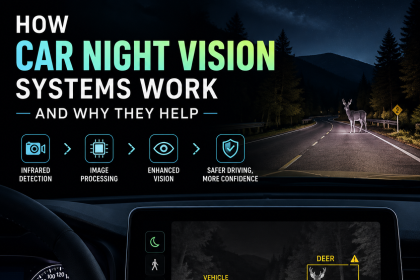
Driving visibility also deserves attention. People who frequently travel at night or on poorly lit rural roads may consider aftermarket awareness technology such as Robofinity InsightDrive, a vehicle thermal imaging night vision system designed to support recognition of pedestrians and animals in low-light or poor-visibility conditions. Such driver-assistance technology may supplement road awareness, but it does not replace headlights, mirrors, safe speed, adequate braking distance, traffic laws, or driver attention.
This wider view prevents a common buying mistake: paying for AWD while overlooking the features and maintenance items that may be more relevant to everyday risk.
Questions to Ask Before Paying for AWD
Use your actual routes and obligations to answer these questions:
- How many days each year do I drive on snow, ice, mud, gravel, or steep wet roads?
- Can I delay travel during severe weather, or must I drive regardless?
- Are my usual roads cleared and maintained promptly?
- Would suitable winter or all-weather tires solve most of my traction concerns?
- Does the AWD version have different fuel economy, range, towing limits, or ground clearance?
- Can I comfortably cover additional tire and maintenance expenses?
- Am I choosing AWD for a specific need, or simply because the badge feels reassuring?
- Which safety and comfort features would I give up to keep the purchase within budget?
Calculate the total cost for the configuration you would actually buy. Include the vehicle price, expected fuel or charging cost, tires, scheduled service, insurance quote, and likely ownership period.
How to Evaluate an AWD Car During a Test Drive
A normal test drive may not involve snow or loose surfaces, but it can still reveal useful information.
Listen for humming, whining, clunking, or vibration during acceleration and deceleration. Make several slow, tight turns in a safe location and note any binding, shuddering, or unusual resistance. Check whether warning lights remain illuminated and whether the vehicle displays drivetrain messages.
For a used AWD vehicle, inspect all four tires. They should generally match in size and appropriate specification, with reasonably even tread depth. A mismatched set may suggest poor maintenance and could affect system operation.
Ask the seller or dealer:
- Is AWD always active or automatically engaged?
- Does the vehicle offer selectable terrain or drive modes?
- Are there special tire-matching requirements?
- Which drivetrain fluids require service?
- Does the warranty cover all AWD components?
- Is the claimed towing capacity specific to this configuration?
A pre-purchase inspection remains valuable because some drivetrain problems will not be obvious during a short drive.
Frequently Asked Questions
Is all-wheel drive safer than front-wheel drive?
AWD can improve traction during acceleration on slippery surfaces, but it does not inherently shorten braking distances or make excessive cornering speed safe. Tires, speed, visibility, stability control, and driver behavior remain central to overall safety.
Do I need AWD if I live where it snows?
Not necessarily. The answer depends on snowfall frequency, road clearance, terrain, travel flexibility, and tire choice. FWD with proper winter tires can be highly capable, while AWD with unsuitable tires may still struggle to stop or turn.
Is AWD worth the extra fuel cost?
It may be if you frequently use the added traction. If most driving occurs on dry, maintained roads, the ongoing fuel or range penalty may outweigh the limited benefit. Compare official figures for the exact models and estimate the difference over your expected annual mileage.
Is AWD the same as 4WD?
No. AWD usually operates automatically and is optimized for mixed on-road conditions. Traditional 4WD is commonly associated with trucks and off-road vehicles and may include selectable modes or low-range gearing. However, manufacturers use these terms differently, so examine the actual system.
Can I replace just one tire on an AWD car?
Sometimes, but not always. A substantial difference in tire circumference can be problematic for certain AWD systems. Follow the vehicle manufacturer’s limits and obtain professional advice when the remaining tires have noticeable wear.
Does AWD help in rain?
AWD may reduce wheelspin when accelerating on a wet surface, especially in a powerful vehicle. It cannot prevent hydroplaning, which occurs when a tire loses effective contact with the road through standing water. Suitable tires, reduced speed, smooth inputs, and adequate following distance remain essential.
Conclusion
All-Wheel Drive is a worthwhile investment when snow, steep roads, loose surfaces, or slippery access routes are part of normal life rather than rare exceptions. It can make acceleration more controlled and help a vehicle keep moving when available traction is uneven.
For drivers in mild climates who mainly use maintained pavement, FWD often provides the better balance of purchase price, efficiency, maintenance simplicity, and capability. RWD may also suit buyers prioritizing towing, performance, or a particular driving character.
Make the final choice by evaluating your routes, weather exposure, schedule, tires, ownership budget, and the design of the specific vehicle. A carefully selected two-wheel-drive car can be more sensible than an AWD model chosen for reassurance alone, while the right AWD vehicle can be a practical tool for drivers who will regularly use what it provides.