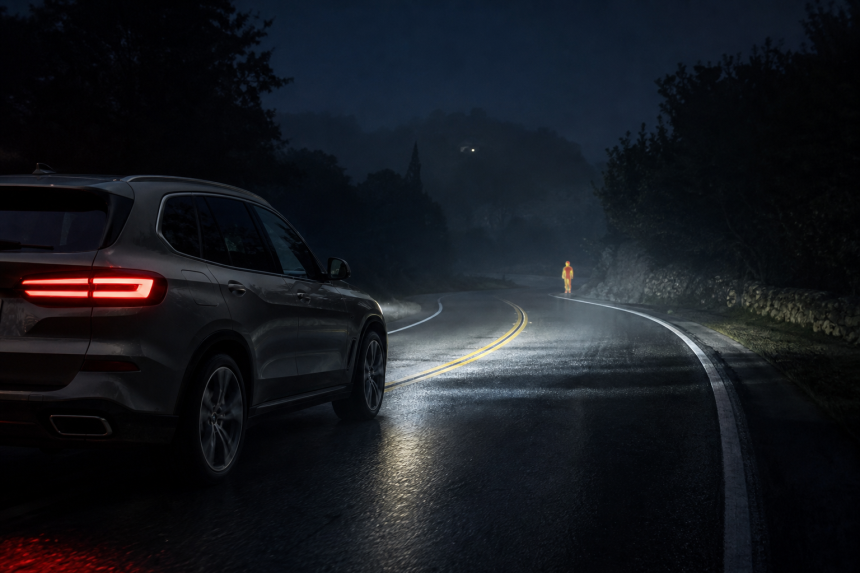
SEO Title: How to Choose the Best Automotive Thermal Night Vision System in 2026
- What Is an Automotive Thermal Night Vision System?
- Who Is Most Likely to Benefit?
- Rural and Suburban Drivers
- Night-Shift Workers and Frequent Night Drivers
- Long-Distance and Highway Drivers
- Urban Drivers
- Family Drivers
- The Most Important Buying Criteria
- 1. Detection Range Versus Useful Recognition Range
- 2. Pedestrian, Animal, and Vehicle Recognition
- 3. Image Quality, Refresh Rate, and Latency
- 4. Alert Design and False-Alert Management
- 5. Display Size, Position, and Driver Distraction
- 6. Camera Durability and Installation Location
- 7. Vehicle Compatibility and Electrical Integration
- 8. Recording, Privacy, and Data Handling
- 9. Warranty, Updates, Support, and Replacement Parts
- How to Compare Thermal Night Vision With Other Options
- A Practical Shortlisting Method
- Step 1: Define the Driving Problem
- Step 2: Set Non-Negotiable Requirements
- Step 3: Compare Evidence, Not Headline Claims
- Step 4: Plan the Installation Before Purchase
- Step 5: Evaluate the Complete Ownership Cost
- A Relevant Current-System Example
- Where Thermal Night Vision Helps, and Where It Does Not
- Everyday Use and Maintenance
- Common Buying Mistakes
- Choosing Only by Maximum Range
- Ignoring the Display
- Assuming Every Warm Object Is a Hazard
- Overlooking Installation Costs
- Expecting an Autonomous Safety System
- Trusting Demonstrations Without Context
- Buyer Checklist for 2026
- Frequently Asked Questions
- Is automotive thermal night vision useful with headlights on?
- Can a thermal camera see through fog, rain, or snow?
- Can automotive thermal imaging detect deer and other animals?
- Is professional installation necessary?
- Does thermal night vision replace automatic emergency braking?
- Is a higher-resolution thermal camera always better?
- Making the Final Decision
Meta Description: Find the best automotive thermal night vision system 2026 with practical guidance on detection, alerts, installation, image quality, and safety.
Driving after dark presents a basic visibility problem: headlights illuminate only what their beams reach, while pedestrians, animals, stalled vehicles, and roadside hazards may appear with little warning. Choosing the best automotive thermal night vision system 2026 therefore requires more than comparing detection-distance claims. Everyday drivers need a system that produces a useful image, identifies relevant hazards, delivers timely alerts, fits their vehicle, and remains easy to interpret without becoming a distraction.
This guide takes a buying-decision and product-technology approach. It explains how automotive thermal imaging works, which specifications matter in real traffic, where the technology helps, and what limitations to consider before installing an aftermarket system.
What Is an Automotive Thermal Night Vision System?
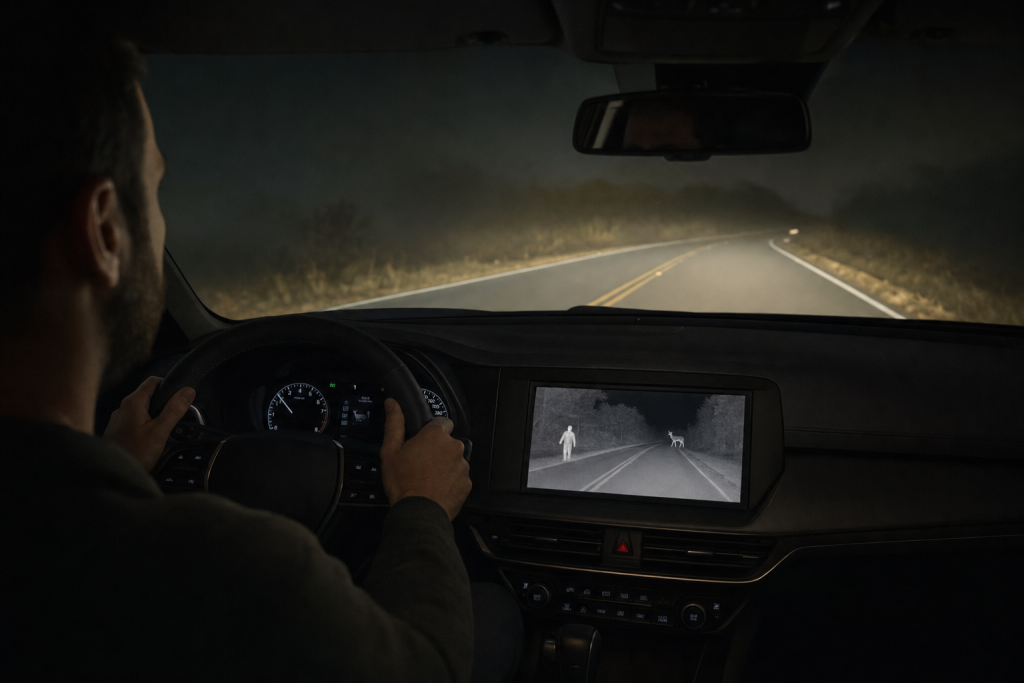
An automotive thermal night vision system uses an infrared camera to detect differences in heat rather than relying solely on visible light. People and many animals typically appear distinct from cooler surroundings, allowing the system to show potential hazards that may be difficult to see through a conventional camera or windshield.
A typical aftermarket setup includes:
- A forward-facing thermal camera
- An in-cabin display or compatible video interface
- Power and data connections
- Image-processing software
- Detection or recognition functions on more advanced models
- Visual or audible hazard alerts
Thermal imaging differs from an ordinary low-light camera. A conventional night camera generally amplifies available light or uses near-infrared illumination, so its effectiveness can still depend on lighting conditions and reflective surfaces. A thermal camera visualizes emitted heat patterns, which can make warm road users easier to distinguish against a dark background.
The result is an additional source of road awareness, not a replacement for normal vision. Drivers must still use legal, properly maintained headlights and remain attentive to mirrors, road markings, traffic signals, following distance, and braking conditions.
Who Is Most Likely to Benefit?
Thermal night vision is not equally valuable for every driver. Its practical worth depends on where, when, and how often the vehicle is used.
Rural and Suburban Drivers
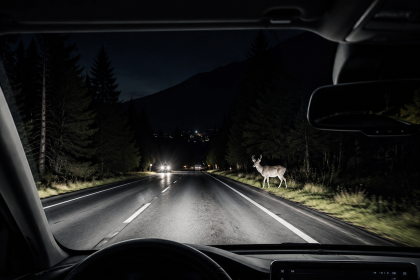
Dark rural roads often combine limited lighting, higher speeds, narrow shoulders, and animal activity. A person walking near the edge of the road or an animal approaching from vegetation may not become obvious until it enters the headlight beam.
A thermal system may provide earlier awareness of a heat signature ahead or near the roadside. Recognition software can add value when it distinguishes a pedestrian or animal from less relevant warm objects.
Night-Shift Workers and Frequent Night Drivers
Drivers who regularly commute before sunrise or after dark have more opportunities to benefit than those who make an occasional nighttime trip. Consistent use also makes display placement, alert quality, and interface simplicity especially important.
A system that looks impressive during a demonstration but demands repeated menu adjustments may become frustrating during daily ownership.
Long-Distance and Highway Drivers
On highways, the central issue is time. At higher speeds, the distance covered between noticing a hazard and beginning to respond increases quickly. Long-range detection can help only when the displayed information is clear, stable, and communicated early enough to be useful.
Thermal imaging does not change the vehicle’s stopping distance. Speed, tire condition, road surface, weather, vehicle load, and driver reaction still determine whether the vehicle can stop or change course safely.
Urban Drivers
City streets are generally brighter but visually crowded. Pedestrians, cyclists, parked vehicles, signs, storefronts, reflections, and opposing headlights all compete for attention.
In this setting, the quality of the recognition and alert system may matter more than maximum camera range. Frequent unnecessary alerts can reduce usefulness, while clear identification of a pedestrian entering a poorly lit crossing can support better awareness.
Family Drivers
Parents driving on unlit roads, during winter evenings, or on long family trips may value an extra layer of visibility. However, the system should be simple enough that it does not add another attention-demanding screen to the cabin.
For a shared family vehicle, evaluate whether different drivers can understand the display and alerts without extensive setup.
The Most Important Buying Criteria
No single specification determines the best system. A useful decision combines camera performance, software quality, installation, ergonomics, and long-term ownership considerations.
1. Detection Range Versus Useful Recognition Range
Manufacturers may publish a maximum detection range, but “detection” can mean that the camera senses some thermal contrast at a distance. That is not necessarily the same as recognizing a pedestrian, animal, or vehicle with enough confidence to alert the driver.
Ask what the stated distance represents:
- Maximum thermal detection
- Human recognition
- Animal recognition
- Vehicle recognition
- Automatic alerting range
- Performance under specific environmental conditions
A longer range can be useful on open highways and rural roads, but distance without clarity has limited value. For slower urban driving, dependable recognition at moderate range may be more practical than an impressive maximum figure.
Treat all published range claims as condition-dependent. Object size, temperature contrast, camera position, road shape, weather, and software processing can affect real-world performance.
2. Pedestrian, Animal, and Vehicle Recognition
Basic thermal cameras show an image and leave interpretation to the driver. More advanced systems use image processing to recognize categories of hazards and highlight them on the display.
This distinction matters because drivers should spend as little time as possible studying an auxiliary screen. Recognition overlays and real-time alerts can direct attention to relevant objects without requiring constant display monitoring.
When comparing systems, check whether they can identify:
- Pedestrians
- Large animals
- Vehicles
- Stationary or moving roadside obstacles
- Multiple objects at the same time
Also investigate how alerts are prioritized. A warm object far outside the vehicle’s projected path should not necessarily receive the same urgency as a pedestrian near the lane.
No recognition system is infallible. Unusual postures, partial obstruction, temperature conditions, small animals, and complex backgrounds can contribute to missed or incorrect classifications.
3. Image Quality, Refresh Rate, and Latency
Resolution is important, but it should not be judged alone. Contrast, refresh rate, processing quality, screen clarity, and end-to-end delay all affect whether the image is useful in motion.
A higher frame rate generally produces smoother movement. Low latency matters because an old image of a moving pedestrian or animal can misrepresent the current situation. Ask whether the quoted frame rate applies to the sensor, display output, or complete operating system.
Look for sample footage that shows:
- Moving traffic rather than static demonstrations
- Curves and elevation changes
- People near parked vehicles
- Animals entering from the roadside
- Oncoming headlight glare
- Different ambient temperatures
- Rain, mist, or other challenging conditions
Highly edited promotional clips may not represent typical driving. Full-length, real-time footage is more informative.
4. Alert Design and False-Alert Management
An effective warning should be noticeable without being startling or ambiguous. Too many alerts can lead a driver to ignore them; too few may leave the system functioning as little more than an extra camera.
Useful systems may offer:
- Visual object highlighting
- Audible warnings
- Adjustable alert sensitivity
- Different warning levels
- Configurable sound volume
- Suppression of irrelevant detections
The best configuration depends on the environment. A driver traveling through a dense city may need different sensitivity from someone crossing an open rural area.
Before buying, determine whether alert settings remain saved after the vehicle is switched off. Reconfiguring the system at every start is a small inconvenience that can become a significant ownership problem.
5. Display Size, Position, and Driver Distraction
A larger display is not automatically safer. It may show more detail, but it can also block part of the windshield or draw the eyes farther away from the road.
The display should be:
- Legible with a brief glance
- Positioned close to the normal forward sightline
- Stable over rough roads
- Adjustable for brightness
- Dim enough for night use
- Free from dashboard and windshield reflections
- Clear without requiring tiny text or icons
Check the rules governing windshield-mounted devices in your location. Regulations vary, and a legal mounting position in one jurisdiction may be restricted in another.
Some vehicles may support integration with an existing display, but compatibility should be verified carefully. A dedicated screen is often simpler to install, while an integrated display may reduce dashboard clutter.
6. Camera Durability and Installation Location
The external camera faces water, dirt, insects, road salt, temperature changes, vibration, and impacts from small debris. Environmental sealing is therefore a practical requirement, not a minor specification.
Review the documented protection rating and operating-temperature limits. A camera intended for external automotive use should be designed for the conditions in which the vehicle operates.
Mounting location also affects performance. The camera needs:
- A clear forward view
- Minimal obstruction from bodywork
- Protection from avoidable impact
- Proper alignment with the road
- Access for cleaning
- Stable attachment that resists vibration
A thermal camera should not be installed behind ordinary glass unless the manufacturer explicitly supports that arrangement. Standard automotive glass can interfere with the long-wave infrared energy used by many thermal imagers.
7. Vehicle Compatibility and Electrical Integration
Confirm compatibility before ordering. Consider the vehicle’s electrical system, available mounting locations, cable-routing path, display placement, startup behavior, and any interaction with existing electronics.
A quality installation should avoid:
- Loose cables near pedals or steering controls
- Wiring across airbag deployment areas
- Poorly protected exterior connectors
- Unfused or unsuitable power connections
- Holes drilled without corrosion protection
- Camera placement that blocks airflow or sensors
Modern vehicles can have sensitive electrical architectures and densely packed bumpers containing radar, parking sensors, and cameras. Professional installation may be appropriate when trim removal, permanent wiring, or integration with factory systems is required.
Ask whether camera alignment or calibration is needed after installation. A misaligned recognition box can create a false impression of where a hazard is located relative to the vehicle’s path.
8. Recording, Privacy, and Data Handling
Some thermal systems can record video. That may be useful for reviewing an incident or understanding an alert, but recording introduces additional questions.
Check:
- Whether recording is continuous or manual
- What storage media and capacity are supported
- Whether older files are overwritten automatically
- How files are exported
- Whether location, audio, or other data is stored
- Whether processing occurs locally or requires connectivity
Recording and privacy laws vary across the United States and Europe. Drivers should understand local requirements, particularly if a system records public spaces, audio, or identifiable information.
9. Warranty, Updates, Support, and Replacement Parts
The initial purchase price is only one part of ownership cost. An aftermarket thermal system may depend on proprietary cables, brackets, software, displays, or camera modules.
Before purchase, look for clear information about:
- Warranty scope and exclusions
- Technical support
- Firmware-update procedure
- Availability of replacement cables and mounts
- Camera or screen replacement options
- Return terms
- Installer support
Do not assume that recognition software will automatically improve over time. Confirm whether updates are provided, how they are installed, and whether future functionality requires additional fees.
How to Compare Thermal Night Vision With Other Options
Drivers considering a nighttime safety upgrade may encounter thermal cameras, low-light cameras, infrared-illuminated cameras, and factory night vision. These technologies address overlapping problems but operate differently.
Thermal Imaging
Thermal imaging detects heat contrast and can make pedestrians and animals stand out in darkness. It does not reproduce the scene exactly as human eyes see it, and fine visual details such as text, road-sign colors, and lane markings may be limited.
Low-Light Cameras
Low-light cameras can present a more familiar road image and may show road markings or vehicle details well when some light is available. Performance can decline in extreme darkness, and visible-light glare may affect the image.
Near-Infrared Systems
Near-infrared systems use infrared illumination that the camera can see. They can produce detailed monochrome imagery within the illuminated area, but their range and performance depend partly on the illuminator and environmental reflections.
Factory-Integrated Night Vision
Factory systems can offer close integration with the instrument panel and other driver-assistance features. However, they are generally tied to particular vehicle models or trim levels and may be expensive or impractical to retrofit.
Aftermarket thermal systems are more accessible across different vehicles, but installation quality and interface design vary. Buyers should assess the complete system rather than choosing solely by camera type.
A Practical Shortlisting Method
A structured process helps prevent specification overload.
Step 1: Define the Driving Problem
Write down the conditions that create the most concern. Examples include animals on rural roads, pedestrians during an urban night commute, frequent winter darkness, or long highway trips.
This determines which features deserve priority. Rural drivers may emphasize distance and animal recognition; city drivers may prioritize pedestrian classification and controlled alert frequency.
Step 2: Set Non-Negotiable Requirements
A useful shortlist might require:
- Documented vehicle compatibility
- External-use camera protection
- Pedestrian and animal recognition
- Real-time alerts
- Adjustable display brightness
- Acceptable mounting options
- Accessible customer support
This prevents an attractive but unsuitable system from advancing simply because it has a long feature list.
Step 3: Compare Evidence, Not Headline Claims
Review manuals, installation guides, unedited driving footage, warranty information, and documented specifications. Determine whether the company clearly explains what its detection figures mean.
Be cautious when a product promises broad safety outcomes without explaining operating limitations.
Step 4: Plan the Installation Before Purchase
Identify the camera location, screen position, wiring route, and power source. Obtain an installation estimate when professional work is likely.
This can reveal hidden costs or compatibility issues before the return period becomes relevant.
Step 5: Evaluate the Complete Ownership Cost
Include the system, mounting hardware, professional installation, storage media, replacement components, and any paid software or connectivity requirements.
A less expensive unit is not necessarily better value if the display is distracting, the mount is unstable, or support is unavailable.
A Relevant Current-System Example
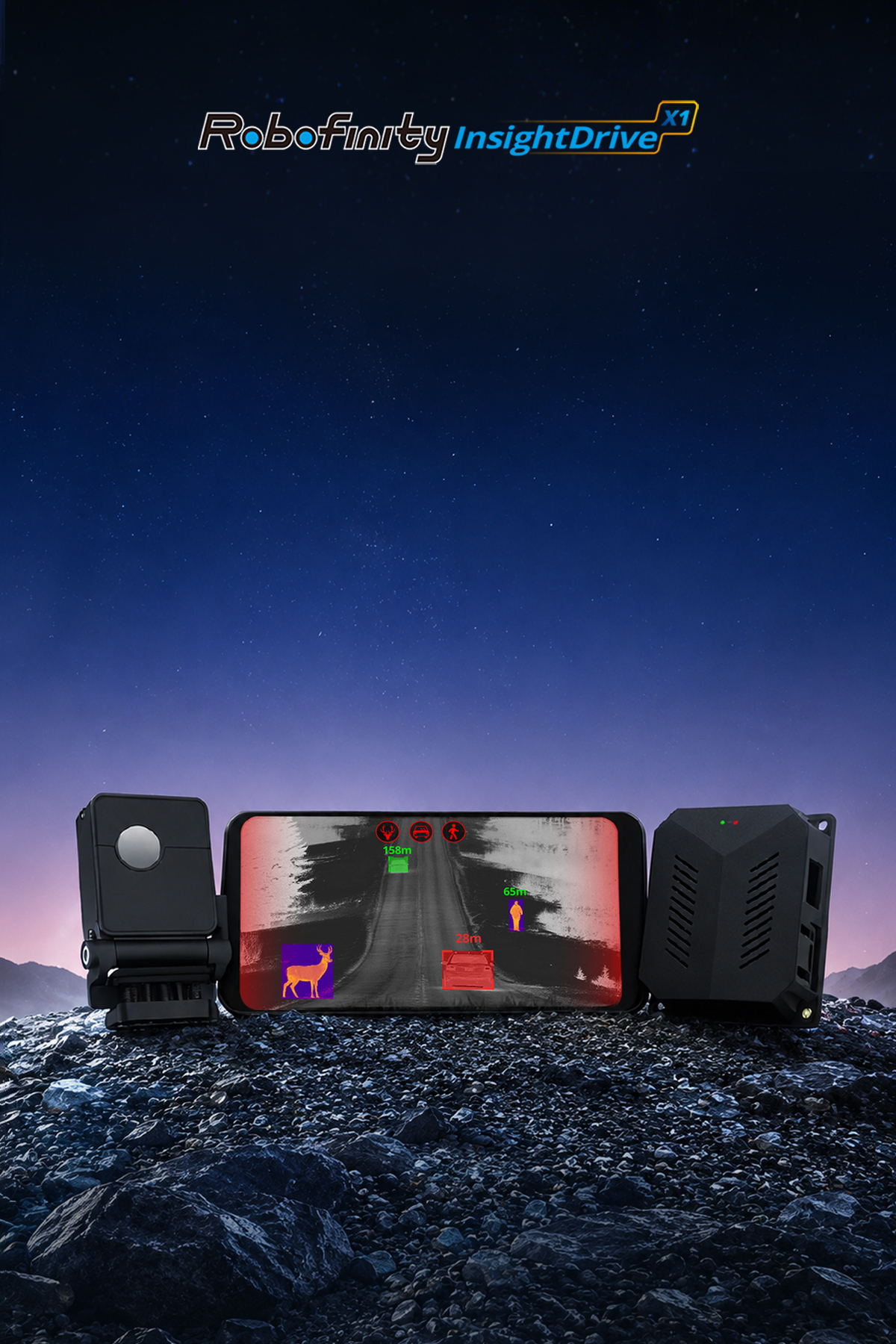
Robofinity InsightDrive is one example in the aftermarket vehicle thermal imaging category. According to its documented positioning, it combines AI-powered thermal imaging with recognition for pedestrians, animals, and vehicles, along with real-time alerts. Those are relevant capabilities to compare when researching systems for low-light or poor-visibility driving, but buyers should still verify installation compatibility, current specifications, support terms, and suitability for their own routes.
Robofinity also lists an up-to-200-meter, or 656-foot, detection range for InsightDrive. As with any distance claim, buyers should distinguish maximum detection from reliable recognition and alerting under the conditions they actually encounter.
Where Thermal Night Vision Helps, and Where It Does Not
Thermal night vision can be especially useful on an unlit road when a pedestrian wears dark clothing, an animal stands near the shoulder, or visible contrast is reduced by headlight glare. It may also support awareness when a warm object is visually obscured by a dark background.
However, thermal imaging has firm limitations.
It cannot reliably communicate every detail needed for driving. The system should not be expected to read signs, determine traffic-light color, identify road-surface markings, or confirm that a route is clear. Objects with weak thermal contrast may be difficult to distinguish, and some materials can block or reflect infrared energy in unexpected ways.
Weather also requires realistic expectations. Thermal imaging may retain advantages over visible-light cameras in some poor-visibility conditions, but heavy rain, dense fog, snow, spray, lens contamination, and reduced temperature contrast can degrade performance. “Works in bad weather” should never be interpreted as “unaffected by weather.”
Most importantly, seeing a hazard on a screen does not mean there is enough space to avoid it. A driver traveling too fast for the road, weather, or headlight visibility may still lack adequate braking distance.
Everyday Use and Maintenance
A thermal camera needs routine attention like any exposed vehicle sensor.
Before night driving, check that the camera lens or protective window is clean. Remove dirt, salt, snow, ice, and insect residue using methods approved by the manufacturer. Abrasive cleaning can damage coatings or scratch the surface.
Periodically inspect:
- Camera alignment
- Mounting-bracket security
- Exterior cable condition
- Connector seals
- Display mount stability
- Startup and alert operation
- Available recording storage, if applicable
After front-end repairs, bumper removal, or minor impacts, confirm that the camera still points correctly. If detection boxes no longer align with visible objects or alerts become inconsistent, consult the manufacturer’s troubleshooting guidance or a qualified installer.
Drivers also need time to understand the thermal image. Initial familiarization should occur while parked and through cautious use on known roads. Settings should not be adjusted while the vehicle is moving.
Common Buying Mistakes
Choosing Only by Maximum Range
Range matters, but recognition accuracy, latency, road geometry, and alert timing determine whether that distance provides practical value.
Ignoring the Display
An excellent camera paired with a dim, reflective, awkwardly mounted display can produce a poor driving experience.
Assuming Every Warm Object Is a Hazard
Exhaust systems, recently driven vehicles, building vents, and heated surfaces can all appear prominently. Good classification and restrained alerts help reduce confusion.
Overlooking Installation Costs
A low advertised price may exclude professional wiring, custom mounting, trim removal, or replacement hardware.
Expecting an Autonomous Safety System
Thermal night vision does not steer, brake, or guarantee that every hazard will be recognized. Unless a specific system is formally integrated with vehicle controls, treat it as an information and awareness tool.
Trusting Demonstrations Without Context
A clear video from a cold, dry, open road does not establish performance in warm weather, rain, traffic, or a visually complex city. Look for varied operating examples and clear technical documentation.
Buyer Checklist for 2026
Before making a final decision, confirm the following:
- The camera and electrical system are compatible with the vehicle.
- Published range claims define detection, recognition, or alert distance.
- The system recognizes the hazard types relevant to the driver’s routes.
- Alerts are timely, understandable, and adjustable.
- The video feed is smooth and has acceptably low latency.
- The display is readable without blocking the road view.
- Brightness can be reduced sufficiently for night driving.
- The camera has documented environmental protection.
- The mounting position provides a clear thermal view.
- Installation avoids airbags, controls, factory sensors, and unsafe wiring.
- Software-update and recording procedures are clearly documented.
- Warranty, support, and replacement-part information are available.
- Total cost includes installation and likely accessories.
- The driver understands that the technology supplements, rather than replaces, attentive driving.
Frequently Asked Questions
Is automotive thermal night vision useful with headlights on?
Yes. Headlights remain essential, while thermal imaging provides a different kind of information based on heat contrast. It may reveal warm road users beyond or near the edges of the most useful visible illumination, depending on conditions and system capability.
Can a thermal camera see through fog, rain, or snow?
Thermal imaging may provide useful contrast in some poor-visibility conditions, but it cannot see perfectly through weather. Dense fog, heavy precipitation, road spray, lens contamination, and reduced thermal contrast can all limit performance.
Can automotive thermal imaging detect deer and other animals?
Many systems can display the heat signatures of animals, and some include dedicated animal recognition. Detection depends on the animal’s size, distance, exposure, background, weather, and the system’s processing. Small or partially hidden animals may not trigger an alert.
Is professional installation necessary?
Not always, but it is advisable when installation involves permanent wiring, trim removal, difficult cable routing, integration with factory displays, or mounting near existing sensors. Poor installation can impair performance and create electrical or safety problems.
Does thermal night vision replace automatic emergency braking?
No. Thermal night vision generally provides visual information or warnings. Automatic emergency braking is a separate vehicle system with its own sensors, control logic, and limitations. Do not assume that an aftermarket thermal camera can activate the brakes unless explicit, verified vehicle integration is documented.
Is a higher-resolution thermal camera always better?
Higher resolution can improve detail, but overall usefulness also depends on lens selection, refresh rate, latency, image processing, display quality, recognition software, and camera placement. Compare the complete system rather than resolution alone.
Making the Final Decision
The right thermal night vision system is the one that addresses a specific driving need without creating a new source of distraction. Start with the routes you travel, identify the hazards most likely to appear, and then compare recognition performance, alerts, image quality, installation, durability, and ownership support.
For frequent rural or nighttime driving, long-range pedestrian and animal recognition may deserve priority. In urban use, well-managed alerts and a glanceable display can matter more. For every driver, documented compatibility and careful installation are essential.
Thermal imaging can add valuable information when darkness, glare, or limited illumination makes hazards difficult to see. It should remain one layer in a broader nighttime safety routine that includes clean headlights and windows, suitable speed, adequate following distance, maintained tires and brakes, and full attention to the road.