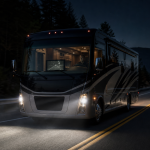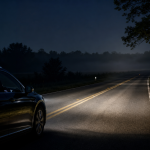
Thermal Imaging at Night gives off-road drivers an added layer of hazard awareness when trails get dark and unpredictable. Headlights help you see what reflects light, but they can’t reliably reveal people, wildlife, warm engines, or moving activity that blends into the night. A thermal camera detects infrared heat differences and can help you notice certain warm targets earlier—especially in dusty, brush-filled, or obstacle-heavy environments where visible detail is limited.
- Why Nighttime Off-Road Driving Is Unusually Difficult
- How Vehicle Thermal Imaging Works
- Where Thermal Imaging Provides the Most Value
- Detecting People Around the Trail
- Identifying Animals Earlier
- Recognizing Vehicles in Darkness
- Supporting Recovery and Campsite Awareness
- Thermal Imaging Versus Auxiliary Lights and Low-Light Cameras
- Important Limitations Drivers Should Understand
- Terrain Hazards May Not Stand Out
- Similar Temperatures Reduce Contrast
- Weather Still Matters
- Displays Can Distract the Driver
- Distance Can Be Misjudged
- Choosing a Thermal System for an Off-Road Vehicle
- Prioritize a Useful Field of View
- Look for Clear, Stable Imaging
- Evaluate Detection and Alert Features Carefully
- Check Environmental Protection
- Plan the Electrical Installation
- Confirm Road-Legal Use
- How to Use Thermal Night Vision Responsibly
- Situations Where Thermal Imaging May Be Worth the Cost
- A Practical Pre-Drive Checklist
- Frequently Asked Questions
- Can thermal imaging see through trees or bushes?
- Does an off-road vehicle still need auxiliary lights?
- Can thermal imaging detect cold obstacles?
- Does thermal night vision work in fog, rain, dust, or snow?
- Where should a thermal camera be mounted on an off-road vehicle?
- Can thermal imaging replace a trail spotter?
- Conclusion
- Why Nighttime Off-Road Driving Is Unusually Difficult
- How Vehicle Thermal Imaging Works
- Where Thermal Imaging Provides the Most Value
- Thermal Imaging Versus Auxiliary Lights and Low-Light Cameras
- Important Limitations Drivers Should Understand
- Choosing a Thermal System for an Off-Road Vehicle
- How to Use Thermal Night Vision Responsibly
- Situations Where Thermal Imaging May Be Worth the Cost
- A Practical Pre-Drive Checklist
- Frequently Asked Questions
Why Nighttime Off-Road Driving Is Unusually Difficult
Public roads are generally designed around predictable lanes, signs, intersections, and sight distances. Trails are not. A route can rise over a crest, turn behind trees, narrow beside a drop-off, or change from hard-packed soil to loose rock without warning.
Several factors make nighttime trail driving particularly demanding:
- Uneven ground: Ruts, washouts, rocks, and sudden dips can alter the vehicle’s direction and reduce the driver’s view.
- Limited reference points: Without lane markings or roadside lighting, judging distance and trail boundaries becomes harder.
- Wildlife activity: Animals may stand motionless near a trail or move through it unexpectedly.
- Dust and moisture: Airborne dust, mist, rain, or snow can reflect visible light toward the driver.
- Remote traffic: Another off-road vehicle, camper, cyclist, or person may be ahead without effective lighting.
- Driver fatigue: Low-light driving requires sustained concentration, often after a long day outdoors.
More powerful auxiliary lights can extend visible range, but they still depend on reflected light. Anything outside the beam, obscured by brush, or lost against a dark background can remain difficult to recognize—even with excellent lighting.
How Vehicle Thermal Imaging Works
A thermal imaging system senses infrared energy emitted by objects and converts differences in surface temperature into an image. Instead of showing ordinary colors, it displays thermal contrast. Depending on the display mode, warmer objects may appear brighter or in a contrasting color palette.
This distinction matters because visible-light cameras and thermal cameras solve different problems.
A conventional camera records reflected light, much like the human eye. Its performance depends heavily on available illumination, lens quality, glare, and contrast. A thermal camera does not need a headlight beam to reveal a warm person or animal against a cooler background.
That does not mean thermal imaging can see through everything. Dense trees, solid barriers, rock faces, and vehicle bodywork block the view. Thermal cameras generally show surface temperatures rather than revealing objects through solid materials. Their performance can also vary when the target and surrounding environment have similar temperatures.
What a Driver May Recognize
In an off-road setting, thermal imaging at night may help reveal:
- A person walking along or standing beside a dark trail
- Wildlife near the route or partially concealed by light vegetation
- A recently operated vehicle or warm engine area
- Other off-road users beyond the most useful portion of the headlight beam
- A companion outside the vehicle during spotting or recovery work
- Heat associated with some mechanical components during an inspection
Object recognition matters as much as detection. Seeing a bright shape on a screen is useful only if the driver can interpret it correctly and has enough time and space to respond safely.
Where Thermal Imaging Provides the Most Value
The strongest case for thermal imaging at night is not simply that the trail is dark. It is that a heat-emitting hazard may be difficult to distinguish with visible light alone.
Detecting People Around the Trail
Off-road groups frequently operate outside their vehicles. Someone may be guiding a driver over rocks, attaching recovery equipment, checking a tire, setting up camp, or walking between parked vehicles.
Dark clothing can blend into the surroundings, and a person may stand just outside the main headlight beam. Thermal imaging at night can make human heat contrast easier to notice, supporting better road awareness around campsites, trail junctions, recovery areas, and remote work locations.
This assistance does not replace clear hand signals, radios, designated spotters, or a rule that the vehicle stops when visual contact is lost. Thermal imaging at night should reinforce those practices, not relax them.
Identifying Animals Earlier
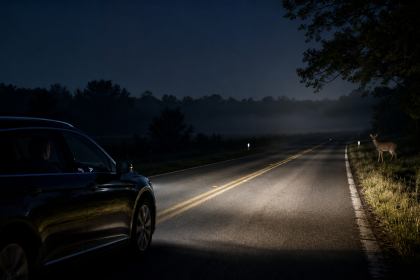
Animal detection is one of the most relevant benefits for rural and off-road driving. Wildlife can enter a trail suddenly, but it may also remain still near brush or tree lines where its body shape is difficult to identify.
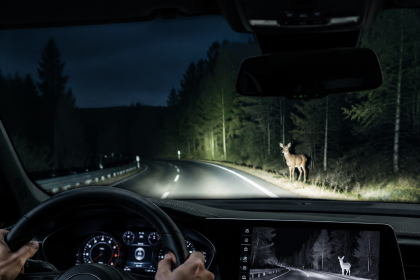
Thermal contrast may reveal an animal before ordinary vision does, particularly when its fur or coloring blends into the background. With thermal imaging at night, earlier recognition can give the driver more time to slow down rather than making an abrupt steering input on unstable ground.
A thermal display cannot predict animal movement. Drivers should reduce speed when animals are present and avoid assuming that one detected animal is alone.
Recognizing Vehicles in Darkness
Stopped or disabled vehicles do not always present clear lighting. Dust, terrain, and vegetation may also conceal their shape. Heat from an engine, exhaust area, tires, or occupants can sometimes create a recognizable thermal signature.
Vehicle recognition can be helpful on forest roads, desert routes, work sites, and organized trail rides where several vehicles are spread out. However, parked equipment that has cooled to ambient temperature may be less obvious than an operating vehicle—so thermal imaging at night is best treated as an awareness aid, not a guaranteed identifier.
Supporting Recovery and Campsite Awareness
Nighttime recovery work creates a complex environment. People may be moving around tow points, winch lines, straps, trees, and multiple vehicles. Thermal imaging at night can help an in-vehicle driver maintain awareness of people in the scene, but it cannot reliably show every recovery component.
Synthetic ropes, steel cables, shackles, rocks, and tree trunks may not stand out clearly based on temperature. The recovery area still requires adequate work lighting, direct communication, controlled access, and established safety procedures.
Around a campsite, thermal imaging at night may help identify a person or animal approaching from darkness. It should not be treated as a perimeter-security guarantee because terrain and solid obstructions can create blind areas.
If you’re choosing equipment for a truck or SUV, you may also find this guide useful: SUV Night Driving Safety: How to Choose Night Safety Features for SUVs.
Thermal Imaging Versus Auxiliary Lights and Low-Light Cameras
These technologies are complementary rather than interchangeable.
Auxiliary Lighting
LED light bars, driving lights, and scene lights improve visible detail. They help drivers read trail texture, locate rocks, judge ruts, and distinguish branches or signs. Those are tasks for which thermal imaging at night may provide limited information, since it focuses on heat contrast rather than surface color or fine texture.
Powerful lighting also has drawbacks. Dust, snow, rain, and fog can scatter light and reduce forward visibility. Excessive brightness can affect other trail users and may violate local rules on public roads.
Low-Light and Near-Infrared Cameras
Low-light cameras amplify available light, while some camera systems use infrared illumination. They can produce an image that resembles a conventional scene and may show terrain details more naturally than a thermal camera.
Their effectiveness can still be affected by glare, shadows, airborne particles, and the range of the illumination source. Thermal cameras are often better at separating a warm living subject from a dark background—especially when visible lighting is weak or obscured.
Thermal Imaging
Thermal imaging is strongest at detecting heat contrast. It can draw attention to a pedestrian or animal that might otherwise blend into the scene. Thermal imaging at night is generally less suitable for reading signs, identifying trail colors, judging the exact depth of a hole, or determining whether a surface is mud, sand, water, or solid ground.
A well-equipped off-road vehicle therefore uses layered visibility:
- Headlights provide the legally and practically essential forward view.
- Auxiliary lights reveal trail geometry and nearby working areas.
- Visible-light cameras can improve sight around the vehicle.
- Thermal imaging adds heat-based hazard detection, particularly when trails are dark and unpredictable.
- A spotter provides human judgment in difficult technical sections.
Important Limitations Drivers Should Understand
Thermal Imaging at Night is valuable precisely because it adds information, but it does not provide complete information. Understanding these limitations helps you act sooner and more safely.
Terrain Hazards May Not Stand Out
A cold rock, rut, ditch, cable, fallen branch, or eroded edge may have nearly the same surface temperature as its surroundings. Thermal contrast alone may not clearly show its shape or depth.
This makes thermal imaging unsuitable as the primary view for negotiating technical terrain. Drivers should continue looking through the windshield and use appropriate lighting, cameras, and spotters.
Similar Temperatures Reduce Contrast
On a hot day, rocks, soil, vegetation, and vehicle surfaces may retain heat well into the night. When background temperatures approach those of an animal or person, the target can become less distinct on the thermal display.
Temperature patterns also change with wind, rain, shade, season, and time since sunset. A system that produces strong contrast on a cold night may show a more complex scene after a hot afternoon.
Weather Still Matters
Thermal imaging can remain useful when visible light performs poorly, but it is not immune to the environment. Heavy rain, dense fog, snow, water on the lens, mud, and dust buildup can reduce image clarity or detection performance.
The camera must also have an unobstructed view. A sensor coated in trail mud cannot provide dependable information simply because it is thermal.
Displays Can Distract the Driver
A screen introduces another place to look. If it is poorly positioned, too bright, or visually busy, it can pull attention away from the trail.
The display should be mounted where it can be checked briefly without blocking the windshield or interfering with controls. Alerts may reduce the need for constant screen monitoring, but drivers must understand what an alert means and recognize that no detection system identifies every hazard.
Distance Can Be Misjudged
A thermal image may make a target visible without making its exact distance obvious. Image size, field of view, terrain, and display scaling can affect perception.
Once a possible hazard appears, the correct response is generally to reduce speed smoothly, verify the scene through the windshield and other cameras, and maintain a safe path. The driver should not make a sharp maneuver based solely on an ambiguous thermal shape seen through thermal imaging at night.
For additional background on infrared radiation and thermal sensing principles, see the U.S. National Institute of Standards and Technology (NIST) overview: NIST Thermal Physics resources.
Choosing a Thermal System for an Off-Road Vehicle
A buying decision should start with the intended use rather than the longest specification list. A driver crossing remote ranch roads has different needs from someone crawling over rocks at walking speed.
Prioritize a Useful Field of View
A wide field of view helps with nearby trail edges and areas around a campsite, while a narrower view may provide more useful detail farther ahead. The right balance depends on speed and terrain.
For moderate-speed forest roads or open desert routes, forward detection range may be a priority. For slow trail work, scene coverage and convenient display placement may matter more.
Look for Clear, Stable Imaging
Resolution is only one factor in image quality. Refresh rate, contrast processing, camera stability, and display readability all influence whether the driver can interpret moving subjects.
A laggy or unstable image can make motion harder to judge. The system should present information quickly enough to support awareness without encouraging the driver to stare at the display.
Evaluate Detection and Alert Features Carefully
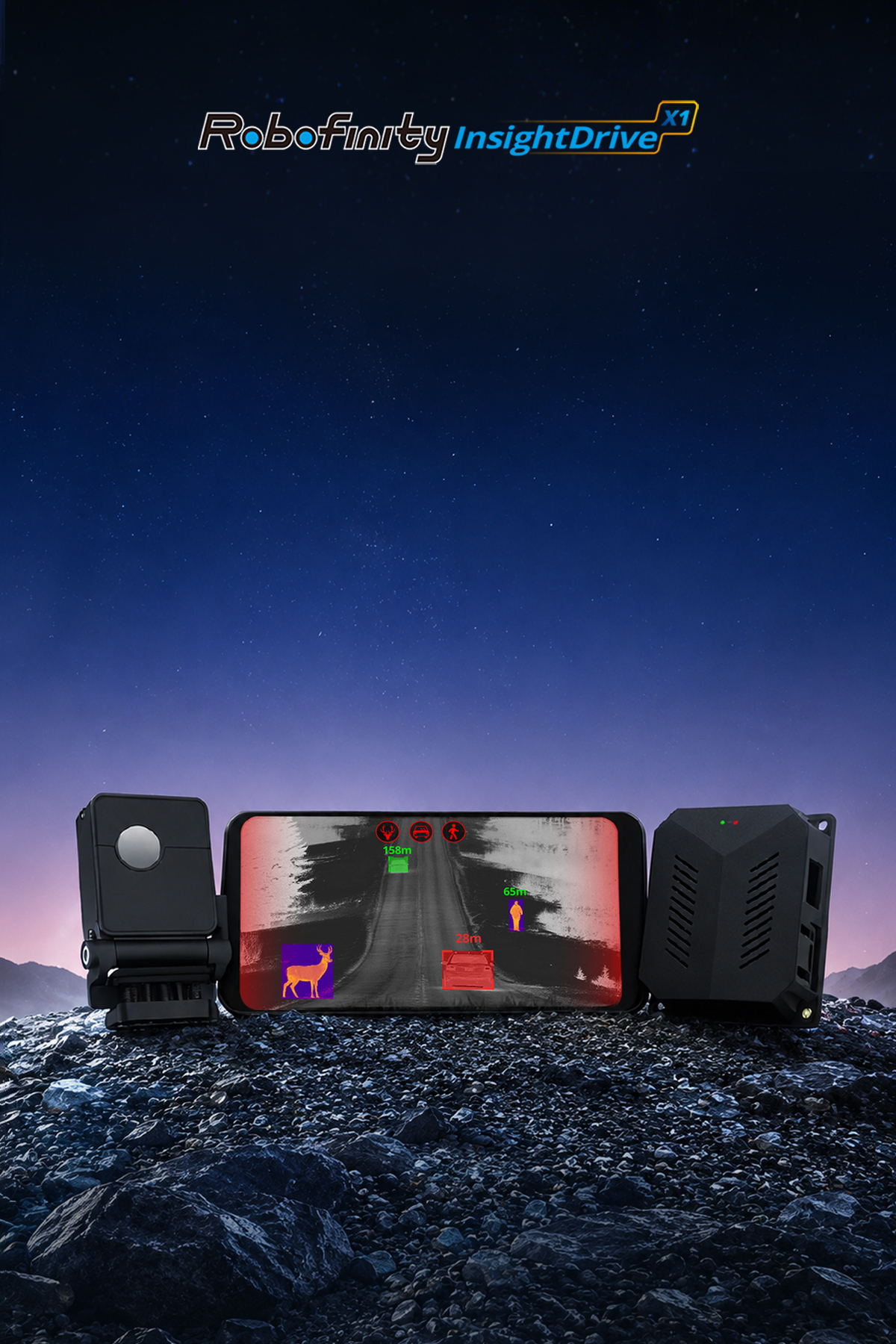
Some thermal imaging systems use software to identify pedestrians, animals, or vehicles and issue real-time alerts. Such features can help direct attention, especially when the driver is scanning a complex trail.
Drivers should still expect false alerts and missed detections. Vegetation, hot surfaces, partial obstructions, unusual body positions, and weather can complicate classification. Alerts are prompts to inspect the road, not instructions to make an automatic maneuver.
As one relevant example, Robofinity InsightDrive is a vehicle thermal imaging night vision system that uses AI-powered thermal imaging to support recognition of pedestrians, animals, and vehicles with real-time alerts. This type of driver-assistance technology may improve awareness in low-light or poor-visibility conditions, but it does not replace headlights, braking distance, mirrors, trail discipline, or continuous driver attention.
Check Environmental Protection
Off-road cameras face vibration, dust, mud, water, branches, and temperature changes. Buyers should review the manufacturer’s documented environmental protection, mounting requirements, operating limits, and cleaning guidance.
The installation location should protect the camera without restricting its view. A position that looks tidy in a workshop may become useless after the first mud crossing or may be vulnerable to brush and stones.
Plan the Electrical Installation
Aftermarket equipment adds electrical load and wiring complexity. Proper fusing, weather-resistant connectors, protected cable routing, grounding, and compatibility with the vehicle’s charging system are essential.
Cables should remain clear of exhaust components, steering parts, suspension travel, sharp edges, and recovery points. A professional installer may be appropriate when the vehicle uses complex electronics or when the owner is not experienced with automotive wiring.
Confirm Road-Legal Use
Off-road accessories may be subject to different rules when the vehicle returns to public roads. Display positioning, windshield obstruction, auxiliary lighting, and driver-screen use can be regulated.
Requirements vary by location, so owners in the United States and Europe should confirm applicable local rules rather than assuming that an off-road thermal imaging setup is automatically acceptable on-road.
How to Use Thermal Night Vision Responsibly
Good operating habits determine whether a thermal camera supports safety or becomes another distraction. Thermal imaging at night works best when you treat it as part of a layered system and a disciplined driving routine.
Before leaving pavement, clean the camera lens and confirm that the image is clear. Check the mount for movement and ensure wiring has not been damaged by previous trail use. Adjust screen brightness so the display is readable without impairing dark adaptation.
During the drive:
- Use the windshield as the primary view. Check the thermal display briefly, as you would a mirror or instrument.
- Slow down when the image is uncertain. More technology does not justify higher nighttime speeds, especially when thermal imaging at night is showing reduced contrast.
- Confirm detected hazards. Use headlights, auxiliary cameras, a spotter, or a controlled stop to understand the scene.
- Expect blind areas. Hills, trees, parked vehicles, and rock formations can hide heat sources.
- Keep stopping distance conservative. Loose gravel, mud, snow, and steep grades can greatly increase the distance needed to stop.
- Avoid overdriving the full visibility system. The vehicle must be able to stop within the distance in which hazards can be identified and interpreted.
- Recheck the lens after dirty sections. Mud splashes and dust can degrade performance without immediately triggering a fault.
For group travel, establish communication rules before the trail becomes difficult. Thermal imaging at night may help locate people, but radio calls and clear spotting procedures remain more reliable for coordinating movement.
Situations Where Thermal Imaging May Be Worth the Cost
Not every off-road owner needs a thermal imaging system. Thermal imaging at night is most compelling when nighttime or poor-visibility travel is frequent rather than occasional.
It may be a practical upgrade for:
- Drivers who regularly use remote rural or forest roads after dark
- Overland travelers arriving at campsites late at night
- Farmers, utility crews, and land managers operating on private property
- Off-road groups that conduct nighttime recovery or support work
- Drivers in areas with frequent wildlife activity
- Search, patrol, or site-support vehicles that require enhanced environmental awareness
It may offer less value to drivers who rarely leave pavement after sunset, use only well-lit recreation areas, or primarily need help judging rocks and wheel placement. In those cases, quality work lights, underbody cameras, or a better spotter communication setup may provide a more immediate benefit than thermal imaging at night alone.
The ownership calculation should include installation, maintenance, display placement, camera cleaning, electrical capacity, and how often the feature will realistically be used.
A Practical Pre-Drive Checklist
Before relying on thermal imaging at night, verify the following:
- The windshield, headlights, auxiliary lights, and thermal camera lens are clean.
- The display is secure, visible, and not blocking the driver’s normal view.
- Screen brightness is appropriate for dark conditions.
- Camera alignment matches the vehicle’s forward path.
- Alerts and display modes are understood before driving.
- Wiring, connectors, and mounts show no visible damage.
- The route, weather, fuel range, and recovery plan have been reviewed.
- A spotter or group communication method is available where needed.
- The driver knows how to turn the system off or change modes without searching through menus.
- Speed will be based on actual visibility and stopping distance, not on the presence of driver-assistance technology.
Frequently Asked Questions
Can thermal imaging see through trees or bushes?
It cannot see through solid objects such as trunks, rocks, walls, or vehicle panels. It may reveal part of a warm person or animal through gaps in light vegetation, but dense foliage can conceal the target.
Does an off-road vehicle still need auxiliary lights?
Yes. Thermal imaging is useful for detecting heat, while visible lighting is necessary for reading terrain, identifying trail boundaries, judging surface conditions, and seeing objects with little thermal contrast. The two technologies serve different purposes, and thermal imaging at night should be treated as an add-on.
Can thermal imaging detect cold obstacles?
It may display them if there is sufficient temperature contrast with the background, but many rocks, branches, holes, and cables can be difficult to interpret. Drivers should not rely on thermal imaging for complete obstacle detection—even when viewing thermal imagery at night.
Does thermal night vision work in fog, rain, dust, or snow?
It may provide useful awareness when visible-light performance is reduced, particularly for warm targets. However, heavy precipitation, dense airborne material, lens contamination, and changing temperatures can reduce image quality. It is not an all-weather guarantee.
Where should a thermal camera be mounted on an off-road vehicle?
The camera generally needs a stable, forward-facing position with an unobstructed view and protection from impact and contamination. The correct location depends on the camera’s design, field of view, vehicle shape, and manufacturer instructions. Wiring and sensor alignment should also be considered.
Can thermal imaging replace a trail spotter?
No. A spotter can judge tire placement, communicate a route, inspect clearances, and recognize hazards that have little thermal contrast. Thermal imaging can support awareness, but technical obstacles still require direct observation and coordinated guidance.
Conclusion
Nighttime off-road driving combines limited visibility with unpredictable terrain, wildlife, people outside vehicles, and fewer roadside safeguards. Thermal imaging at night can strengthen a driver’s awareness by making heat-emitting subjects easier to distinguish when headlights and visible-light cameras struggle.
Its limits are equally important. Thermal imaging at night may not clearly reveal a cold obstacle, trail edge, cable, or surface change, and its image can be affected by weather, temperature, obstructions, and lens contamination. The most effective setup combines thermal detection with suitable lighting, conservative speed, clear communication, proper recovery procedures, and attentive driving.
For drivers who regularly travel remote trails after dark, evaluating thermal imaging at night as part of a layered nighttime safety setup is reasonable. Choose a system around actual terrain and operating needs, install it correctly, and treat every alert as additional information rather than a guarantee of a clear path.