SEO Title: Thermal Dash Cam vs Regular Dash Cam: Key Differences Explained
- The Main Difference at a Glance
- How a Regular Dash Cam Works
- How Thermal Vehicle Imaging Works
- Recording Evidence Versus Detecting Hazards
- Real-World Driving Scenarios
- Key Buying Considerations
- Define the Primary Goal
- Check Camera Placement
- Evaluate Alerts, Not Just Detection
- Consider Storage and Heat Tolerance
- Budget for the Complete Installation
- Pros and Cons of Each Option
- Regular Dash Cam Advantages
- Regular Dash Cam Limitations
- Thermal Imaging Advantages
- Thermal Imaging Limitations
- Can You Use Both?
- How to Choose the Right System
- Maintenance and Responsible Use
- Frequently Asked Questions
- Is a thermal dash cam better than a regular dash cam?
- Can a thermal camera read license plates?
- Does thermal imaging work through a car windshield?
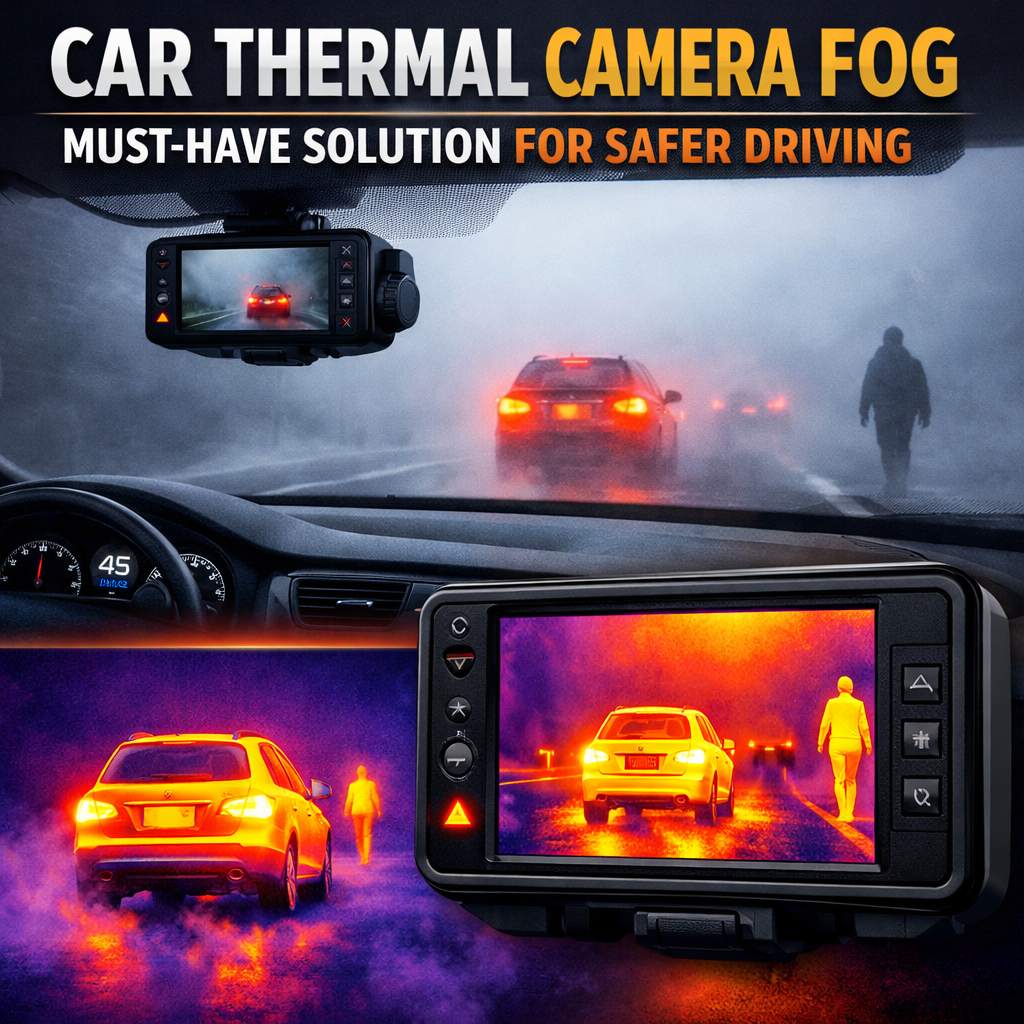
- Does a thermal dash cam work in fog or rain?
- Can thermal night vision replace headlights?
- Is it worth installing both types of camera?
- Conclusion
Meta Description: Compare a thermal dash cam vs regular dash cam to understand visibility, recording, detection, costs, and which technology suits your driving.
A thermal dash cam vs regular dash cam comparison is not simply about which camera produces the better picture. The two devices serve different purposes. A regular dash cam records visible road scenes for evidence and trip documentation, while a thermal system detects heat patterns that may reveal people, animals, and vehicles in darkness or difficult visibility.
For many drivers, a conventional dash cam remains the practical choice. Others may benefit from combining video recording with thermal night vision, especially if they regularly drive after dark, use unlit rural roads, or encounter fog, glare, and roadside wildlife. Understanding the strengths and limitations of each technology is essential before choosing either one.
The Main Difference at a Glance
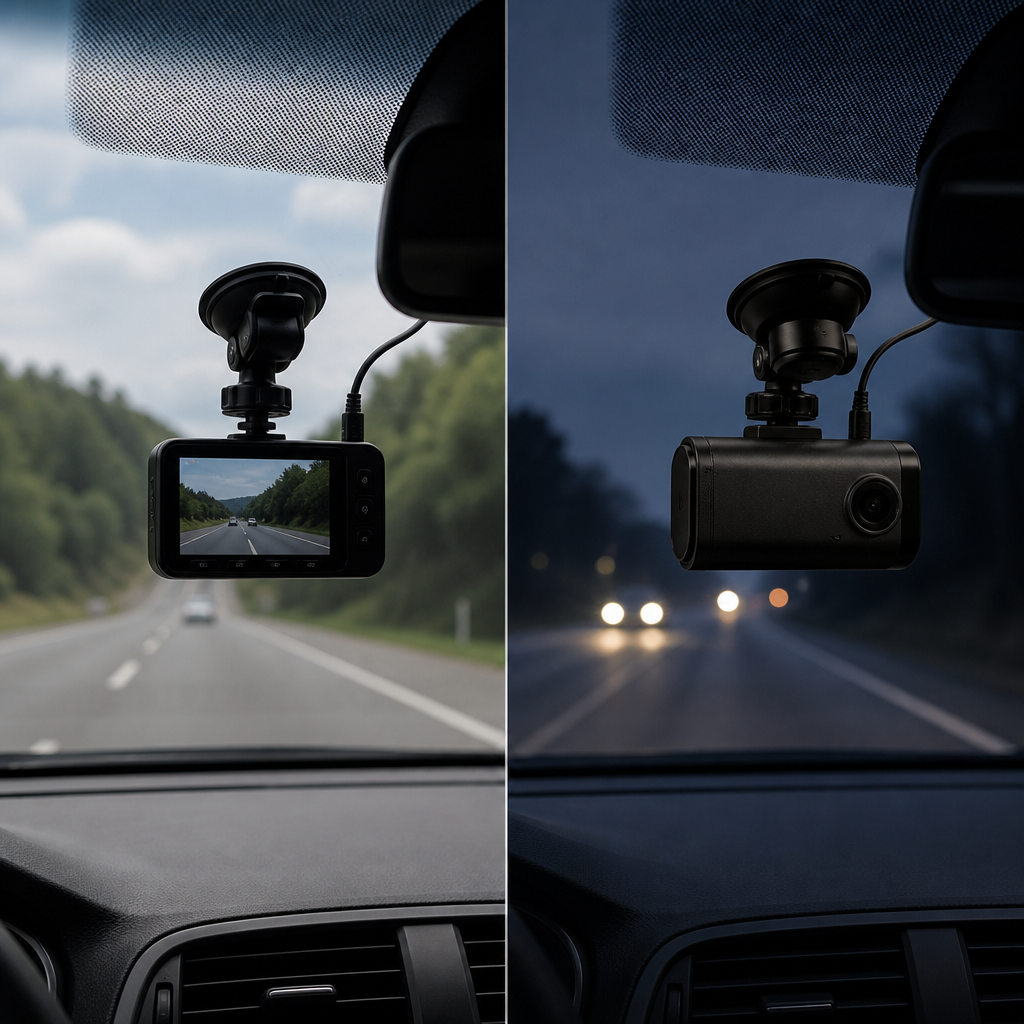
A regular dash cam uses a conventional optical sensor to capture visible light, much like a smartphone or digital camera. It records recognizable details such as road markings, traffic signals, vehicle colors, and, under suitable conditions, license plates.
A thermal camera detects infrared energy associated with heat. Instead of showing natural colors and familiar visual detail, it creates an image based on temperature differences. Warm objects may stand out against cooler surroundings, depending on the display palette and environmental conditions.
That distinction affects how each device performs:
| Feature | Regular Dash Cam | Thermal Dash Cam or Night Vision System |
|---|---|---|
| Primary purpose | Records visible road footage | Reveals heat patterns and supports hazard awareness |
| Image source | Visible light | Thermal infrared energy |
| Natural colors | Yes, typically | No |
| Performance in complete darkness | Limited without illumination | Can detect heat without visible light |
| Traffic signs and road markings | Usually clear in suitable conditions | Often less detailed |
| License plate capture | Possible but condition-dependent | Generally not its strength |
| Pedestrian and animal visibility | Depends heavily on lighting and contrast | Warm bodies may stand out more clearly |
| Evidence value | Generally more useful for recognizable scene details | Useful as supplementary context |
| Typical role | Documentation and recording | Nighttime awareness and hazard detection |
The technologies are therefore complementary more often than interchangeable.
How a Regular Dash Cam Works
A conventional dash cam combines a lens, visible-light image sensor, processor, and storage system. It normally begins recording when the vehicle starts and saves footage in short video segments. When storage fills, loop recording replaces older, unprotected files.
Many models also include a G-sensor that can protect a recording after sudden movement or impact. Depending on the product, other features may include GPS data, rear-camera support, parking surveillance, audio recording, smartphone connectivity, and high dynamic range processing.
What Regular Dash Cams Do Well
Their biggest advantage is contextual detail. Good visible-light footage can show:
- Traffic-light states
- Lane positions and road markings
- Vehicle type and color
- Signs and storefronts
- Weather and road conditions
- The sequence of events before an incident
- Potentially, license plates and faces
This makes a regular dash cam useful for documenting collisions, road disputes, vandalism, and unusual driving events. It may also help a driver recall where and when something occurred.
However, recording a scene does not guarantee that every detail will be readable. Plate capture depends on resolution, distance, relative speed, lens quality, exposure, viewing angle, weather, and lighting. Even a high-resolution camera can struggle with a reflective plate illuminated by headlights at night.
Where Visible-Light Cameras Struggle
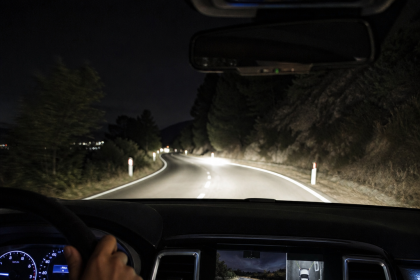
A regular dash cam depends on available light or artificial illumination. Its nighttime image can deteriorate on an unlit road, particularly beyond the reach of the headlights. Rain on the windshield, dirty glass, headlight glare, and reflections from the dashboard can reduce clarity further.
Image-processing features can improve low-light footage, but they cannot recover visual information the sensor never captured. Marketing terms such as “night vision” may refer only to enhanced low-light processing, not actual thermal imaging. Buyers should verify the underlying technology rather than relying on the label.
How Thermal Vehicle Imaging Works
Thermal cameras sense infrared radiation emitted by objects and convert temperature differences into a visible image. They do not require headlights to illuminate the subject in the conventional sense.
A person, animal, engine, exhaust system, or recently driven vehicle may appear distinct from a cooler background. The exact appearance varies with the sensor, software, color palette, weather, surface temperatures, and distance.
In automotive use, thermal imaging may be integrated into a driver display or paired with detection software. Some systems identify likely pedestrians, animals, or vehicles and issue visual or audible alerts. This makes thermal imaging primarily a road-awareness technology rather than a conventional evidence camera.
Why Heat Detection Can Help at Night
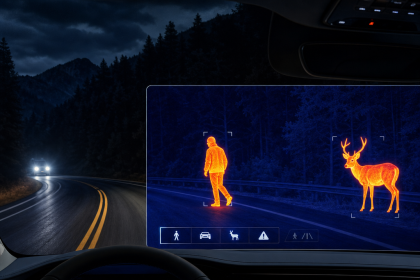
Consider a driver approaching a dark rural bend. A person in dark clothing near the roadside may blend into the visual background until the headlights reach them. A thermal sensor may detect the person’s heat contrast sooner, although performance varies and detection does not guarantee correct classification.
The same principle may apply to deer or other animals near the shoulder. Thermal imaging can make a warm body more noticeable against cooler vegetation, helping the driver recognize that something is present. This additional information can be valuable when ordinary visual contrast is poor.
What a Thermal Image Does Not Show Well
Thermal imaging sacrifices familiar visual detail. It generally cannot replace a conventional camera when the objective is to document:
- Natural colors
- Traffic-light colors
- Fine road markings
- Printed sign text
- Reliable license plate detail
- Conventional facial appearance
- The visual condition of paintwork or vehicle damage
Thermal cameras also do not see through every obstruction. They generally cannot provide a useful heat image through a standard windshield because automotive glass can block the relevant infrared wavelengths. That is why vehicle thermal cameras are often mounted externally, creating additional installation, weather protection, alignment, and cable-routing considerations.
A thermal camera also cannot see through buildings, trees, solid barriers, or dense objects. Fog, rain, snow, road spray, and environmental heat can affect range and contrast. “Works in darkness” should not be interpreted as “works perfectly in every condition.”
Recording Evidence Versus Detecting Hazards
The most useful way to compare these products is to ask what job the camera needs to perform.
A regular dash cam mainly answers: What happened?
A thermal night vision system mainly helps answer: Is there a heat-emitting object ahead that I may not have noticed yet?
These goals overlap, but they are not identical.
For Incident Documentation
Choose a regular dash cam as the foundation if the priority is preserving recognizable footage. A front-and-rear setup can provide broader context than a forward-facing unit alone. Suitable resolution, strong low-light performance, reliable storage, and proper positioning matter more than an inflated feature list.
A conventional video recording is usually easier for another person to interpret because it resembles the driver’s visible view. Whether footage is accepted or how it may be used depends on local laws, privacy rules, and the circumstances of the incident.
For Nighttime Hazard Awareness
Thermal imaging becomes more relevant when the priority is seeing potential hazards beyond what visible-light video reveals easily. It may be useful for frequent nighttime driving, rural travel, poorly illuminated roads, roadside work, or routes with recurring animal activity.
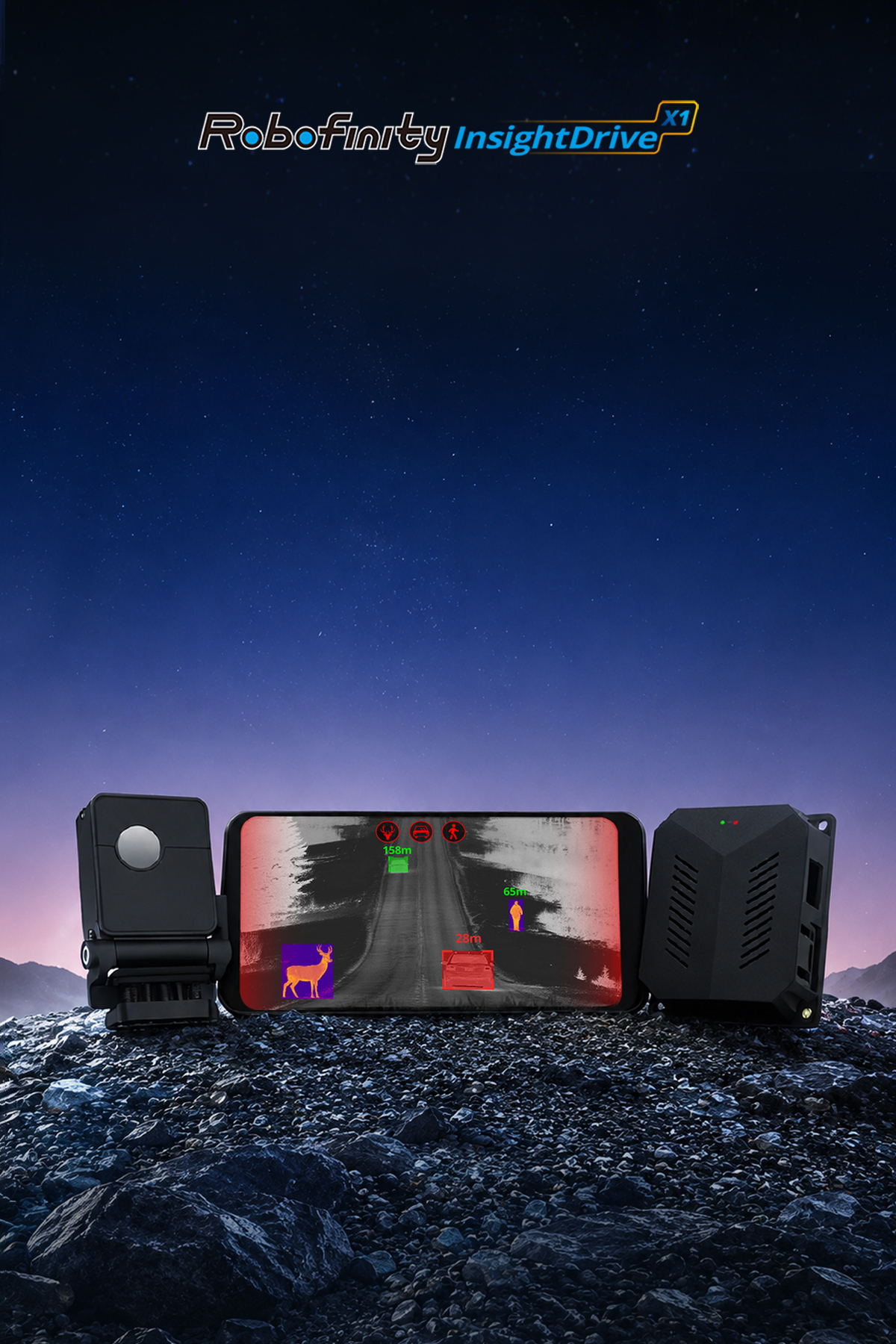
Robofinity InsightDrive is one example of a vehicle thermal imaging night vision system designed to support awareness in low-light and poor-visibility conditions. Its AI-powered thermal imaging can recognize pedestrians, animals, and vehicles and provide real-time alerts. This remains driver-assistance technology: recognition and alerts do not replace attentive observation, appropriate speed, headlights, mirrors, or adequate braking distance.
Real-World Driving Scenarios
The best choice depends less on technical novelty and more on where, when, and why the vehicle is used.
City Commuting
For urban driving, a regular dash cam is usually the first priority. Streets tend to have more lighting, and documentation of lanes, signals, vehicles, cyclists, and interactions at junctions may be more important than long-range heat detection.
Thermal assistance could still help on dim side streets or where pedestrians emerge from poorly lit areas. However, a busy urban thermal display may contain many heat sources, so clear alerts and a restrained interface matter. The driver should not have to study a screen while negotiating dense traffic.
Rural Roads
This is one of the strongest use cases for thermal night vision. Unlit roads may have animals near the shoulder, pedestrians without reflective clothing, or stopped vehicles beyond a bend. High beams help only when their use is legal and safe, and they may need to be dipped for approaching traffic.
A thermal system can add another layer of awareness, while a standard camera records the visible scene. For frequent rural night driving, using both may be more practical than choosing one.
Highway Travel
A regular dash cam is valuable for recording lane changes, sudden braking, debris encounters, and collisions. Thermal imaging may assist with identifying a person near a disabled car or a warm object ahead, but speed significantly reduces reaction time.
No camera overcomes insufficient following distance. At highway speeds, early detection only has value if the driver maintains enough space and attention to respond smoothly.
Fog, Rain, and Snow
A regular camera may lose contrast in fog and can be affected by light reflecting from rain, snow, or airborne moisture. Thermal imaging may preserve useful contrast in some poor-visibility conditions, but it is not immune to weather. Atmospheric moisture and precipitation can reduce thermal performance, while spray, snow, mud, or ice on an externally mounted lens can obstruct it physically.
Drivers should treat any imaging system as supplementary information and reduce speed according to actual visibility. Technology does not change the stopping-distance limits of the vehicle.
Family Driving and Long Trips
For family vehicles, a standard front-and-rear dash cam provides broad day-to-day value. It can document incidents during commuting, school runs, parking, and vacations.
Families who regularly travel at night may also value thermal awareness, particularly on unfamiliar or rural roads. The important consideration is interface placement: displays and alerts should communicate hazards without distracting the driver or blocking the road view.
Key Buying Considerations
A fair comparison requires more than checking resolution numbers. The two categories use different measurements and should be judged against their intended roles.
Define the Primary Goal
Start by selecting the most important outcome:
- Evidence after a collision
- Parking-event recording
- Front and rear road coverage
- Improved awareness of pedestrians and animals at night
- Support during regular rural travel
- A combined recording and detection setup
If documentation is the main goal, begin with a conventional dash cam. If nighttime awareness is the main concern, investigate a purpose-built automotive thermal system. If both goals matter, plan for both rather than expecting one device to perform every task equally well.
Check Camera Placement
A dash cam normally mounts inside the windshield, where it receives some protection from weather and theft. Placement should avoid blocking the driver’s view and should keep the lens within the windshield-wiper area.
A long-wave thermal camera may require exterior mounting. Buyers should examine how the camera attaches, how cables enter the cabin, whether the camera’s view can be aligned accurately, and how easily the lens can be cleaned.
Local rules governing windshield devices, display placement, recording, and audio capture vary. Installation should comply with the laws that apply where the vehicle is used.
Evaluate Alerts, Not Just Detection
When reviewing a thermal driver-assistance system, determine what happens after an object is detected. A technically capable sensor can still be unhelpful if alerts are late, ambiguous, or excessively frequent.
Useful questions include:
- Does the system distinguish among people, animals, and vehicles?
- Are visual and audible alerts understandable at a glance?
- Can alert settings be adjusted?
- Is the display readable without drawing attention away from the road?
- How does performance change in warm weather or heavy precipitation?
- Does it record thermal video, or only display it live?
The goal is usable information, not simply more on-screen activity.
Consider Storage and Heat Tolerance
For a regular dash cam, storage reliability is critical. Continuous recording creates frequent write cycles, so a memory card designed for endurance is usually more appropriate than a basic consumer card. Capacity must also be compatible with the camera.
Dash cams can experience substantial heat inside a parked vehicle. Buyers should consider the manufacturer’s operating-temperature guidance, mounting method, and power design. Periodically inspect recordings rather than assuming the camera has been saving files correctly.
For a thermal system, assess the external camera’s environmental protection, connector quality, and resistance to vibration. Only rely on explicitly documented ratings rather than assuming every exterior-looking camera is adequately sealed.
Budget for the Complete Installation
The purchase price may not represent the full ownership cost. A dash cam setup can require a rear camera, endurance memory card, hardwire kit, parking-mode power management, or professional installation.
A thermal setup may involve external mounting, cable routing, calibration or alignment, a dedicated display, and additional labor. Installation quality can directly affect reliability and image usefulness, so it should be treated as part of the system rather than an afterthought.
Pros and Cons of Each Option
Regular Dash Cam Advantages
- Produces familiar video that is easy to interpret
- Captures signs, signals, lane markings, and environmental context
- Usually offers straightforward windshield installation
- Commonly supports loop recording and incident-file protection
- Available in front-only, front-and-rear, and multi-camera configurations
- Generally better suited to documenting collisions and traffic events
Regular Dash Cam Limitations
- Depends heavily on visible light
- Can struggle with glare, darkness, rain, and reflective plates
- May record a hazard without making it noticeable to the driver
- Parking mode may require careful power management
- Image quality claims do not guarantee readable details
Thermal Imaging Advantages
- Detects heat without visible illumination
- May make pedestrians and animals stand out in darkness
- Can support road awareness on unlit routes
- May add useful contrast in some poor-visibility situations
- Can pair with software recognition and alerts
Thermal Imaging Limitations
- Does not provide natural-color visual evidence
- Is poorly suited to plate, sign, and traffic-light detail
- May require exterior camera installation
- Can be affected by weather, contamination, and low thermal contrast
- May introduce display distraction or unnecessary alerts
- Does not replace headlights or direct observation
Can You Use Both?
Yes. For drivers who want evidence recording and enhanced nighttime awareness, the more complete arrangement is often a regular dash cam plus a separate thermal system.
The conventional camera records the visual scene. The thermal system provides a different layer of information about heat-emitting objects. If an animal appears near a dark roadside, for example, the thermal display may make it easier to notice, while the regular camera preserves recognizable road context.
A combined setup should still be designed carefully. Multiple screens, alerts, power connections, and cables can create distraction or clutter. The installation should preserve the driver’s field of view, use secure mounts, and avoid overloading an accessory circuit. Professional installation may be appropriate when routing wiring through trim, connecting to vehicle power, or mounting an exterior sensor.
How to Choose the Right System
Use this practical decision sequence:
- Identify the main purpose. Choose documentation, nighttime hazard awareness, or both.
- Review normal driving conditions. Consider how often you drive after dark, on rural roads, in cities, or during severe weather.
- Decide what details matter. Visible signs and plate context favor a regular camera; heat detection favors thermal imaging.
- Inspect installation requirements. Confirm mounting location, power needs, cable routing, weather protection, and legal placement.
- Assess the interface. Alerts and displays should be understandable without demanding prolonged attention.
- Calculate total ownership cost. Include storage, rear-camera modules, wiring kits, installation, and maintenance.
- Verify limitations in product documentation. Look for clear statements about detection, recording, operating conditions, and compatibility.
- Keep core safety practices unchanged. Continue using suitable headlights, clean glass and lenses, legal speeds, adequate following distance, and active observation.
For most drivers seeking their first in-car camera, a reliable conventional dash cam is the logical starting point. Thermal imaging is a more specialized practical driving upgrade for people whose routes and schedules create a recurring low-visibility challenge.
Maintenance and Responsible Use
Both technologies require periodic attention.
Clean the windshield around an interior dash cam and remove fingerprints, haze, or residue near the lens. Check the camera angle after windshield work, rough-road travel, or accidental contact. Review sample recordings regularly, verify the date and time, and replace storage media when it develops errors.
An exterior thermal camera should be inspected for dirt, salt, insects, snow, and damage. A thin layer of contamination can degrade the image. Check its alignment and mounting security, especially after a minor impact, bumper repair, or automated car wash if the installation is exposed.
Drivers should also learn what normal thermal scenes look like without staring at the display while moving. Road surfaces, buildings, exhaust systems, and engine components may all produce heat signatures. Automated classification can support hazard detection, but no recognition system is infallible.
Frequently Asked Questions
Is a thermal dash cam better than a regular dash cam?
Not for every purpose. A thermal system is better at revealing heat-emitting objects in darkness, while a regular dash cam is better at recording recognizable visual details. The right choice depends on whether the priority is hazard awareness or incident documentation.
Can a thermal camera read license plates?
Thermal imaging is generally not the appropriate technology for capturing plate characters. It shows temperature differences rather than conventional reflected-light detail. A visible-light dash cam is the more suitable tool, although plate readability is never guaranteed.
Does thermal imaging work through a car windshield?
Automotive thermal cameras using long-wave infrared generally do not obtain a useful view through standard windshield glass. They commonly require an exterior mounting position. Always follow the product’s installation instructions.
Does a thermal dash cam work in fog or rain?
It may retain useful contrast in some poor-visibility conditions, but fog, rain, snow, spray, and moisture can reduce its effective performance. Dirt or ice on the lens can also block the view. Thermal technology should not be treated as all-weather vision.
Can thermal night vision replace headlights?
No. Headlights are essential for seeing road markings, signs, surface conditions, and other visible details, as well as making the vehicle visible to others. Thermal imaging is an additional awareness tool, not a replacement.
Is it worth installing both types of camera?
It may be worthwhile for drivers who need conventional evidence recording and frequently travel at night on poorly lit roads. Occasional daytime drivers may find a quality regular dash cam sufficient, while rural night drivers may gain more practical value from a combined setup.
Conclusion
The meaningful distinction is purpose. A regular dash cam documents the visible road scene, making it the stronger general-purpose option for recording incidents, traffic behavior, and trip context. A thermal imaging system detects heat, making it potentially valuable for noticing pedestrians, animals, and vehicles when ordinary visual contrast is limited.
Neither technology eliminates the limitations of the other. Conventional cameras need light, while thermal images lack many details needed to interpret signs, signals, and plates. For drivers who routinely face dark rural roads or poor visibility, a combined setup can provide broader information than either system alone.
Before selecting equipment, map the technology to the conditions you actually encounter, account for installation and ownership costs, and review the documented limitations. Most importantly, treat every camera and alert system as support for attentive driving, not a substitute for it.