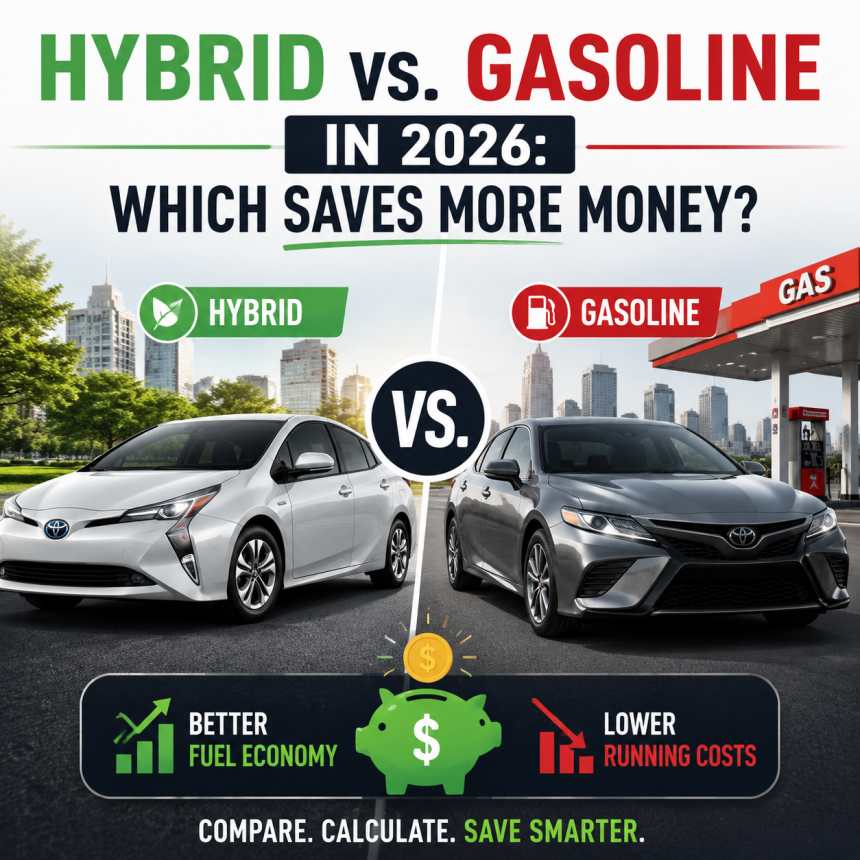
Hybrid vs Gasoline in 2026 is no longer just a fuel-economy contest. Buyers are comparing total cost of ownership, maintenance convenience, resale value, and—just as importantly—the day-to-day headache factor that comes with repairs, part availability, and ownership complexity. The right answer depends on your driving pattern, local fuel prices, and how long you keep a vehicle.
- What Changed in 2026?
- Upfront Price: Hybrid vs Gasoline in 2026
- Fuel Costs: Where Hybrids Often Pull Ahead
- Maintenance and Repairs: Simplicity vs. Complexity
- Battery Life and Replacement Concerns
- Resale Value: What It Means for Your Total Cost
- Driving Style Matters Most
- Convenience and Daily Ownership
- How to Estimate Total Cost for Your Car
- 1) Start with the purchase price difference
- 2) Estimate fuel savings using your driving profile
- 3) Add maintenance and repair expectations
- 4) Include resale value and how long you keep the car
- 5) Add your personal headache tolerance
- So Which Saves More Money in 2026?
- Final Verdict
- What Changed in 2026?
- Upfront Price: Hybrid vs Gasoline in 2026
- Fuel Costs: Where Hybrids Often Pull Ahead
- Maintenance and Repairs: Simplicity vs. Complexity
- Battery Life and Replacement Concerns
- Resale Value: What It Means for Your Total Cost
- Driving Style Matters Most
- Convenience and Daily Ownership
- How to Estimate Total Cost for Your Car
- So Which Saves More Money in 2026?
- Final Verdict
What Changed in 2026?
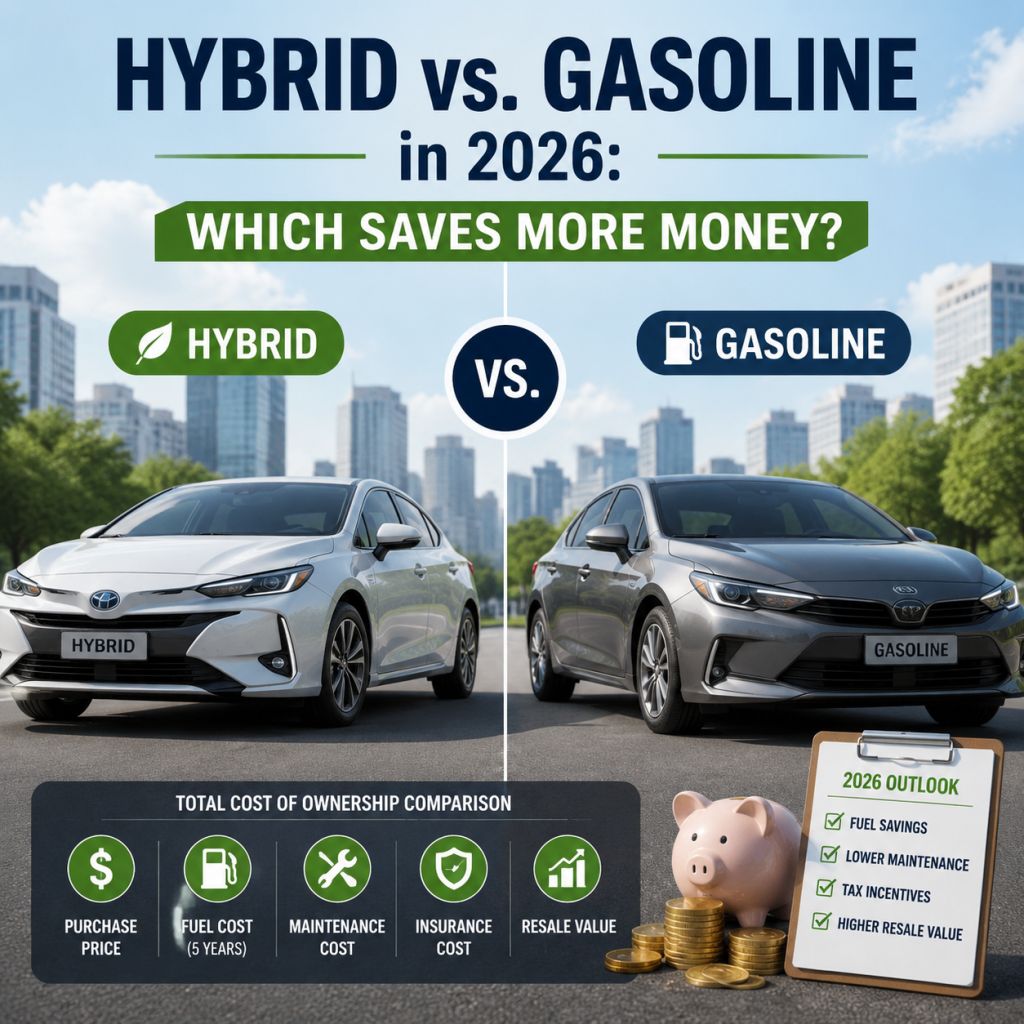
The hybrid vs gasoline decision in 2026 looks different than it did a decade ago. Hybrid platforms are more mature, battery management is more refined, and regenerative braking is standard across many models. Meanwhile, gasoline powertrains have also improved with better engines, improved transmissions, and stronger real-world efficiency—especially on the highway.
Because both sides improved, the outcome is less automatic and more situational. Hybrid systems may deliver bigger savings for certain drivers, while gasoline models can offer better value for others—particularly when purchase price, driving distance, and repair preferences are considered together.
That is why hybrid vs gasoline comparisons now need to look beyond the sticker price. A model with better fuel economy may still cost more overall if it carries a higher purchase price, while a simpler gasoline model may feel cheaper to own even if it uses more fuel. If you are also comparing overall affordability across categories, you may find this related guide useful: Car affordability: What Makes a Car Affordable?.
The big shift in hybrid ownership
Modern hybrid systems are built for durability: batteries, inverters, and electric motors are designed with tighter thermal controls and long-term reliability targets. Many hybrids also reduce brake wear thanks to regenerative braking, which can lower maintenance cost over time.
At the same time, gasoline vehicles still win on straightforward ownership. They typically have fewer specialized parts, fewer high-voltage components, and more universally familiar repair procedures in most regions. For shoppers who strongly value simplicity, that matters in the headache equation.
If you are trying to minimize surprise ownership costs, this is where hybrid vs gasoline becomes a practical question rather than a theoretical one. The more complex the vehicle, the more important it is to consider how often you expect to service it and whether local shops can handle the work confidently.
Upfront Price: Hybrid vs Gasoline in 2026
In many trims and vehicle classes, gasoline cars still cost less to buy. That lower price can matter most for drivers who plan to keep the car briefly, who finance and want lower monthly payments, or who simply need to control upfront cash flow.
Hybrid models often carry a premium because they include additional electric components: an electric motor or generator, inverter, high-voltage battery, and hybrid control systems. Even when that premium has narrowed in 2026, it is not always eliminated.
When buyers compare hybrid vs gasoline in 2026, the first question is often whether the hybrid premium can be recovered through fuel savings and resale value. The answer depends on annual mileage, traffic conditions, and how long you keep the vehicle.
When a lower purchase price matters most
Hybrid vs Gasoline in 2026 tends to favor gasoline if:
- You drive relatively few miles per year.
- You typically trade in or replace vehicles every 3 to 5 years.
- Fuel savings would take too long to offset the higher hybrid price.
- You prioritize the lowest possible monthly payment.
If you do not rack up a lot of annual mileage, your fuel-cost benefit may not have enough time to pay back the extra hybrid upfront cost.
That logic is especially important for shoppers comparing multiple models in the same segment. A gasoline sedan or crossover with a lower purchase price may be more attractive if your mileage is modest, while a hybrid may still make sense for a high-mileage commuter. The best hybrid vs gasoline choice is the one that matches your actual usage, not just the advertised mpg figure.
Fuel Costs: Where Hybrids Often Pull Ahead
Hybrid vs Gasoline in 2026 is often easiest to explain at the pump. Hybrids frequently deliver larger savings in city driving, stop-and-go traffic, and short trips. Because hybrids can blend electric and gasoline power, they reduce wasted fuel during low-speed acceleration and idling.
Gasoline vehicles have become more efficient, but they still burn fuel whenever the engine is running. For drivers who spend a lot of time stuck in congestion or making frequent stops, that difference can add up.
For readers who want to understand where the fuel savings come from in a popular modern hybrid, this test article breaks down real-world numbers well: EPA fuel economy data for the 2026 Toyota RAV4 Hybrid. It is a useful reminder that efficiency claims should be checked against actual test information.
The real-world savings equation
A hybrid can save money on fuel if your driving matches how hybrid systems work best:
- You drive roughly 12,000 miles or more per year as a general benchmark.
- Your route includes frequent traffic lights, congestion, or city stops.
- Your local fuel prices are relatively high.
- You plan to keep the vehicle long enough to recover the purchase-price gap.
For highway-heavy drivers, the gap may shrink. Many efficient gasoline cars can come surprisingly close on steady freeway trips, where there is less opportunity for regenerative braking and frequent stop/start behavior.
That is one reason hybrid vs gasoline comparisons can look different in real life than they do on paper. If most of your time is spent on open roads, the fuel advantage may be smaller than you expect. If your routine involves traffic, errands, and short commutes, the savings can be much more noticeable.
Maintenance and Repairs: Simplicity vs. Complexity
This is where the headache portion of hybrid vs gasoline in 2026 becomes personal. Gasoline cars are mechanically simpler, which often means fewer specialized systems and, frequently, lower diagnostic complexity if something goes wrong.
That does not mean hybrids are unreliable. In fact, many hybrids are among the most dependable vehicles on the road. The key difference is that hybrid systems include additional components: electric motors, battery systems, power electronics, and sophisticated control software.
For many owners, the biggest concern is not whether a hybrid will ever need service. It is whether that service will require a more specialized technician, a longer diagnosis, or a higher bill for certain parts. Those are legitimate concerns, and they should be part of the hybrid vs gasoline decision.
Why gasoline cars can feel easier to own
Gasoline vehicles may offer lower friction because they typically have:
- More widely available repair parts.
- More technicians familiar with the systems.
- Lower costs for many routine repairs.
- Less specialized diagnosis in common scenarios.
If you prefer predictable service, easy access to repair shops, and simpler ownership conversations with mechanics, a gasoline car can be a calmer choice.
This simplicity is one reason hybrid vs gasoline remains a tough comparison for owners who keep vehicles past the warranty period. A gasoline car may not save as much at the pump, but it can be easier to budget for when routine wear items appear. For some buyers, that predictability is worth more than the efficiency gain.
Why hybrids can still be low-stress
Hybrids are designed for durability, and the gasoline engine often runs differently than it does in a non-hybrid vehicle. In many hybrid designs, the electric motor helps smooth acceleration and reduces engine load at times. Regenerative braking also reduces brake wear, which can lower brake maintenance over the years.
If you buy a well-reviewed hybrid from a reliable brand and keep up with scheduled maintenance, the ownership experience can be as straightforward as, and sometimes less costly than, a comparable gasoline alternative.
For shoppers comparing reliability as part of the hybrid vs gasoline decision, it helps to look at brand reputation and long-term ownership history too. A strong platform matters more than the powertrain label alone. You may also want to review broader brand reliability trends here: Most Reliable Car Brands in 2026: Top Picks Ranked.
Battery Life and Replacement Concerns
Battery anxiety is common in the hybrid vs gasoline debate, but it has changed in 2026. Hybrid battery longevity has improved significantly compared to earlier generations, largely due to better battery management systems and more refined thermal control.
Still, battery replacement can be expensive if it becomes necessary out of warranty. The goal is not to ignore risk—it is to understand how your usage and warranty terms affect it.
If you are comparing hybrid vs gasoline primarily because you want to avoid large repair surprises, battery coverage should be part of the conversation. The good news is that many hybrid owners never face a battery replacement during normal ownership, especially when the vehicle is maintained properly and operated within reasonable temperature ranges.
What buyers should know in 2026
- Many hybrid batteries are covered by long warranties, though coverage varies by model and region.
- Battery failures are less common than many shoppers assume.
- Heat, extreme use, and neglect can shorten battery life.
- Replacement cost varies widely depending on the vehicle.
If you keep cars for a long time and want the lowest possible risk of an out-of-pocket major repair, gasoline can feel safer. But if you choose a proven hybrid platform and maintain it properly, battery concerns usually should not dominate the decision.
In practical terms, hybrid vs gasoline often comes down to your tolerance for uncommon but potentially expensive repairs. For some buyers, the possibility of a battery issue outweighs the fuel savings. For others, the likelihood is low enough that the long-term fuel benefits still make the hybrid the better value.
Resale Value: What It Means for Your Total Cost
Hybrid vs Gasoline in 2026 often comes down to depreciation as much as fuel. Resale values can dramatically change total cost of ownership because depreciation is frequently the largest line item for many buyers.
Hybrids often do well on the used market because many buyers want improved fuel economy without switching to full EV charging. When fuel prices rise or when shoppers become more efficiency-focused, hybrid models can remain desirable.
That said, resale value is model-dependent. Some gasoline models—especially popular SUVs and trucks—can hold value extremely well, and a strong gasoline reputation can outperform a weaker hybrid depending on brand and demand.
Because hybrid vs gasoline is so sensitive to depreciation, the exact model matters more than the label. A popular gasoline SUV with strong demand may depreciate slowly, while a less desirable hybrid may not hold value as well as expected. This is why comparing trim-by-trim and model-by-model is important.
How resale affects long-term cost
If a vehicle holds value better, your depreciation loss is lower. That can shrink the real cost difference between hybrid and gasoline options—sometimes enough to change the winner.
It is also smart to consider your timing. If you tend to sell after a short ownership window, the depreciation behavior early in ownership may matter more than long-term wear comparisons.
For readers trying to time the market, this related guide can help you spend smarter and preserve more value: Best Time to Buy a New Car: Save More Now.
Driving Style Matters Most
The best way to decide hybrid vs gasoline in 2026 is to match the powertrain to your habits. The same two cars can produce very different outcomes for two different owners.
In other words, the best financial answer is not universal. A driver who spends half the week in traffic and the other half making short trips will usually see a different result from someone who racks up highway miles every day.
Hybrids make the most sense for:
- City commuters who deal with stop-and-go traffic.
- Ride-share, delivery, or other high-idle-use drivers.
- Families frequently running short errands.
- Owners who keep vehicles for many years.
- Drivers who want lower fuel bills without relying on home charging.
Gasoline cars may be better for:
- Highway commuters with long, steady drives.
- Drivers who put on low annual mileage.
- Shoppers focused on the lowest purchase price today.
- People who prefer simpler repair economics and easier diagnostics.
- Buyers who plan to replace their vehicle relatively soon.
As a general rule, short trips reduce the advantage of any fuel-saving technology because the engine does not reach optimal operating conditions. However, hybrids often still perform well in typical urban usage, where frequent acceleration and braking provide the most benefit.
If your daily routine includes a lot of inner-city driving, hybrid vs gasoline usually tilts toward the hybrid. If your routine is mostly steady-speed highway travel, the gasoline option may close much of the gap.
Convenience and Daily Ownership
Hybrid vs Gasoline in 2026 is not only about money—ownership comfort matters. Gasoline vehicles can be easier to live with because they are intuitive: fuel up, drive, follow the maintenance schedule, and move on.
Hybrids can add complexity on paper, but they often feel convenient in daily use. In traffic, they can be quieter and can reduce the frequency of fuel stops. Many owners also appreciate the smoother acceleration blend that hybrids provide in urban conditions.
That day-to-day ease matters if you spend a lot of time behind the wheel. A quieter commute, less frequent refueling, and smoother low-speed operation can make a noticeable difference, even if the financial savings are modest.
The hidden convenience of hybrids
A hybrid tends to feel more convenient if you:
- Dislike frequent gas station stops.
- Spend a lot of time in traffic.
- Want better mileage without plugging in.
- Prefer a more relaxed driving feel in urban driving.
The tradeoff is that when service is needed, the car may require a shop that is comfortable with hybrid systems—especially for high-voltage components or inverter-related diagnostics.
So even in the comfort conversation, hybrid vs gasoline is a balancing act. One powertrain may make life easier at the fuel pump, while the other may make life easier at the repair shop.
How to Estimate Total Cost for Your Car
If you want to make hybrid vs gasoline in 2026 more objective, estimate your costs using a simple total cost of ownership approach. You do not need perfect math—just realistic numbers.
1) Start with the purchase price difference
Compare the actual out-the-door pricing on comparable trims. If you are shopping for used vehicles, consider how mileage and condition affect reliability expectations.
If you are unsure how mileage impacts used-car value, see Used Car Mileage: How Many Miles Is Too High?.
For used-car shoppers, hybrid vs gasoline can also depend on whether the car has a clean maintenance history. A well-documented hybrid with routine service may be a better value than a cheaper gasoline model with unknown upkeep.
2) Estimate fuel savings using your driving profile
Look at realistic fuel economy for your routes, not only ideal test-cycle numbers. City driving and stop-and-go conditions usually create a stronger advantage for hybrids.
For example, if your commute includes frequent congestion, hybrids often keep fuel use lower by using electric assist during the parts of driving where engines are inefficient.
It can help to compare your annual fuel spend side by side. Even a modest difference in mpg becomes meaningful over several years, especially when gas prices rise. That is why hybrid vs gasoline should be viewed as a long-term budget decision, not only a monthly payment decision.
3) Add maintenance and repair expectations
Hybrids may reduce some wear items like brake components due to regenerative braking. Gasoline cars may reduce complexity and sometimes lower diagnostic costs for non-hybrid systems.
Consider whether you will maintain the vehicle at a dealer or independent shop, and whether local shops are comfortable working on hybrid systems.
If you want the lowest stress ownership path, think about the kind of repair you would tolerate most easily. Hybrid vs gasoline is not just about how often a repair might happen; it is also about how complicated and costly that repair might feel when it does happen.
4) Include resale value and how long you keep the car
A hybrid can be a better buy even with higher upfront cost if it depreciates slower. Conversely, if you trade early, depreciation timing might not favor the hybrid.
Long ownership usually gives hybrids more room to prove their fuel savings. Short ownership gives gasoline cars more chance to win because the upfront price matters more than the long-term operating cost.
5) Add your personal headache tolerance
Some owners prioritize predictable service and simpler repairs; others prioritize lower fuel costs and long-term efficiency. Both are rational. The best choice is the one you are most comfortable maintaining for years.
That is the most overlooked part of hybrid vs gasoline. A car that saves a little more money on paper may still feel like the wrong choice if you dislike its service complexity. On the other hand, a simple gasoline vehicle may feel financially worse if you drive enough for the extra fuel cost to add up quickly.
So Which Saves More Money in 2026?
Hybrid vs Gasoline in 2026 usually comes down to a simple principle: hybrids tend to save more money over time when you drive enough miles, especially in city and stop-and-go conditions. Gasoline cars tend to win when purchase price matters most and when your driving produces less opportunity for hybrid fuel savings.
If you want the lowest long-term ownership cost and you drive regularly, a hybrid often has the edge. If your mileage is modest, your driving is mostly steady highway, or you want fewer complex systems and lower upfront spending, a gasoline car can be the smarter choice.
For many shoppers, the decision is close enough that the “winner” depends on just a few variables: annual mileage, expected ownership length, fuel prices, and the strength of the specific model’s resale value. That is why the most accurate hybrid vs gasoline answer is always personal.
Final Verdict
In 2026, hybrid vs gasoline is less about hype and more about matching the powertrain to your lifestyle. Hybrids can cut fuel costs, reduce some wear through regenerative braking, and often hold strong resale value. Gasoline vehicles still win on simplicity, lower upfront cost, and easier repair economics for many owners.
The smartest decision is the one that aligns with your real driving pattern, your budget, and your tolerance for ownership complexity—not a one-size-fits-all comparison.
If you want the shortest answer: choose a hybrid if you drive a lot in the city or plan to keep the vehicle for years; choose gasoline if you want the lowest entry price and the simplest ownership experience. Either way, hybrid vs gasoline should be judged on total cost, not just the badge on the trunk.
External reference: For official guidance on fuel economy and how EPA testing is reported, see the U.S. Environmental Protection Agency’s FuelEconomy.gov.