- Table of Contents
- What Is an Aftermarket Automotive Thermal Camera?
- Typical Price Ranges
- Entry-Level Systems: A Few Hundred Dollars
- Midrange Systems: Several Hundred to Around $1,500
- Premium Systems: Roughly $1,500 to Several Thousand Dollars
- What Affects the Price?
- Thermal Sensor Resolution
- Detection Distance Versus Recognition Distance
- AI Recognition and Real-Time Alerts
- Lens and Field of View
- Frame Rate and Processing Delay
- Display Quality and Placement
- Weatherproofing and Automotive Durability
- Recording and Storage
- Brand Support, Warranty, and Documentation
- Installation Costs and Vehicle Compatibility
- Calculating the Real Ownership Cost
- Which Price Level Fits Your Driving?
- Frequent Rural Night Driving
- City and Suburban Driving
- Highway and Long-Distance Travel
- Fog, Rain, Snow, and Glare
- Family and Occasional Night Driving
- How to Compare Thermal Camera Systems
- 1. Define the Driving Problem
- 2. Compare Complete Packages
- 3. Verify the Meaning of Performance Claims
- 4. Evaluate the Interface
- 5. Check Fitment Before Buying
- 6. Assess Support and Return Terms
- 7. Obtain an Installation Estimate
- Common Ways Buyers Overspend
- Safety Limits Every Owner Should Understand
- Frequently Asked Questions
- Can a thermal camera see through fog?
- Is professional installation necessary?
- Can I connect a thermal camera to my factory screen?
- Is thermal night vision better than a dashcam?
- Does a more expensive thermal camera always detect farther?
- Does an aftermarket thermal camera affect the vehicle warranty?
- Conclusion
An aftermarket thermal camera for cars typically costs from a few hundred dollars for a basic thermal display system to several thousand dollars for an advanced package with clearer imaging, hazard recognition, real-time alerts, recording, and professional installation. The camera sensor is only one part of the price. Display quality, detection software, weather protection, mounting hardware, vehicle integration, installation labor, warranty coverage, and ongoing support can all affect the total.
For most buyers, choosing an aftermarket thermal camera is not simply a matter of finding the cheapest system. The better question is which system provides useful information in the conditions where you actually drive. A basic unit may be sufficient for occasional use on dark roads, while frequent rural or nighttime drivers may value clearer imaging and automatic recognition of pedestrians, animals, or vehicles.
Table of Contents
What Is an Aftermarket Automotive Thermal Camera?
An automotive aftermarket thermal camera detects infrared energy emitted by people, animals, vehicles, and other objects. It converts differences in heat into an image that the driver can view on a dedicated screen or, in some systems, through another compatible display.
This type of aftermarket thermal camera differs from an ordinary low-light or infrared-illuminated camera. A conventional night-vision camera generally relies on available light, additional infrared illumination, or both. A thermal imaging system reads heat patterns, so it can reveal warm objects that may be difficult to distinguish against a dark roadside.
In practical terms, thermal imaging may help a driver notice:
- A pedestrian wearing dark clothing near an unlit road
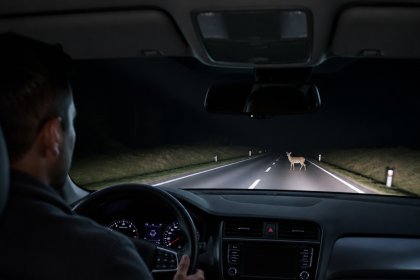
- A deer or other animal approaching from the roadside
- A stopped or slow-moving vehicle ahead
- Warm machinery, motorcycles, or roadside hazards
- Objects that are difficult to separate from the background under headlight glare
An aftermarket thermal camera does not provide a perfect representation of the road. Road signs, lane markings, potholes, cold debris, and other low-temperature objects may not stand out clearly. It is supplemental driver-assistance technology, not a replacement for headlights or direct vision.
Typical Price Ranges
The retail price of an aftermarket thermal camera varies substantially by market, seller, product design, and included equipment. Because automotive electronics change frequently, the ranges below should be treated as budgeting categories rather than fixed price quotes.
Entry-Level Systems: A Few Hundred Dollars
A lower-cost aftermarket thermal camera usually provides the basic combination of a thermal sensor, wiring, mounting components, and a small display or video output. It may suit drivers who want a general thermal view without advanced object recognition.
Common trade-offs include:
- Lower image resolution
- Less detail at longer distances
- A smaller or lower-quality display
- Limited alert functions
- Basic software
- Less refined mounting hardware
- Unclear long-term software or technical support
A budget aftermarket thermal camera can still be useful, but specifications alone do not establish how well it performs from a moving vehicle. Stable imaging, low latency, a practical field of view, and dependable operation in real road conditions matter as much as the presence of a thermal sensor.
Midrange Systems: Several Hundred to Around $1,500
A midrange aftermarket thermal camera often adds better image processing, a more usable display, stronger environmental protection, recording, or software-assisted hazard recognition. This is where many buyers begin to find systems designed specifically for driving rather than general-purpose thermal observation.
Depending on the model, this category may include:
- Pedestrian or animal recognition
- Visual or audible warnings
- Improved camera housings
- Better mounting hardware
- Dedicated in-car displays
- More consistent video output
- Broader installation support
This type of aftermarket thermal camera often makes sense for drivers who regularly travel at night, particularly on unlit highways or rural roads. Its value depends on whether the added features reduce interpretation time without creating excessive false alerts or driver distraction.
Premium Systems: Roughly $1,500 to Several Thousand Dollars
A premium aftermarket thermal camera may combine higher-quality sensors, long-range detection, advanced processing, multiple recognition categories, data recording, and more sophisticated vehicle integration. Installation can also become more complex.
The higher price may reflect:
- Greater image resolution and sensitivity
- More capable hazard-detection software
- Better performance at useful road distances
- Faster, smoother video
- Stronger weather and dust protection
- A larger or higher-quality display
- Specialized installation components
- Better support and warranty provisions
A higher-priced aftermarket thermal camera is not automatically appropriate for every vehicle or driver. Someone who drives mainly in well-lit city traffic may receive limited practical value from capabilities intended for long, dark rural routes.
What Affects the Price?
Thermal Sensor Resolution
Sensor resolution is one of the largest cost drivers for an aftermarket thermal camera. A higher-resolution thermal sensor captures more thermal data, which can make people, animals, and vehicles easier to distinguish.
When evaluating an aftermarket thermal camera, do not compare resolution in isolation. Image-processing quality, optics, display resolution, and software all influence what the driver actually sees. A high-resolution sensor paired with poor processing or an awkward display may deliver less practical value than its specification sheet suggests.
Look for sample footage that represents automotive use. Stationary demonstrations in controlled conditions do not necessarily show how the image handles road vibration, speed, changing temperatures, glare, or rapidly approaching objects.
Detection Distance Versus Recognition Distance
Manufacturers and sellers may use several distance-related terms:
- Detection: The system notices that something is present.
- Recognition: The system classifies it broadly, such as a person, animal, or vehicle.
- Identification: The viewer can determine more specific details.
These are not interchangeable. A camera might detect a heat source at a substantial distance without providing enough information to determine what it is.
Useful driving performance from an aftermarket thermal camera also depends on speed. A range that seems adequate at urban speeds may provide less decision time on a fast rural road. Examine what the stated distance represents, the conditions under which it was measured, and whether it refers to sensor detection, software classification, or clear interpretation by the driver.
AI Recognition and Real-Time Alerts
Some aftermarket thermal camera systems use software to recognize pedestrians, animals, vehicles, or obstacles and then highlight them on the display. Alerts may reduce the time needed to interpret a thermal image, particularly when the road environment contains multiple heat sources.
Recognition can increase the price of an aftermarket thermal camera because it requires more processing power, software development, and calibration. Its value depends on how well it handles real-world conditions. A useful alert system should be timely and understandable without constantly demanding attention.
Buyers should investigate:
- What types of objects the system recognizes
- Whether alerts are visual, audible, or both
- Whether warning sensitivity can be adjusted
- Whether alerts can be muted
- Whether software updates are available
- How the system handles false or repeated warnings
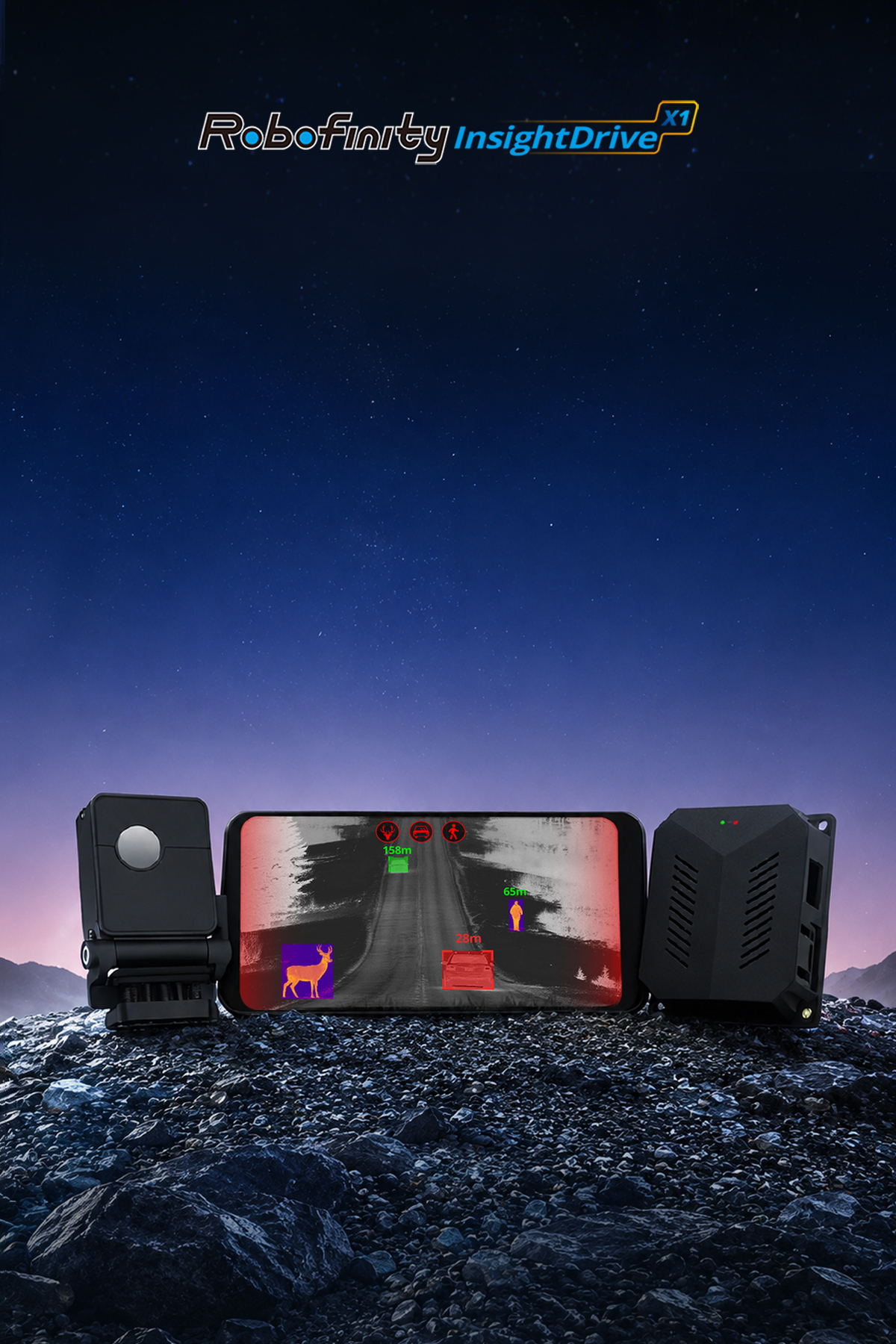
Robofinity InsightDrive is one example in this category. It combines vehicle thermal imaging with recognition of pedestrians, animals, and vehicles and provides real-time alerts. Those functions illustrate why an integrated thermal night-vision product can cost more than a basic camera feed. They remain awareness aids and should not be treated as automatic collision avoidance.
Lens and Field of View
The lens of an aftermarket thermal camera determines how much of the scene appears in the image and how large distant objects look. A wide field of view covers more roadside area but can make distant hazards appear smaller. A narrower view may show greater apparent detail ahead while providing less peripheral coverage.
Neither is universally better. Urban driving may favor broader coverage because hazards can enter from sidewalks or intersections. Rural and highway driving may place more emphasis on looking farther ahead.
Camera placement also changes the effective field of view. A poorly positioned camera can capture part of the hood, grille, or bumper, reducing the useful image and potentially affecting thermal readings.
Frame Rate and Processing Delay
The frame rate of an aftermarket thermal camera affects how smoothly moving objects appear. Processing delay, or latency, determines how closely the display matches what is happening outside the vehicle.
These factors matter because a car, pedestrian, or animal may move quickly relative to the vehicle. A low-cost system that produces a delayed or visibly choppy image can be harder to interpret. Prioritize responsive, stable video over decorative interface features.
Frame rate can also be subject to product or regional restrictions, so confirm the actual specification of the unit offered in your market rather than assuming every version is identical.
Display Quality and Placement
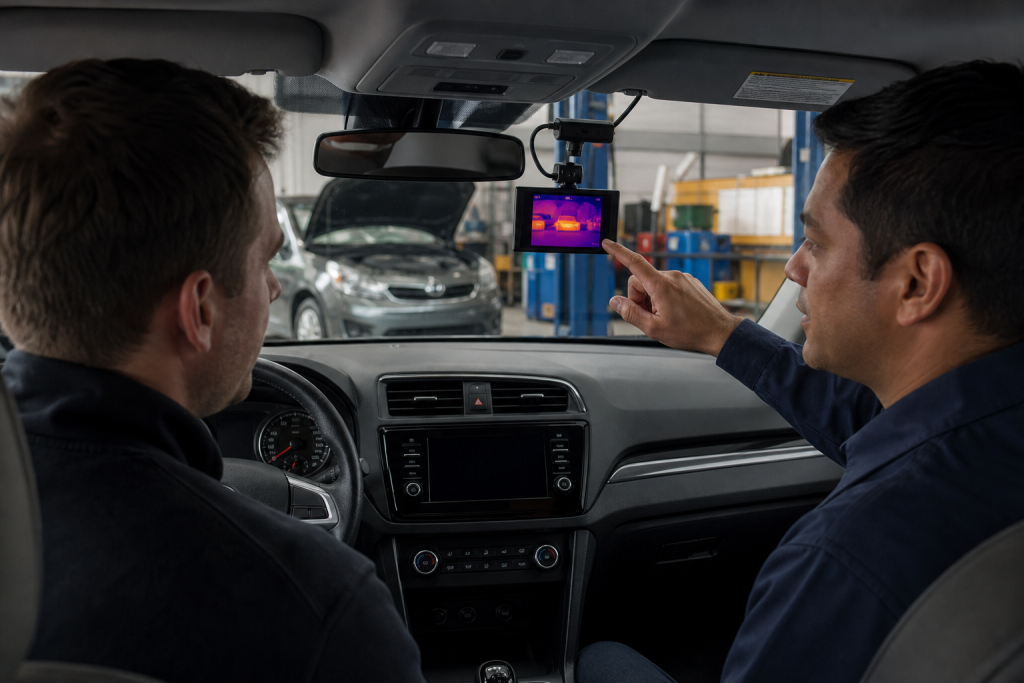
An aftermarket thermal camera package may include a dedicated dashboard display or provide a video connection for compatible hardware. A bundled screen adds to the initial price but may simplify setup.
Display considerations include:
- Screen size
- Brightness adjustment
- Glare control
- Contrast and image modes
- Mount stability
- Viewing angle
- Nighttime dimming
- Startup time
A screen that is too bright can impair night adaptation. One placed too low or too far from the driver may require longer glances away from the road. The display should support quick awareness without obstructing the windshield, instruments, airbags, or controls.
Before installation, check applicable laws and regulations concerning windshield-mounted equipment and driver-visible screens. Requirements differ by location. The National Highway Traffic Safety Administration’s nighttime driving guidance also emphasizes alertness and responsible driving practices, which remain essential when using supplemental displays.
Weatherproofing and Automotive Durability
An exterior aftermarket thermal camera must tolerate rain, road spray, dust, vibration, heat, cold, washing, and seasonal temperature changes. A robust housing and sealed connectors usually cost more than basic consumer-electronics components.
An ingress-protection rating can indicate resistance to dust and water under defined test conditions, but it should not be treated as a guarantee against every installation problem. Connector orientation, cable routing, drilling, seals, and mounting location all influence durability.
The camera also needs a clear view. Mud, snow, ice, road salt, or water droplets on the lens can reduce image usefulness even when the housing itself remains protected.
Recording and Storage
An aftermarket thermal camera with video recording can help owners review an event or document what the system displayed. Recording capability may add hardware, storage, and software costs.
Before paying extra for recording, confirm:
- Whether storage is included
- How old footage is overwritten
- Whether clips can be exported easily
- Whether timestamps are accurate
- Whether recording begins automatically
- Whether the system also records audio
- How local privacy and surveillance laws may apply
A thermal recorder should not automatically be assumed to replace a conventional dash camera. A normal dashcam may capture license plates, signal colors, road markings, and visible scene detail more effectively.
Brand Support, Warranty, and Documentation
Support can significantly affect the long-term value of an aftermarket thermal camera. Clear installation instructions, replacement parts, firmware support, responsive technical service, and a meaningful warranty may justify a higher price.
Check who is actually responsible for support. A marketplace seller, installer, importer, and manufacturer may all be different companies. Verify the return process before installation because drilled holes, cut wires, or adhesive residue can complicate returns.
Installation Costs and Vehicle Compatibility
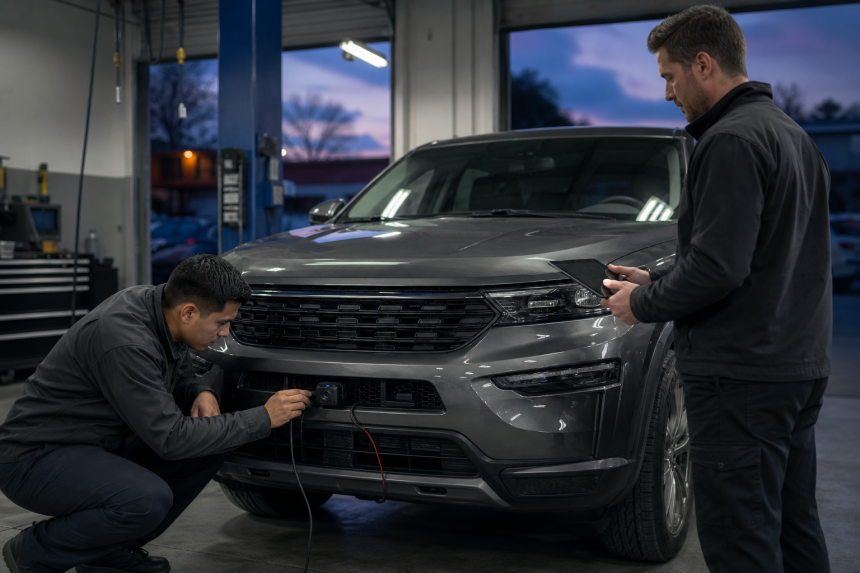
The advertised price of an aftermarket thermal camera is rarely the complete installed cost. Installation may be straightforward on one vehicle and difficult on another.
A professional installer may need to:
- Find a protected camera location with an unobstructed view
- Fabricate or modify a bracket
- Route wiring through the engine bay and firewall
- Provide a fused power connection
- Install and secure the display
- Avoid airbags, sensors, cooling components, and moving parts
- Test the image alignment
- Confirm that the system shuts down correctly
Labor rates vary by country, region, workshop, and vehicle. Premium vehicles, electric vehicles, tightly packaged engine bays, and models with complex factory electronics can require more time.
Before purchasing, ask an installer to review the camera dimensions, cable lengths, power requirements, display mount, and proposed wiring route. A cheaper product can become an expensive project if it does not fit cleanly. For a broader cost comparison, see this vehicle thermal night vision system cost guide.
Calculating the Real Ownership Cost
A practical budget for an aftermarket thermal camera should include more than the camera kit:
Total ownership cost = system price + installation + mounting or wiring extras + maintenance + possible repairs or updates
Potential extra costs include:
- Custom brackets
- Extension cables
- Fuses and power adapters
- Display mounts
- Replacement storage cards
- Lens cleaning supplies
- Firmware or app requirements
- Removal and reinstallation after vehicle repairs
- Replacement connectors or camera housings
Subscription charges are less common in basic standalone systems but may apply to products that depend on connected services or cloud features. Confirm whether core functions continue to work without a paid plan or smartphone connection.
Which Price Level Fits Your Driving?
Frequent Rural Night Driving
For dark rural roads, an aftermarket thermal camera with usable range, a well-chosen field of view, and pedestrian or animal alerts may be more valuable than the least expensive camera. Drivers in these areas often face animals, pedestrians without reflective clothing, unlit vehicles, and limited roadside lighting.
False alerts still matter. A warning system that reacts constantly to harmless heat sources can become distracting or be ignored.
City and Suburban Driving
In urban environments, an aftermarket thermal camera with a broad field of view and effective object classification may be more useful than one designed only for maximum range. Cities contain pedestrians, cyclists, parked vehicles, storefront heat, exhaust, streetlights, and many other visual or thermal sources.
The display must be positioned carefully because city driving already demands frequent checks of mirrors, signals, crossings, and surrounding traffic.
Highway and Long-Distance Travel
For highway use, an aftermarket thermal camera should provide early awareness and smooth, low-latency video. At higher speeds, available reaction time decreases rapidly. Long-distance drivers should also consider display brightness, alert fatigue, and system reliability over extended periods.
Thermal imaging may support awareness, but it does not change the vehicle’s braking capability. Speed must still match the distance illuminated by the headlights, road conditions, and the driver’s ability to stop safely.
Fog, Rain, Snow, and Glare
An aftermarket thermal camera can be useful when visible contrast is poor, but it does not see through every weather condition. Heavy rain, dense fog, falling snow, dirty lenses, and conditions in which objects are thermally similar to their surroundings can reduce performance.
The correct expectation is improved supplemental information in some poor-visibility conditions, not unrestricted vision through bad weather.
Family and Occasional Night Driving
For a household that rarely drives on unlit roads, a premium system may not be the first safety investment to prioritize. Quality tires, correctly aimed headlights, clean glass, effective wipers, brake maintenance, and disciplined driving habits deliver value on every trip.
An aftermarket thermal camera becomes more compelling when nighttime or poor-visibility exposure is frequent enough to justify the cost and the driver is willing to use the display responsibly.
How to Compare Thermal Camera Systems
A structured comparison helps buyers evaluate an aftermarket thermal camera without letting a long feature list obscure practical differences.
1. Define the Driving Problem
Start with the routes and hazards you regularly encounter. Animal detection may be especially relevant on rural roads, while broad pedestrian awareness may matter more in urban areas.
2. Compare Complete Packages
Determine whether the quoted aftermarket thermal camera price includes the camera, processor, display, brackets, wiring, storage, software, and installation. A camera-only price cannot be fairly compared with a complete kit.
3. Verify the Meaning of Performance Claims
Ask whether distance claims refer to detection, recognition, or identification. Check whether example footage shows moving vehicles and real road environments.
4. Evaluate the Interface
The image and alerts should be understandable with brief glances. Look for dimming controls, stable video, clear warning symbols, and a mount that will not obstruct the driver’s view.
5. Check Fitment Before Buying
Confirm power requirements, dimensions, cable lengths, mounting positions, and compatibility with the vehicle. Do not assume that a universal product guarantees effortless installation.
6. Assess Support and Return Terms
Read warranty exclusions and determine who provides technical help. Confirm whether opening, installing, or modifying the kit affects return eligibility.
7. Obtain an Installation Estimate
A written estimate reduces the chance that custom fabrication or difficult cable routing will turn an apparently affordable system into a costly upgrade.
Common Ways Buyers Overspend
Buyers can overspend on an aftermarket thermal camera by paying for maximum advertised range without determining whether the display and software provide meaningful recognition at that distance. Another mistake is selecting the highest-resolution sensor while overlooking latency, lens choice, or screen placement.
Buyers may also overspend by duplicating equipment. If the vehicle already has an appropriate display input or recording solution, a bundled screen or recorder may be unnecessary. Conversely, assembling unrelated components to save money can create compatibility and support problems.
Avoid choosing solely by the number of detection categories advertised. Software features have value only when alerts are reliable, timely, and manageable in the intended environment.
Safety Limits Every Owner Should Understand
An aftermarket thermal camera expands the information available to a driver, but it does not control the vehicle. It cannot guarantee that a hazard will be detected, classified correctly, shown early enough, or noticed by the driver.
Continue to rely on:
- Properly maintained and correctly used headlights
- Clean windows, mirrors, cameras, and lamps
- Appropriate speed for visibility and road conditions
- Adequate following and braking distance
- Direct observation and mirror checks
- Compliance with traffic laws
- Full attention to the road
Do not stare at the thermal display or drive faster because an additional camera is active. A system that encourages overconfidence can undermine the safety benefit it was intended to provide.
Frequently Asked Questions
Can a thermal camera see through fog?
It may provide useful thermal contrast in some foggy or low-visibility conditions, but performance varies with fog density, moisture, temperature, range, and the camera itself. It should not be described as seeing clearly through all fog.
Is professional installation necessary?
Not always, but it is often advisable. Professional installation is particularly valuable when wiring must pass through the firewall, a custom exterior mount is required, or the vehicle has complex electronics and safety systems.
Can I connect a thermal camera to my factory screen?
Possibly, but compatibility depends on the vehicle and camera output. Some factory displays require an interface module or do not accept external video at all. Confirm compatibility before purchasing.
Is thermal night vision better than a dashcam?
They serve different purposes. Thermal night vision emphasizes heat contrast and nighttime hazard awareness. A conventional dashcam generally records visible details such as road markings, signs, vehicle colors, and sometimes license plates. One does not necessarily replace the other.
Does a more expensive thermal camera always detect farther?
No. Price may reflect resolution, software, display quality, durability, support, or included accessories rather than range alone. Detection claims must also be separated from recognition and identification performance.
Does an aftermarket thermal camera affect the vehicle warranty?
The camera itself does not automatically determine warranty consequences, but installation methods can matter. Poor wiring or modifications that damage vehicle systems may create warranty disputes. Use a qualified installer and retain installation documentation.
Conclusion
The cost of an aftermarket thermal camera depends on much more than the infrared sensor. Image quality, detection software, frame rate, field of view, display design, weather resistance, installation complexity, and after-sales support all contribute to the final price.
Begin with your real driving conditions, then compare complete installed costs rather than headline prices. Frequent rural and nighttime drivers may benefit from paying more for useful recognition and alerts, while occasional users may be well served by a simpler system. In every case, verify fitment, examine realistic footage, understand the difference between detection and recognition, and budget for installation.
An aftermarket thermal camera can be a practical road-awareness upgrade when its limitations are understood. It should complement sound nighttime driving habits, proper vehicle maintenance, and attentive observation, never replace them.