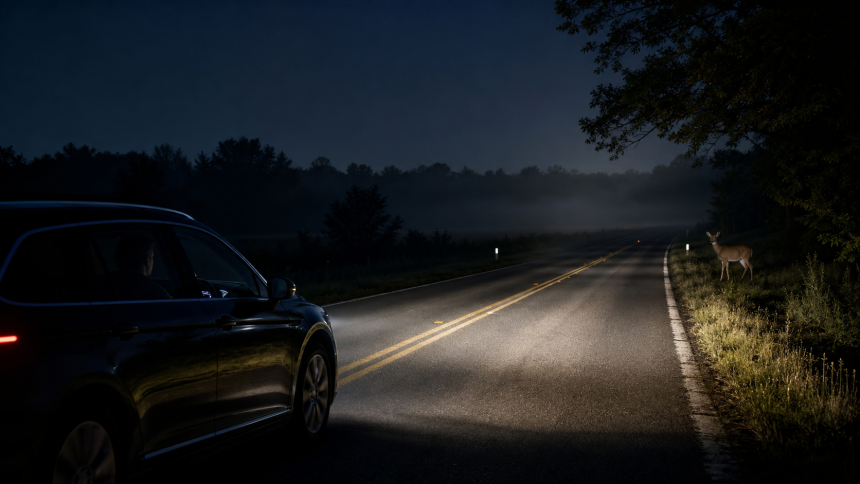
Detect Animals at Night on rural roads by scanning the shoulders, recognizing subtle motion and roadside clues, using headlights correctly, and matching speed to the distance you can actually stop within. This guide walks through practical habits and technology options so you can reduce the risk of collisions after dark.
- Why Animals Are Difficult to See at Night
- Scan Beyond the Center of the Road
- Treat One Animal as a Warning of More
- Match Speed to the Distance You Can See
- Use Headlights Correctly
- Read the Landscape for Animal Risk
- What to Do When You See an Animal
- 1. Lift Off the Accelerator
- 2. Check Mirrors
- 3. Brake Firmly in a Straight Line
- 4. Use the Horn When Appropriate
- 5. Avoid Reflexive Swerving
- 6. Continue Watching After the Animal Moves
- Common Mistakes That Reduce Detection
- Driving at the Posted Limit Regardless of Visibility
- Looking Only for Eyeshine
- Overdriving the Headlights
- Accelerating Immediately After One Animal Crosses
- Staring at Oncoming Headlights
- Treating Driver Assistance as Automatic Protection
- How Thermal Imaging Can Support Animal Detection
- Evaluating an Aftermarket Detection System
- Why Animals Are Difficult to See at Night
- Scan Beyond the Center of the Road
- Treat One Animal as a Warning of More
- Match Speed to the Distance You Can See
- Use Headlights Correctly
- Read the Landscape for Animal Risk
- What to Do When You See an Animal
- Common Mistakes That Reduce Detection
- How Thermal Imaging Can Support Animal Detection
- Evaluating an Aftermarket Detection System
- Prepare the Vehicle Before a Rural Night Trip
- A Practical Strategy for Different Rural Scenarios
- What to Do After an Animal Collision
- Frequently Asked Questions
- Conclusion
Why Animals Are Difficult to See at Night
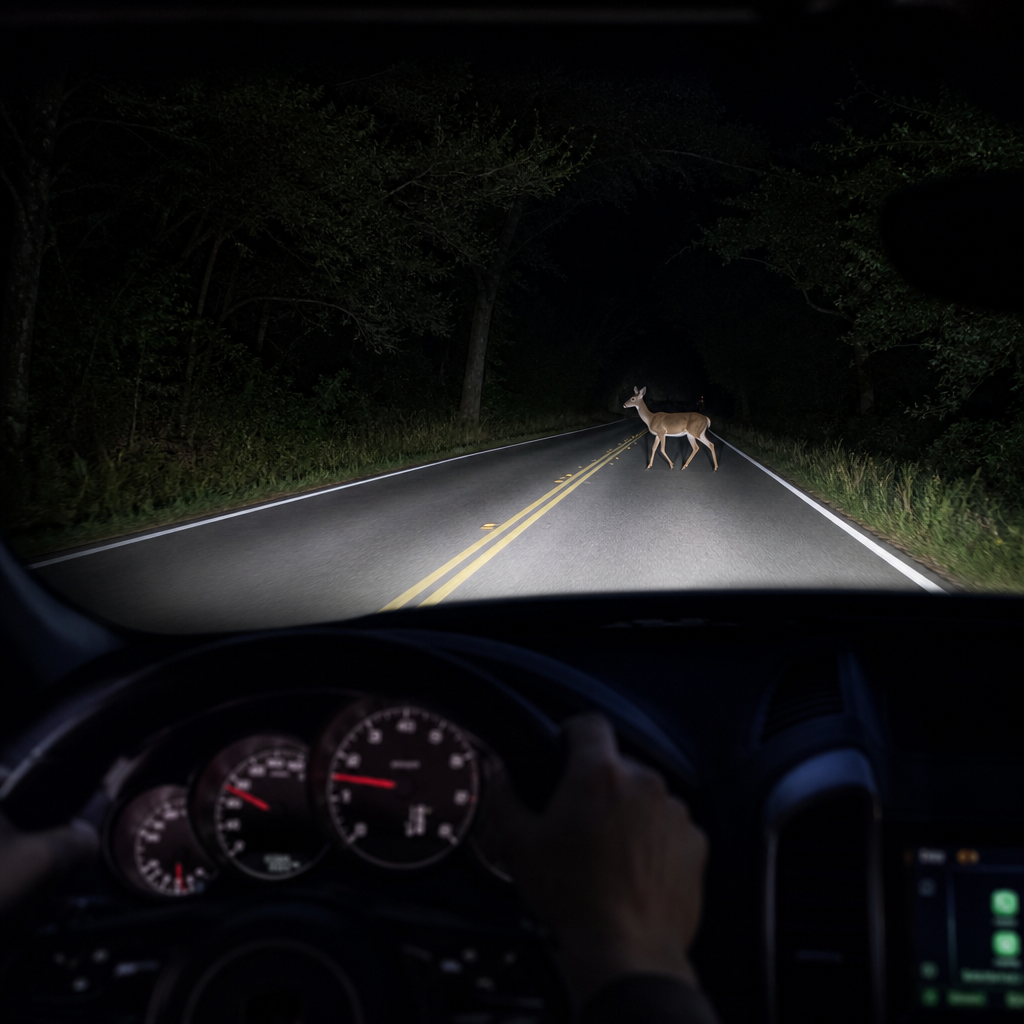
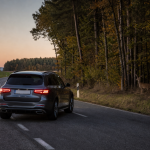
Animals rarely enter the road in a predictable way. They may emerge from woodland, fields, drainage ditches, hedges, or gaps between parked vehicles. Their coloring often blends into the background, and conventional headlights illuminate only part of the scene ahead.
Several factors make nighttime animal detection especially difficult:
- Limited contrast: Dark fur can merge with vegetation, shadows, or unlit pavement.
- Restricted headlight coverage: Low beams prioritize the road ahead without fully illuminating the shoulders.
- Sudden movement: An animal may remain hidden until it is close to the lane.
- Unpredictable behavior: It may stop, reverse direction, or follow another animal.
- Road geometry: Curves, crests, dips, and roadside vegetation shorten the visible approach.
- Weather and glare: Rain, fog, snow, dirty glass, and oncoming headlights can reduce driving visibility.
- Driver fatigue: Tired eyes scan less effectively and react more slowly.
An animal does not have to be large to create a serious hazard. Swerving to avoid a smaller animal can lead to a loss of control, while a collision with a larger animal can cause significant vehicle damage and injury. The objective is therefore not merely to spot wildlife, but to detect it early enough to slow down in a controlled manner.
Scan Beyond the Center of the Road
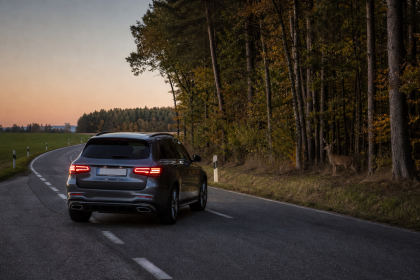
Many drivers concentrate almost entirely on the lane markings and the taillights ahead. On rural roads, that focus is too narrow. The earliest warning often appears at the edge of the headlight beam rather than directly in the road.
Adopt a repeating scan pattern:
- Look well ahead along your lane.
- Check the left roadside, including hedges, verges, ditches, and field entrances.
- Move your attention across the road surface.
- Check the right roadside.
- Return your gaze to the distance ahead.
- Briefly check mirrors and instruments without lingering.
Keep your eyes moving rather than staring at one point. Peripheral vision is useful for noticing motion, while direct vision helps identify what moved. If you see a flash, shape, or shadow near the shoulder, look toward it without steering toward it.
Look for Partial Clues
You may not see an entire animal at first. Watch for smaller indicators such as:
- Two reflective points near the road edge
- A shape that interrupts a fence line or hedge
- Legs visible beneath roadside vegetation
- A dark mass moving against a lighter field
- A shadow traveling in a different direction from your vehicle
- Grass, branches, or crops moving without an obvious wind pattern
- An animal already standing on the opposite shoulder
Eye reflection can help, but it is not a dependable detection method. Detecting animals at night depends on position and headlight angle—eyeshine may appear only briefly. Some animals may be visible only as a warm-looking silhouette, an irregular outline, or short bursts of movement.
Treat One Animal as a Warning of More
One of the most useful rural-driving rules is simple: where there is one animal, there may be others.
Some wildlife moves in groups, while young animals may follow an adult. An animal that has crossed successfully can also be followed by another moments later. Livestock may enter through the same damaged fence or open gate.
After one animal crosses:
- Reduce speed and remain prepared to stop.
- Check both shoulders, not only the side from which it appeared.
- Do not accelerate immediately after it clears your lane.
- Watch for young or smaller animals that may be harder to see.
- Expect the first animal to turn back unexpectedly.
This applies even if the road appears clear after the initial crossing. The second hazard may still be outside your headlight beam.
Match Speed to the Distance You Can See
Safe nighttime speed is not determined solely by the posted limit. It also depends on how far ahead you can see and whether you can stop within that visible distance. If you want to detect animals at night early enough, your speed must preserve decision time and braking space.
Your usable stopping space includes:
- The distance traveled while noticing the animal
- The distance traveled while deciding to brake
- The vehicle’s actual braking distance
- An additional margin for wet pavement, loose gravel, downhill grades, worn tires, or an animal changing direction
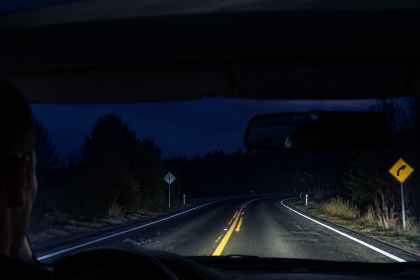
If the road disappears into darkness beyond your low beams, driving faster does not make that unseen area safe. It only reduces the time available when a hazard enters the illuminated zone.
Slow earlier when approaching:
- Wooded sections and tree lines
- Fields next to the roadway
- Rivers, streams, ponds, and drainage areas
- Warning signs for wildlife or livestock
- Blind bends and hill crests
- Open gates, damaged fences, or cattle grids
- Harvested fields and roadside crop areas
- Locations where you have previously seen animals
- Dawn and dusk, when some species may be more active
A speed that feels comfortable on a straight, dry road may be inappropriate once vegetation closes in or visibility shortens around a bend.
Create a Rural Night-Driving Buffer
Increase the following distance behind another vehicle. More space gives you a wider view around it and more time if the driver ahead brakes for an animal.
Avoid following so closely that the other vehicle’s lights become your primary source of information. The driver ahead may see the hazard late, react abruptly, or swerve. Your own scanning and stopping margin still matter.
Use Headlights Correctly
High beams can reveal roadside movement earlier than low beams, but they must be used responsibly. Use them on dark roads when traffic conditions and local rules permit, then dip them promptly for oncoming traffic and when following another vehicle.
Do not assume that bright light solves every visibility problem. Bright light can reflect from fog, rain, snow, roadside signs, or airborne moisture and make it harder to see. In those conditions, low beams may produce less backscatter. For more on planning night visibility choices, see Night Driving Assistance Systems Explained: Types, Benefits, and Limitations.
Maintain the Entire Visibility System
Nighttime road safety depends on more than the bulbs themselves. Check:
- Headlight lenses for clouding, dirt, snow, or ice
- Correct headlight aim
- Operation of low beams, high beams, and fog lights where fitted
- Windshield cleanliness inside and outside
- Wiper condition and washer-fluid supply
- Mirrors for dirt and excessive glare
- Eyeglasses for smears or scratches
- Dashboard brightness, which should not overpower your view outside
Misaligned headlights may illuminate too little road or create glare for other drivers. If the light pattern appears unusually low, high, or uneven, have the alignment inspected rather than trying to compensate with brighter bulbs.
Read the Landscape for Animal Risk
Rural roads provide environmental clues before an animal becomes visible. Learning to read those clues improves road awareness and makes it easier to detect animals at night before they reach the lane.
Wooded Edges and Hedgerows
Dense vegetation can conceal wildlife until it reaches the pavement. Reduce speed where trees or hedges stand close to the lane, especially on narrow roads without a clear shoulder.
Fields and Farm Access
Livestock can escape through open gates, damaged fencing, or poorly secured access points. Farm roads may also be used to move animals between fields. Mud, manure, hoof marks, or a stopped farm vehicle can indicate activity nearby.
Water and Drainage Areas
Streams, ponds, culverts, and drainage ditches can attract wildlife. Guardrails and bridge approaches may restrict an animal’s escape path, causing it to remain on the roadway.
Roadside Warning Signs
A wildlife warning sign identifies an area where animal crossings are known to occur or are considered a meaningful risk. It does not mean animals appear only within a short distance of the sign. Treat it as a prompt to widen your scan and reassess your speed for the broader area.
What to Do When You See an Animal
Early detection matters only if the response is controlled. The correct action depends on traffic, road conditions, vehicle stability, and the animal’s movement, but the following sequence provides a practical foundation.
1. Lift Off the Accelerator
Reduce speed immediately and smoothly. This transfers less weight abruptly than panic braking and gives you time to assess the situation.
2. Check Mirrors
Know whether another vehicle is close behind. This does not mean avoiding necessary braking; it helps you understand the surrounding risk and respond more deliberately.
3. Brake Firmly in a Straight Line
If a collision appears possible, use strong, controlled braking while keeping the vehicle stable and pointed along the road. Modern anti-lock braking systems generally allow you to maintain steering control during hard braking, but available grip still depends on the surface and tires.
4. Use the Horn When Appropriate
A horn may alert an animal, but its reaction is unpredictable. It could move away, freeze, or reverse direction. Do not rely on sound as a substitute for slowing down.
5. Avoid Reflexive Swerving
A sudden swerve can put the vehicle into oncoming traffic, a ditch, a tree, a barrier, or a rollover situation. It can also produce a more severe outcome than the original hazard.
There is no universal maneuver for every encounter. The safest response depends on speed, road width, traffic, vehicle type, surface grip, and available escape space. In general, reducing speed while maintaining control is more predictable than making a violent steering input.
6. Continue Watching After the Animal Moves
Do not fixate on the animal to the exclusion of the road. Track its direction while also checking for other animals, oncoming traffic, and the path your vehicle must follow.
Common Mistakes That Reduce Detection
Driving at the Posted Limit Regardless of Visibility
A speed limit is not a promise that every hazard will be visible in time. Darkness, rain, curves, and vegetation may require a lower speed.
Looking Only for Eyeshine
Eye reflection is useful when visible, but relying on it can cause you to miss animals looking away or standing outside the strongest part of the beam.
Overdriving the Headlights
If the distance needed to stop is greater than the clear distance illuminated ahead, a hazard can appear too late for controlled braking.
Accelerating Immediately After One Animal Crosses
Additional animals may follow, and the first one may return to the road.
Staring at Oncoming Headlights
Look toward the right-hand road edge in right-driving countries, or the left-hand edge in left-driving countries, while maintaining lane position. Avoid looking directly into high beams. Once the vehicle passes, allow your vision a moment to readjust.
Treating Driver Assistance as Automatic Protection
Detection systems can miss hazards, produce alerts too late for the situation, or be affected by installation, calibration, environmental conditions, and system limitations. An alert is additional information, not permission to drive faster.
How Thermal Imaging Can Support Animal Detection
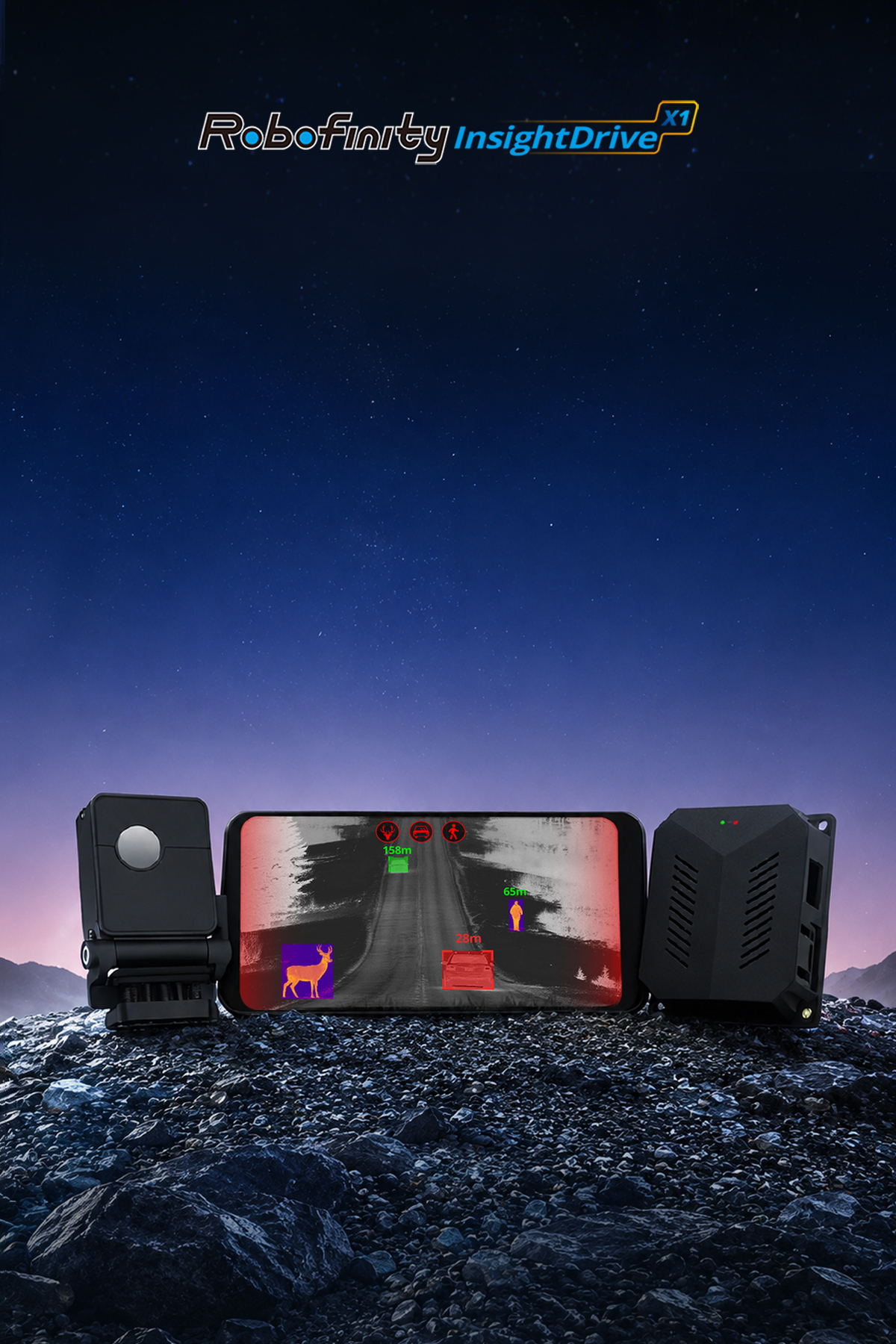
Conventional cameras and headlights depend on visible light. A vehicle thermal imaging system detects heat patterns, which can help distinguish warm-bodied animals and pedestrians from a cooler background in low-light conditions. When your goal is to detect animals at night, thermal can provide additional cues—especially on unlit rural roads.
This can be particularly relevant when an animal is outside the main headlight beam or visually blends into vegetation. Depending on its design, a thermal night vision system may display the scene on a screen, use software to identify certain road users or hazards, and issue real-time alerts.
Robofinity InsightDrive is one example of a vehicle thermal imaging night vision system designed to support awareness in low-light and poor-visibility driving. Its AI-powered thermal imaging includes animal recognition and real-time alerts, giving the driver another source of information when scanning dark roads.
Thermal technology still has important boundaries. Detection does not guarantee correct identification, an immediate driver response, or enough stopping distance. The display can also become a distraction if it is positioned poorly or checked for too long. Such equipment should supplement headlights, mirrors, sensible speed, and active observation rather than replace them.
Thermal Imaging Compared With Visible-Light Night Vision
These technologies address darkness in different ways.
Visible-light systems use available light or infrared illumination to create an image resembling a conventional camera view. They can show road markings, signs, and environmental detail, but performance may depend heavily on lighting and weather.
Thermal systems emphasize heat differences. They can make a warm animal more noticeable against cooler surroundings, but they may provide less familiar visual detail and cannot show every road feature as clearly as a visible-light camera.
Neither approach makes the roadway hazard-free. The more useful option depends on the driving environment, installation quality, display placement, detection features, and how well the driver can interpret information without losing attention.
Evaluating an Aftermarket Detection System
A night-vision or hazard-detection product should be assessed as driver-assistance technology, not as a substitute for careful driving. Consider the complete ownership experience.
Detection and Recognition
Find out what the system is designed to identify. Animal, pedestrian, and vehicle recognition are different functions. A device that produces a thermal image does not necessarily classify hazards or provide alerts.
Display Position
The display should be visible with a short glance without obstructing the windshield, controls, or legally required field of view. Mounting rules may vary by location, so installation should account for applicable regulations.
Alert Design
Warnings should be clear without becoming disruptive. Frequent unnecessary alerts may encourage a driver to ignore the system, while unclear alerts can increase distraction.
Camera Placement
The camera needs an unobstructed view and a mounting location suited to road spray, dirt, vibration, and weather exposure. Poor positioning can reduce useful coverage.
Installation and Calibration
Incorrect wiring, alignment, or calibration may undermine performance. Professional installation may be appropriate when the system interfaces with the vehicle’s electrical equipment or requires precise camera positioning.
Realistic Use Case
Consider where you actually drive. A driver who regularly travels on unlit rural roads may receive more practical value than someone whose nighttime driving occurs almost entirely on brightly lit urban streets.