
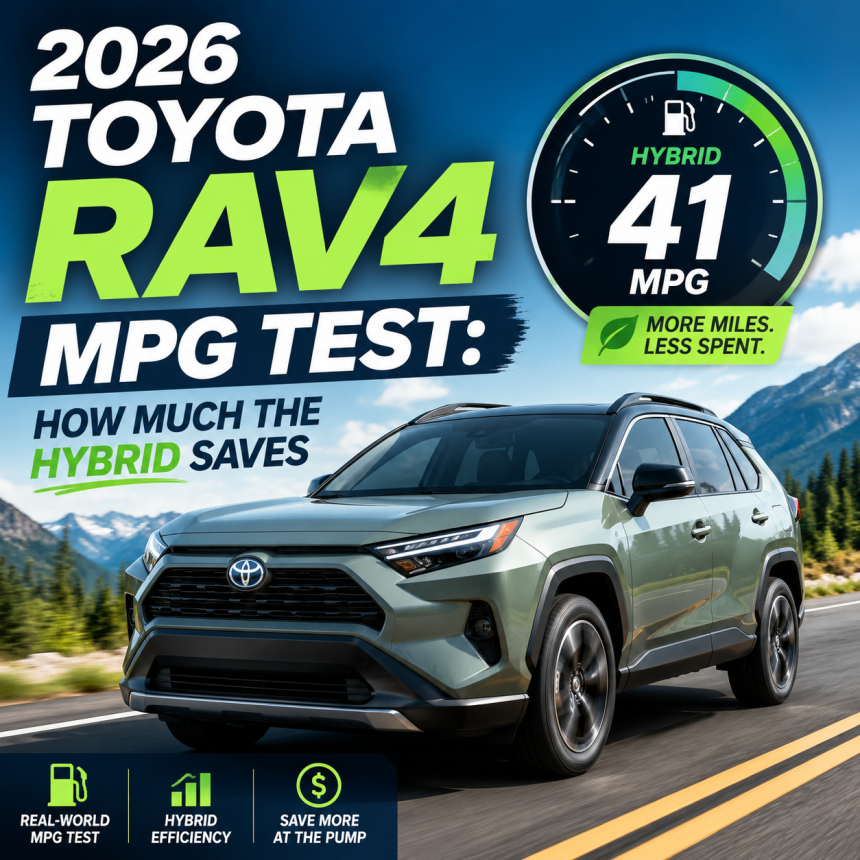
If you’re shopping for a 2026 compact SUV, real-world fuel economy matters as much as EPA estimates—especially when the RAV4 is available in hybrid form. In this 2026 Toyota RAV4 MPG Test, we break down how the hybrid performs in everyday city, highway, and mixed driving, and whether it truly saves enough fuel to justify the premium.
Table of Contents
Why Real-World Fuel Economy Matters
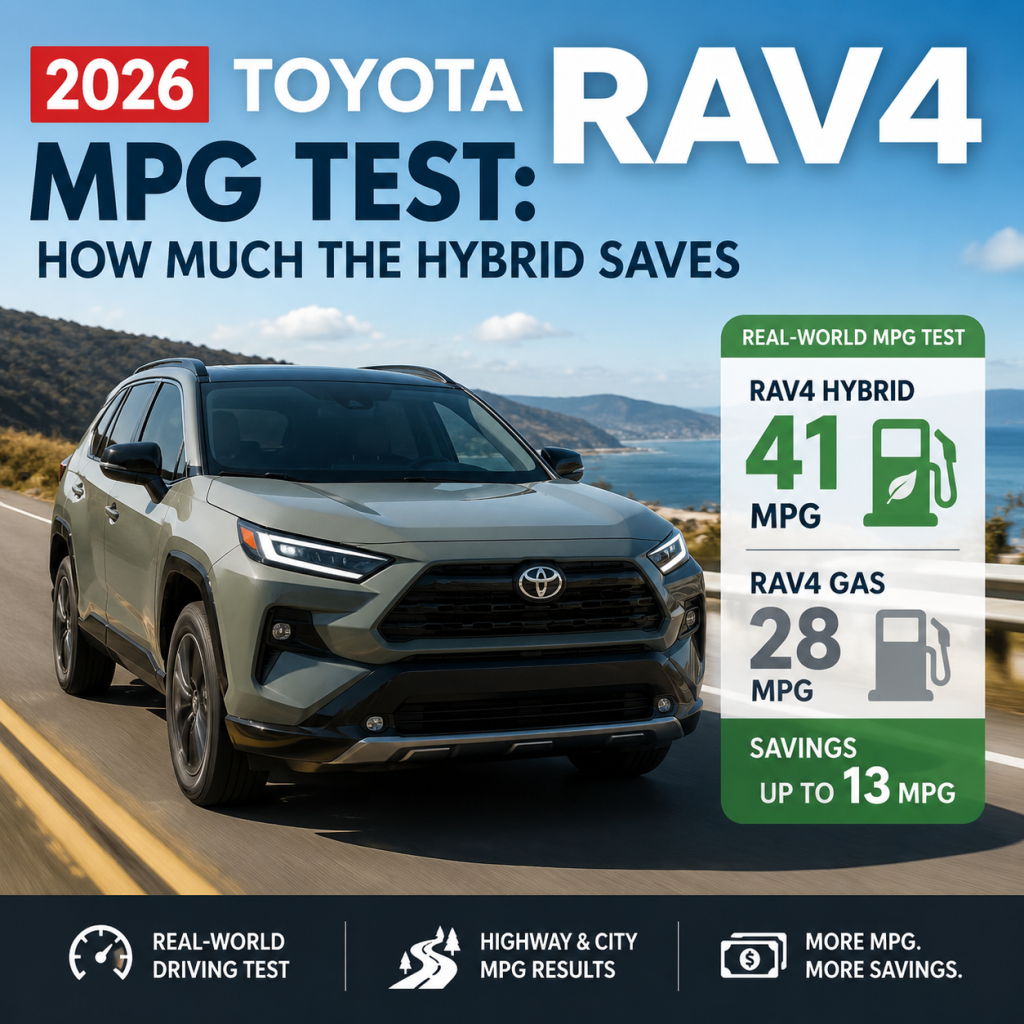
EPA ratings provide a standardized comparison, but they don’t always reflect how people actually drive. Real-world MPG changes based on traffic conditions, climate, terrain, cargo, driving style, and even how often the engine is warming up.
For a compact SUV like the RAV4, this matters a lot. Many buyers use it as a daily commuter, family hauler, or weekend road trip vehicle, which means a mix of city starts and stops, highway cruising, and occasional loaded-down driving. A model that looks efficient on paper may be less impressive once it faces the realities of everyday use.
The hybrid version is designed to reduce fuel consumption in stop-and-go traffic and improve overall efficiency without asking the driver to change habits. The key question is whether that advantage remains significant once the novelty of the technology fades into normal ownership. According to the U.S. Department of Energy’s FuelEconomy.gov resource, results can vary widely depending on driving patterns and conditions.
That’s why this 2026 Toyota RAV4 MPG Test focuses on how the vehicle behaves in ordinary use, not just on paper claims. For most shoppers, the practical question is simple: will the hybrid save enough fuel to justify the extra cost over time? In many households, the answer depends less on one perfect tank and more on the average over months of commuting, errands, school runs, and weekend travel.
It’s also worth remembering that fuel economy is only one part of ownership. Two SUVs can post similar numbers in a brochure and still feel very different in the real world. Cabin comfort, traffic patterns, local gas prices, and how often you carry passengers can all influence whether a hybrid’s efficiency edge feels small or substantial. That broader picture is what makes the 2026 Toyota RAV4 MPG Test useful for buyers weighing everyday costs rather than showroom specs.
What the 2026 RAV4 Hybrid Is Expected to Deliver
Toyota’s hybrid system has a strong reputation for balancing performance and efficiency. In the 2026 RAV4, the hybrid is expected to continue that formula with a gasoline engine paired with electric motors and a battery that helps recover energy during braking and provide assistance during low-speed driving.
This setup is especially useful in urban and suburban environments, where frequent braking and acceleration create repeated opportunities for electric assistance. On the highway, the advantage usually becomes smaller, though it can still be meaningful because the gasoline engine does most of the work at steady speeds.
Depending on trim and drivetrain, the hybrid should remain more efficient than the conventional gas model. The question is not whether it saves fuel at all, but how much of that savings survives during day-to-day use. For shoppers comparing Toyota RAV4 MPG Test results to ownership costs, that difference often determines which version feels like the better buy.
In practical terms, hybrid design helps smooth out fuel consumption where traditional gasoline SUVs are least efficient. Stoplights, traffic jams, parking lots, school pickup lines, and neighborhood driving create repeated opportunities for the electric system to assist or temporarily take over. That’s why this 2026 Toyota RAV4 MPG Test tends to look strongest in city-focused scenarios, where regenerative braking and low-speed electric support can make the biggest difference.
It’s also important to understand that hybrid efficiency doesn’t mean identical results for every configuration. Tire size, drivetrain details, and equipment level can all nudge MPG up or down. Still, the core takeaway stays the same: the hybrid is built to stretch a gallon farther than the gas-only version, and that advantage shows up most clearly when a driver’s routine includes plenty of short trips and repeated stops.
Real-World MPG: What Drivers Can Typically Expect
City Driving
City driving is where the hybrid earns its keep. In traffic, the RAV4 hybrid can shut off the engine more often, use electric power at low speeds, and recapture energy when slowing down. That’s the scenario a 2026 Toyota RAV4 MPG Test typically reflects best because it mirrors how many owners spend most of their weekdays.
In real-world conditions, drivers may see city MPG close to, or sometimes even above, the official estimates—especially when routes include lots of stoplights and gentle driving. For commuters who spend significant time in congestion, this can make a noticeable difference at the pump.
A gas-only RAV4 tends to lose more efficiency in the same environment because its engine must work harder during frequent stops and restarts. Even with modern engine management, it can’t match the hybrid’s ability to reclaim energy and reduce fuel use during idle-heavy driving patterns.
For example, a driver who spends an hour each day navigating suburban congestion may never see the mileage numbers a highway-focused test suggests. In that setting, the 2026 Toyota RAV4 MPG Test is more useful than a spec sheet because it better matches real traffic behavior. The hybrid’s advantage may show up not in one dramatic fill-up, but in the way the fuel gauge moves more slowly week after week.
City driving also rewards smooth inputs. Smooth throttle use, early braking, and avoiding unnecessary idling help the RAV4 hybrid stay within its most efficient operating range. The vehicle’s systems are designed to make efficient driving easier, but the driver still influences outcomes—so a 2026 Toyota RAV4 MPG Test is best interpreted as a “typical” result, not a guaranteed single number.
Highway Driving
Highway MPG is usually less dramatic for hybrids because there are fewer braking events and less opportunity to use electric assistance. Still, the RAV4 hybrid can remain competitive thanks to efficient engine design and powertrain tuning, which often shows up in a 2026 Toyota RAV4 MPG Test once speeds stabilize.
On real-world highway routes, the hybrid’s advantage may shrink compared to city use, but it rarely disappears. Long road trips at steady speeds can still benefit from the hybrid’s system efficiency, though the fuel savings aren’t usually as eye-catching as they are in town.
The gas model can perform well on the highway too, which is why some shoppers wonder if the hybrid premium pays off. In many cases, the answer comes down to how much of your driving happens outside the city—exactly the kind of split a 2026 Toyota RAV4 MPG Test is built to help you evaluate.
Highway use also introduces variables. Crosswinds, roof cargo, heavier passenger loads, and sustained higher speeds can lower mileage in any SUV. That’s why a 2026 Toyota RAV4 MPG Test is best read as a range of outcomes rather than a single guaranteed promise. If your weekends include long interstate stretches, the hybrid should still help, but savings may feel smaller than during stop-and-go commuting.
Even so, highway efficiency matters. Many owners mix long drives with local errands, so the hybrid still has opportunities to reduce fuel consumption throughout the week. The real question is whether the overall average comes out high enough to make ownership feel noticeably cheaper and easier to live with—an outcome this 2026 Toyota RAV4 MPG Test aims to clarify.
Mixed Driving
Mixed driving is often where the hybrid proves its value most clearly. In a combination of suburban streets, traffic lights, and stretches of highway, the system can use both engine and electric power effectively, and that balance is a big reason the 2026 Toyota RAV4 MPG Test often lands closer to “what most people actually do.”
This mix tends to produce real-world MPG numbers that are meaningfully better than the gas version without requiring the driver to make special efforts. For the average household, mixed driving is the most realistic lens for ownership value, and it’s frequently where fuel savings become obvious over time.
Mixed commuting also makes the 2026 Toyota RAV4 MPG Test a practical daily-driver comparison. Very few owners drive in one pure environment. Most people start the day in neighborhood traffic, merge onto faster roads, idle briefly at school drop-off, and finish with local errands. In that routine, the hybrid’s energy recovery and engine shutoff behavior can help in many small ways that add up across the month.
If your commute blends suburban and highway travel, the hybrid’s real-world performance may look less dramatic than a city-only test, but it can still be enough to save meaningful money each year. The value often becomes clearer once you stop thinking about a single trip and start thinking about total annual fuel use—exactly what a 2026 Toyota RAV4 MPG Test helps you estimate.
How Much Fuel Does the Hybrid Actually Save?
Fuel savings depend on how many miles you drive and the type of routes you take. A difference of several MPG may not seem huge at first, but over thousands of miles it adds up fast—one of the core goals of the 2026 Toyota RAV4 MPG Test: turning “better MPG” into understandable real-world savings.
To illustrate, if a gas RAV4 averages in the mid- to high-20s in everyday use and the hybrid averages in the low- to mid-30s, that gap can translate into dozens of gallons saved per year. For drivers with long commutes or frequent city errands, the savings can be even greater. That’s why this 2026 Toyota RAV4 MPG Test is especially useful when comparing the hybrid against the gas model in ownership math.
Annual mileage also changes the equation. A driver covering about 8,000 miles per year benefits, but total dollar savings may feel modest. A driver covering 15,000 to 20,000 miles per year, however, can see fuel savings become much more noticeable. In general, the more you drive, the more each extra mile per gallon matters.
Gas prices also affect payback. When fuel is cheap, the hybrid’s payback period tends to lengthen. When prices rise, the hybrid becomes more appealing because avoided gallons have a bigger financial impact. This is one reason the 2026 Toyota RAV4 MPG Test stays relevant even as gas prices fluctuate month to month.
A Simple Ownership Example
Imagine two drivers each travel 12,000 miles per year:
- One drives a gas RAV4 averaging 28 MPG
- The other drives a RAV4 hybrid averaging 36 MPG
The gas model would use about 429 gallons per year, while the hybrid would use about 333 gallons. That’s roughly 96 gallons saved annually.
At average fuel prices, that can mean several hundred dollars in yearly savings. Over five years, the hybrid could offset a substantial portion of its higher purchase price—especially if gas prices rise. For buyers cross-shopping efficiency-focused models, this is similar to the budgeting logic behind fuel-efficient SUVs in 2026.
A second way to look at it is routine convenience. If you fill up every two weeks in the gas model but every three weeks in the hybrid, the convenience value can matter nearly as much as the cash savings. Fewer fuel stops also means less time at the pump, a small but real ownership benefit many drivers appreciate over the life of the vehicle.
In other words, the hybrid’s advantage isn’t only about money. The 2026 Toyota RAV4 MPG Test points to a change in ownership rhythm: drivers with lots of errands, school runs, and commuting may find they spend less time thinking about fuel because the vehicle uses it more slowly.
Factors That Affect Real-World MPG
Driving Style
Aggressive acceleration and hard braking reduce efficiency in any vehicle, including hybrids. Smooth driving helps the RAV4 hybrid get the most from electric assist and regenerative braking—one reason real results in a 2026 Toyota RAV4 MPG Test can vary between drivers.
Anticipating traffic lights and easing into speed are simple habits that can improve mileage without making the drive feel slow or unnatural. In the 2026 Toyota RAV4 MPG Test context, small behavior changes matter because the hybrid is most efficient when it can transition gently between power sources. Harsh throttle inputs force the gasoline engine to do more work, shrinking the gap versus the gas model.
Weather and Climate
Cold weather can reduce MPG because engines take longer to warm up and batteries are less efficient in low temperatures. Air conditioning in summer can also trim mileage slightly.
That’s normal, but it matters more when owners expect best-case hybrid ratings all year long. A real-world test should reflect winter mornings, hot afternoons, and the energy required to keep the cabin comfortable. The 2026 Toyota RAV4 MPG Test is therefore most useful when read as an average across seasons, not a snapshot from one ideal day.
Terrain and Load
Mountain roads, towing, roof racks, and heavy cargo can all increase fuel consumption. A loaded SUV rarely matches its best-case MPG numbers.
Families using the RAV4 for vacations, sports equipment, or weekend projects should expect some variation from the advertised figures. Even a well-designed hybrid must work harder when carrying more weight or climbing steep grades. If your driving includes frequent hills or a packed cargo area, this 2026 Toyota RAV4 MPG Test will likely show lower mileage than a lightly loaded commuter run.
Tire Pressure and Maintenance
Proper tire inflation and routine maintenance matter more than many drivers realize. Low tire pressure and neglected service can slowly erode efficiency over time—and that can change the outcome of any 2026 Toyota RAV4 MPG Test you try to compare to published figures.
It also helps to connect fuel economy expectations with broader ownership planning. If you’re balancing fuel costs with long-term durability, it can be useful to review used car reliability and trouble-free brands before deciding whether the hybrid premium fits your household.
Regular maintenance is especially important for keeping the 2026 Toyota RAV4 MPG Test results closer to what you expect over the long run. Clean filters, healthy tires, and timely service all support efficiency. Even small issues like underinflated tires can chip away at the fuel savings the hybrid is designed to deliver.
Is the Hybrid Worth the Extra Cost?
For many buyers, the decision comes down to usage. If you drive mostly in the city or have a long daily commute, the RAV4 hybrid is often the smarter choice because it tends to save more fuel and reduce trips to the gas station—results that a 2026 Toyota RAV4 MPG Test usually supports.
If your driving is mostly short local trips with frequent traffic, the hybrid can be especially rewarding. It can also feel better at low speeds due to quieter operation, and it pairs that efficiency with confidence in long-term Toyota hybrid reliability.
However, if your miles are mostly highway and you don’t put many miles on each year, the gas model may make more financial sense. In that scenario, fuel savings alone may take longer to justify the higher upfront price. If monthly budget is your main concern, this is a helpful complement to car affordability on a $60,000 salary, which shows how purchase price affects long-term decisions.
There’s also a comfort and lifestyle factor that doesn’t always show up in MPG discussions. Some drivers prefer the smoothness of hybrid operation, especially in parking lots and low-speed traffic. Others prioritize simpler ownership costs and may prefer the gas model’s lower entry price. The 2026 Toyota RAV4 MPG Test helps clarify which tradeoff matters most for your routine.
If you typically keep vehicles for many years, small MPG improvements can have a bigger cumulative effect than they seem at first glance. A modest per-gallon advantage can become significant over 60,000 or 100,000 miles. On the other hand, if you trade vehicles frequently or drive very little, the hybrid payback can feel less compelling. That’s why the 2026 Toyota RAV4 MPG Test is most valuable when you match the test assumptions to your real driving.
Another way to frame the decision is total cost of ownership rather than fuel economy alone. Insurance, depreciation, maintenance, and financing all matter. Still, because fuel is a recurring expense, the 2026 Toyota RAV4 MPG Test provides one of the clearest clues about which trim may save you more over the life of the SUV.
The Bottom Line on the 2026 RAV4 Hybrid
The 2026 Toyota RAV4 MPG Test hybrid should continue the nameplate’s practical efficiency reputation, but the biggest takeaway from real-world MPG testing is that savings are most noticeable in city and mixed driving. On paper, the hybrid already looks efficient. In everyday use, it’s often the version that delivers the more meaningful long-term payoff.
If your driving routine includes commuting, errands, traffic, or lots of stop-and-go miles, the hybrid can save a substantial amount of fuel over time. If your routes are mostly highway and your annual mileage is modest, the advantage remains real, but it tends to feel less dramatic.
Either way, the RAV4 hybrid is still one of the strongest answers in the compact SUV segment for buyers who want improved efficiency without losing daily versatility. For shoppers comparing this model against other dependable options, it also helps to review most reliable car brands in 2026 before making a final decision.
In the end, the 2026 Toyota RAV4 MPG Test points to a simple conclusion: the hybrid saves the most when life is busy—stop-and-go streets, frequent short trips, and changing speeds. That’s exactly where many SUVs spend most of their time. If it matches your routine, the fuel savings can be meaningful enough to justify the hybrid premium. If not, the gas model still offers respectable efficiency and may fit your budget better. Either way, the RAV4 remains a practical compact SUV, and the hybrid is the version most likely to reduce fuel spending in the real world.
For shoppers who want the clearest answer, compare your own commute, yearly mileage, and fuel budget against the likely outcomes you’d expect from the 2026 Toyota RAV4 MPG Test. That simple exercise usually reveals whether the hybrid’s extra efficiency becomes a small perk or a major long-term advantage.