How Far Can a Car Thermal Camera Detect Pedestrians?
- How Far Can a Car Thermal Camera Detect Pedestrians?
- What a Car Thermal Camera Actually Sees
- Typical Detection Range for Pedestrians
- Key Factors That Affect Detection Distance
- 1. Camera Resolution
- 2. Lens and Field of View
- 3. Weather Conditions
- 4. Pedestrian Clothing and Position
- 5. Vehicle Speed
- 6. Image Processing and AI Detection
- Thermal Camera Detection vs. Human Eye Visibility
- Real-World Use Cases and Expected Range
- Detection, Recognition, and Identification: Why the Difference Matters
- How Thermal Cameras Compare With Other Car Sensors
- Examples of Detection in Everyday Situations
- Example 1: A pedestrian crossing a dark road at night
- Example 2: A jogger near the roadside in light fog
- Example 3: A person standing behind a parked car
- Example 4: A pedestrian wearing heavy winter clothing
- Limitations You Should Know
- They do not see through solid objects
- Heat contrast matters
- Image quality varies widely
- False positives can happen
- Detection range is not the same as safe reaction range
- Choosing the Right Thermal Camera for Pedestrian Detection
- Safety Benefits of Thermal Pedestrian Detection
- Conclusion
Car thermal cameras have moved from niche safety technology to an increasingly practical tool for drivers, fleet operators, and advanced driver assistance systems. One of the most common questions people ask is simple: how far can a car thermal camera detect pedestrians? The answer depends on the camera’s quality, resolution, lens, weather conditions, and how “detect” is defined. In some situations, a thermal camera can spot a pedestrian from several hundred meters away. In others, it may only provide a useful alert much closer in.
To understand what these systems can actually do, it helps to look at how thermal imaging works, what influences range, and what kind of real-world performance drivers should expect.
What a Car Thermal Camera Actually Sees
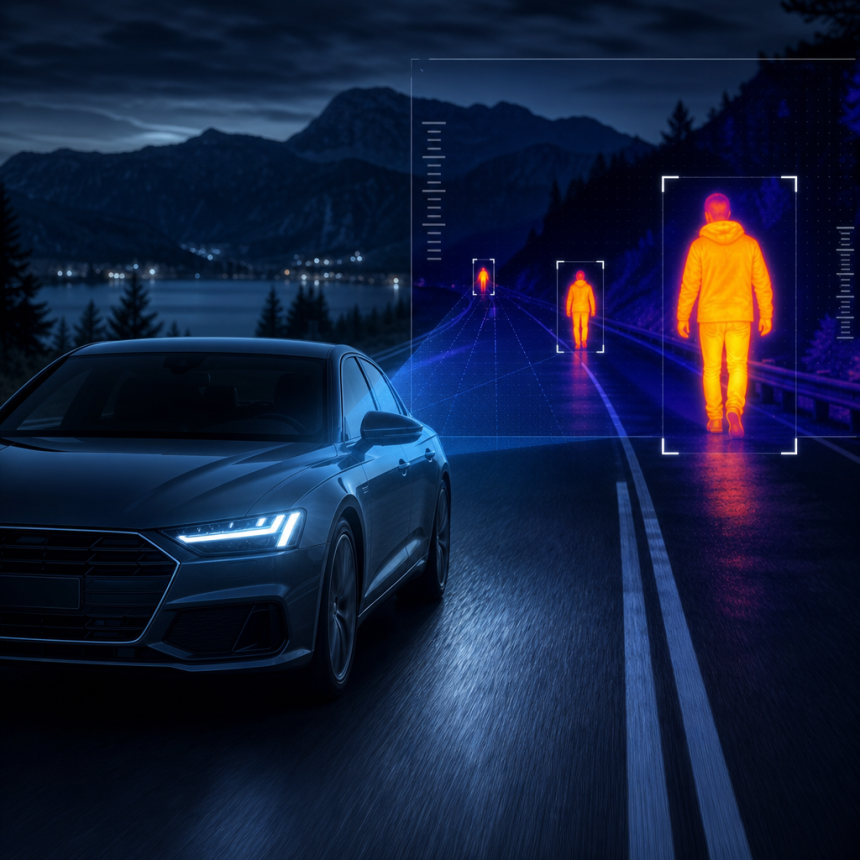
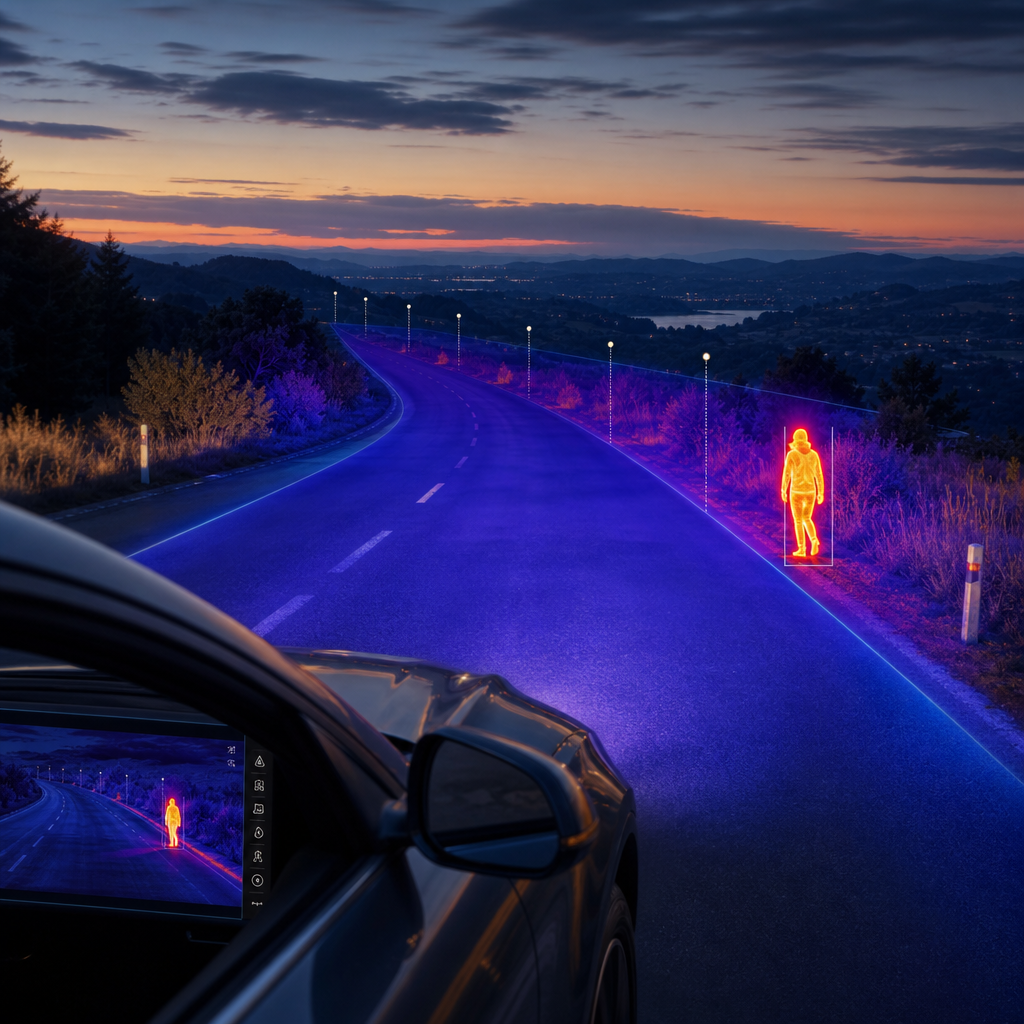
A thermal camera does not see visible light the way a normal car camera does. Instead, it detects infrared radiation, which is emitted by all objects based on their temperature. Humans are usually much warmer than the surrounding environment, so they appear as bright heat signatures against cooler backgrounds.
That makes pedestrians easier to detect at night, in fog, or in low-light conditions where regular cameras struggle. However, thermal cameras are not magic. They do not automatically identify a person with the same clarity as a daytime HD video feed. They create a thermal image in which the body heat of a pedestrian stands out.
This distinction matters because detection range depends on several layers of performance:
- Detection: noticing that something warm is present
- Recognition: understanding that the warm object is likely a person
- Identification: confirming details such as clothing, pose, or whether the person is carrying something
A camera may detect a pedestrian much farther away than it can identify one.
Typical Detection Range for Pedestrians
In practical automotive use, a car thermal camera can often detect a pedestrian at a distance of roughly:
- 100 to 300 meters for many consumer and mid-range systems
- 300 to 500 meters or more for higher-end automotive thermal cameras
- Shorter distances in poor conditions or with low-resolution systems
Some premium long-range thermal systems can detect a person even farther away under ideal conditions, especially when mounted with a narrow field of view and a high-quality sensor. But for everyday driving, the useful range is often limited by the camera’s resolution and the vehicle’s speed.
A Useful Way to Think About Range
Instead of asking only, “How far can it see?” it is better to ask:
- How far can it detect a warm human shape?
- How far can it alert the driver in time?
- How far can it recognize that the shape is a pedestrian?
A camera that can detect a pedestrian at 400 meters may still only provide a useful driver warning at 150 to 250 meters if the image is small, the road is cluttered, or the system needs extra processing time.
Key Factors That Affect Detection Distance
No single number applies to every car thermal camera. Several factors dramatically affect how far it can detect pedestrians.
1. Camera Resolution
Resolution is one of the most important factors. A thermal sensor with higher resolution can distinguish smaller heat signatures at longer distances.
Common thermal resolutions include:
- 160 × 120
- 320 × 240
- 640 × 480
- Higher professional-grade options
A 160 × 120 camera might detect a pedestrian, but the person may appear as a very small blob at longer distances. A 640 × 480 camera captures much more detail, making it easier to detect and track a pedestrian farther away.
2. Lens and Field of View
The lens determines how much of the road scene the camera captures.
- Wide field of view: better for seeing more of the road and surroundings, but distant pedestrians appear smaller
- Narrow field of view: better for long-range detection, because it “zooms in” on objects farther away
A camera designed for city driving may prioritize a wider view, while one built for highway use may use a narrower lens to extend range.
3. Weather Conditions
Thermal cameras are often praised for working in darkness, but weather still matters.
Fog and haze
Thermal imaging usually performs better than visible-light cameras in fog, but heavy fog can still reduce distance and image clarity.
Rain and snow
Rain and snow can reduce contrast, obscure the scene, and create noise in the image. Heavy precipitation can shorten useful detection range.
Humidity
High humidity can affect infrared transmission and slightly reduce the effective range.
Wind and ambient temperature
When the environment is very hot, the difference between a pedestrian’s body temperature and the background may be smaller, making detection harder. In cool weather, pedestrians stand out more clearly.
4. Pedestrian Clothing and Position
A thermal camera detects heat, so clothing affects what the sensor sees.
- Thick insulated clothing can reduce the visible heat signature
- A person facing away may present a smaller thermal profile
- A pedestrian partially hidden behind a vehicle, shrub, or barrier may be harder to detect
- A crouching or seated person may appear less obvious than someone standing upright
Even so, the body heat of a person usually remains visible in some form unless fully blocked by an object.
5. Vehicle Speed
A car traveling at highway speed covers distance quickly. Even if a thermal camera can detect pedestrians far ahead, the driver or system may need enough time to react.
For example:
- At 50 km/h, a vehicle travels about 14 meters per second
- At 100 km/h, it travels about 28 meters per second
That means a pedestrian detected at 150 meters gives more reaction time at city speeds than on a high-speed road. This is why detection range must be matched to driving conditions.
6. Image Processing and AI Detection
Modern thermal systems often use software to analyze the image and distinguish people from other heat sources such as animals, vehicles, or hot pavement.
AI-based systems can improve:
- Pedestrian classification
- False alarm reduction
- Tracking of moving objects
- Warning timing
However, poor software can also create missed detections or too many false alerts. A strong sensor combined with weak processing may not perform as well as expected.
Thermal Camera Detection vs. Human Eye Visibility
Thermal cameras excel in situations where human vision is limited, especially:
- night driving
- glare from headlights
- dark rural roads
- foggy conditions
- low-contrast environments
A pedestrian wearing dark clothes on an unlit road may be difficult to see with the human eye or a conventional camera, but thermal imaging can make that person stand out as a bright shape.
That said, thermal imaging is not the same as seeing a detailed silhouette. The image may look blurry or abstract compared with a standard video feed. This is why thermal cameras are often used as a supplement to visible-light systems rather than a complete replacement.
Real-World Use Cases and Expected Range
City driving
In urban environments, buildings, parked cars, streetlights, and pedestrians moving unpredictably all affect visibility. Thermal cameras can still detect people effectively, but the practical warning distance may be shorter because of clutter and more frequent obstructions.
Typical useful range:
- 50 to 200 meters, depending on system quality and street layout
Suburban roads
On roads with fewer visual obstacles, thermal systems can be especially helpful for detecting pedestrians on the shoulder, crossing roads, or walking near driveways.
Typical useful range:
- 100 to 300 meters
Highway or rural roads
This is where thermal cameras can be most valuable. Roads are darker, speeds are higher, and pedestrians are rarer but more dangerous when present. A long-range thermal camera can detect a person at significant distance, which may provide crucial reaction time.
Typical useful range:
- 200 to 500 meters or more with advanced systems
Detection, Recognition, and Identification: Why the Difference Matters
Many people assume that if a thermal camera can “see” a pedestrian from 400 meters, it should be equally useful at that distance. In reality, the camera may only be doing one of three things well.
Detection
At long range, the camera may simply flag a warm object as something worth noticing. This is useful for warnings, but not always enough for certainty.
Recognition
At a moderate range, the camera can often show that the object is likely a human body rather than a dog, tree, or signpost.
Identification
At closer distances, the system may provide enough detail to confirm that the object is a pedestrian and perhaps even show body orientation or movement.
In practical terms, the distance for identification is usually much shorter than the distance for detection. A camera may detect a pedestrian at 300 meters, recognize one at 150 meters, and identify one clearly at 75 meters.
How Thermal Cameras Compare With Other Car Sensors
Many modern vehicles use several sensor types at once. Thermal imaging is only one part of the picture.
Visible-light cameras
- Excellent detail in daylight
- Struggle in darkness and glare
- Often cheaper than thermal systems
Radar
- Good for measuring distance and speed
- Works in poor weather
- Less useful for visually identifying pedestrians
LiDAR
- Very accurate 3D sensing
- Can detect shapes and distances well
- May be affected by weather and is often more expensive
Thermal cameras
- Strong in darkness and low light
- Detect warm bodies well
- Less detailed than visible-light cameras
- Helpful for detecting pedestrians not easily seen by other sensors
The most effective vehicle safety systems often combine thermal imaging with radar and standard cameras.
Examples of Detection in Everyday Situations
Example 1: A pedestrian crossing a dark road at night
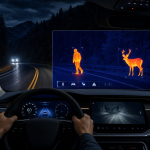
A thermal camera on a vehicle may spot the person as a bright figure 200 meters ahead. Even if the driver cannot yet see the pedestrian clearly with the naked eye, the system can issue a warning.
Example 2: A jogger near the roadside in light fog
A mid-range thermal camera might detect the jogger at 120 to 180 meters, depending on sensor quality and fog density. The person may be visible as a strong heat signature, but fine details may be limited.
Example 3: A person standing behind a parked car
The thermal camera may detect part of the person’s body or outline if heat is visible around the vehicle, but the parked car could block a full signature. Detection range drops because of the obstruction, not because of the camera alone.
Example 4: A pedestrian wearing heavy winter clothing
The person may still be detected, but the heat signature could be less distinct than if they were wearing lighter clothing. The camera might need to be closer for reliable recognition.
Limitations You Should Know
Thermal cameras are powerful, but they have limits that affect pedestrian detection range.
They do not see through solid objects
If a pedestrian is fully blocked by a vehicle, wall, or large obstacle, the camera cannot detect them directly.
Heat contrast matters
On a hot day, pedestrians may blend more with the background, reducing contrast and making them harder to spot.
Image quality varies widely
A budget thermal camera and a high-end automotive system are not comparable. Sensor size, processing, and lens quality all matter.
False positives can happen
Hot exhaust pipes, animals, roadside machinery, and reflective surfaces can confuse the system if software is weak.
Detection range is not the same as safe reaction range
A driver needs enough time to slow down or stop, which depends on speed, road conditions, and alert timing. A camera may technically detect a pedestrian far away, but the real value is whether it gives a meaningful safety margin.
Choosing the Right Thermal Camera for Pedestrian Detection
If you are evaluating a car thermal camera, pay attention to more than just the advertised range.
Look for these features
- High resolution sensor
- Appropriate lens for your driving environment
- Reliable pedestrian detection software
- Good performance in low light and bad weather
- Clear integration with displays or warning systems
- Reasonable refresh rate for moving objects
Ask practical questions
- Can it detect pedestrians on roads like the ones I drive on?
- Does it work at the speeds I usually travel?
- Can it distinguish people from animals and vehicles?
- How does it perform in rain, fog, or heat?
- Is the range based on detection, recognition, or identification?
The best camera for you depends on whether you need city safety, highway awareness, fleet monitoring, or advanced driver support.
Safety Benefits of Thermal Pedestrian Detection
When used well, car thermal cameras can improve safety in several ways:
- They can alert drivers earlier at night
- They help detect pedestrians on unlit roads
- They can improve awareness in fog or glare
- They support advanced safety systems for fleet vehicles
- They may reduce reaction delay in unexpected situations
For drivers in rural areas or regions with limited street lighting, this can be especially valuable.
Conclusion
So, how far can a car thermal camera detect pedestrians? In many real-world cases, about 100 to 300 meters is a reasonable expectation, while high-end systems may detect people 300 to 500 meters or more under good conditions. But the true answer depends on sensor resolution, lens choice, weather, pedestrian visibility, vehicle speed, and software quality.
The most important point is this: detection range is not just about seeing a person far away; it is about seeing them early enough to react safely. A thermal camera can be a powerful tool for that, especially at night and in low-visibility conditions, but its performance is only as good as the system design and the driving situation.
If you understand what affects range and what kind of performance to expect, you can judge thermal imaging more realistically and make better decisions about vehicle safety technology.