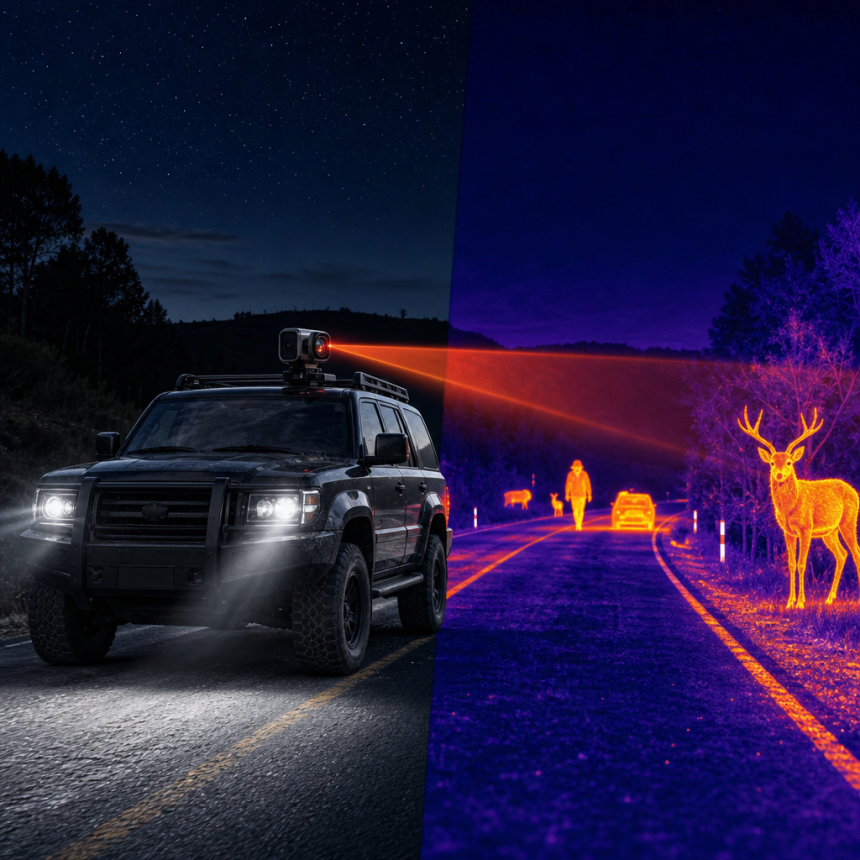
Choosing the right thermal imaging system for a vehicle comes down to more than price or resolution. The best setup depends on how you drive, where you work, and whether you need a fixed view or a camera that can scan a wide area on command. A vehicle mounted thermal camera can improve awareness in darkness, fog, smoke, and rough terrain, but only if it matches the mission.
- What a Vehicle Mounted Thermal Camera Does
- Common Uses for Vehicle Mounted Thermal Cameras
- Law Enforcement and Security Patrol
- Search and Rescue
- Utility and Infrastructure Inspection
- Off-Road and Overland Driving
- Wildlife and Conservation Work
- Key Features That Define the Best Vehicle Mounted Thermal Camera
- 1. Resolution
- 2. Thermal Sensitivity
- 3. Detection Range
- 4. Field of View
- 5. Pan-Tilt-Zoom Capability
- 6. Image Stabilization and Vibration Resistance
- 7. Display Quality and User Interface
- 8. Recording and Connectivity
- 9. Weatherproofing and Durability
- 10. Power Requirements
- Types of Vehicle Mounted Thermal Cameras
- How to Match the Camera to Your Use Case
- Mounting Considerations
- Important Technical Specifications to Compare
- Common Mistakes When Buying a Vehicle Mounted Thermal Camera
- Choosing Resolution Without Considering Lens and Range
- Ignoring the Mounting Environment
- Overlooking the Display
- Forgetting About Integration
- Buying Too Much Camera
- What Makes the Best Vehicle Mounted Thermal Camera?
- Example Buying Scenarios
- Scenario 1: Police Patrol Vehicle
- Scenario 2: Utility Inspection Van
- Scenario 3: Off-Road SUV
- Scenario 4: Search and Rescue Truck
- Maintenance and Long-Term Use
- Final Buying Checklist
- Conclusion
Table of Contents
- What a Vehicle Mounted Thermal Camera Does
- Common Uses for Vehicle Mounted Thermal Cameras
- Key Features That Define the Best Vehicle Mounted Thermal Camera
- Types of Vehicle Mounted Thermal Cameras
- How to Match the Camera to Your Use Case
- Mounting Considerations
- Important Technical Specifications to Compare
- Common Mistakes When Buying a Vehicle Mounted Thermal Camera
- What Makes the Best Vehicle Mounted Thermal Camera?
- Example Buying Scenarios
- Maintenance and Long-Term Use
- Final Buying Checklist
- Conclusion
What a Vehicle Mounted Thermal Camera Does
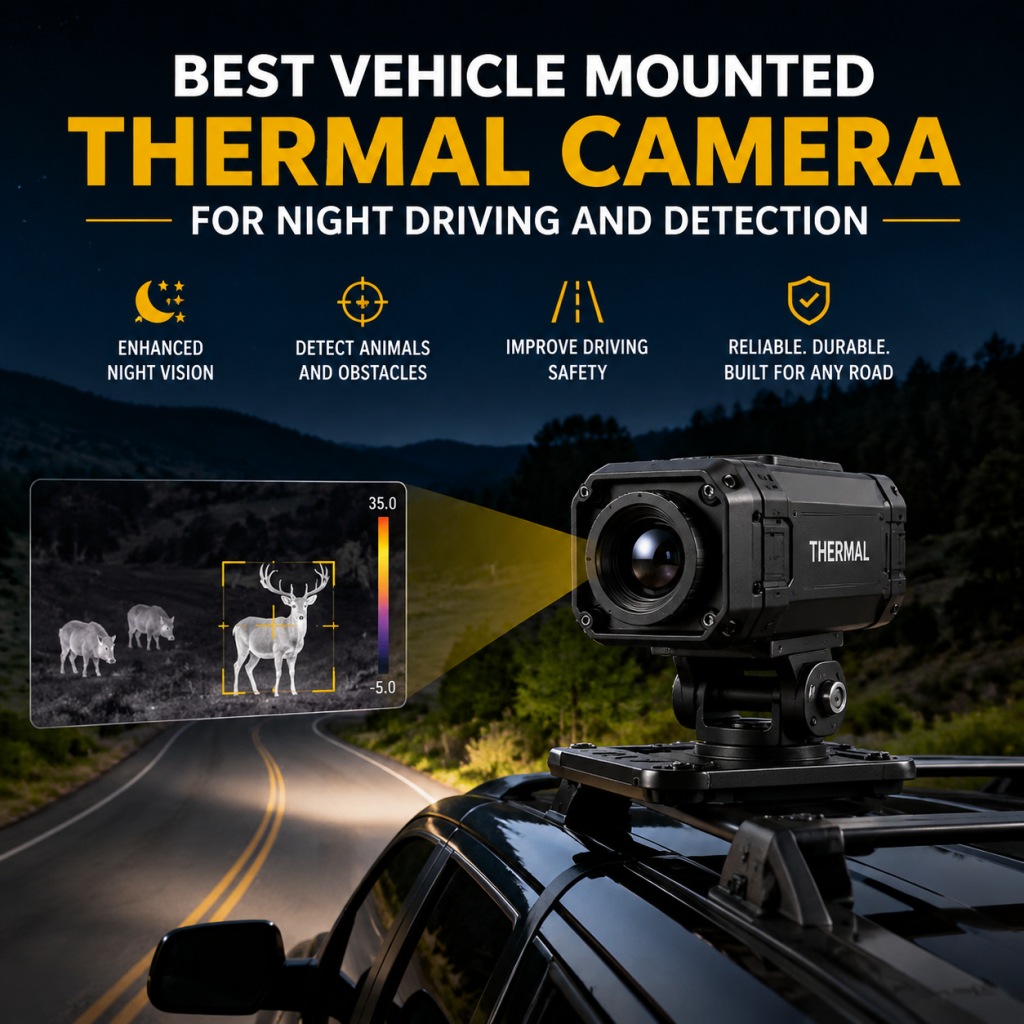
A vehicle mounted thermal camera detects infrared radiation emitted by objects and converts temperature differences into a visual image. Hotter objects usually appear brighter or in lighter colors, while cooler objects appear darker, depending on the color palette used.
Unlike standard cameras, thermal imaging does not depend on ambient light. That means a vehicle mounted thermal camera can still “see” in:
- Total darkness
- Smoke
- Fog
- Light rain
- Dusty environments
- Vegetation with limited visibility
For vehicles, this is especially useful because the camera can be used while driving, patrolling, or parked, giving the operator situational awareness beyond the limits of headlights or visible-light optics. For readers comparing options, the thermal imaging camera for car guide is a useful next step.
Common Uses for Vehicle Mounted Thermal Cameras
Before deciding on the best model, it helps to understand how these systems are typically used. A vehicle mounted thermal camera can support safety, detection, and inspection in many real-world settings.
Law Enforcement and Security Patrol
Police, border control, and private security teams use thermal cameras to detect:
- People hiding in darkness
- Vehicles parked in remote areas
- Movement in fields or along fences
- Heat signatures after a pursuit
A mounted thermal camera allows officers to scan large areas without relying on spotlights, which can reveal their position.
Search and Rescue
Thermal imaging is often used to locate missing persons, stranded hikers, or accident victims. A vehicle-mounted setup can quickly scan road shoulders, ravines, open fields, and wooded areas.
Utility and Infrastructure Inspection
Utility crews use vehicle mounted thermal cameras to identify overheating components on:
- Power lines
- Transformers
- Electrical panels
- Substations
- Pipeline infrastructure
These cameras help detect potential failures before they become expensive outages.
Off-Road and Overland Driving
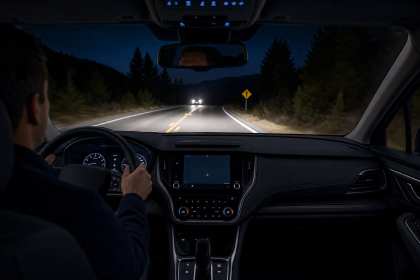
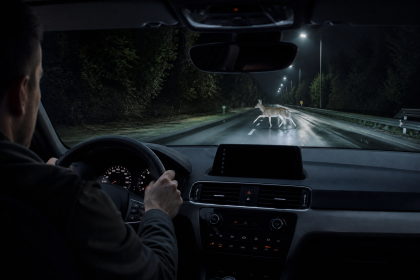
Off-road drivers and overlanders use thermal cameras to spot:
- Animals crossing the path
- People ahead on unlit trails
- Warm engine parts after a stop
- Terrain obstructions in poor visibility
This is one reason many drivers pair a vehicle mounted thermal camera with a forward-facing night setup. If that is your goal, see the best night vision camera for car article for a related option.
Wildlife and Conservation Work
Researchers and wildlife officers use thermal cameras to track animals at night and monitor habitat movement without disturbing the environment.
According to the National Institute of Standards and Technology, accurate measurement and calibration are central to trustworthy thermal imaging performance.
Key Features That Define the Best Vehicle Mounted Thermal Camera
The best thermal camera for a vehicle is the one that matches your operational needs. These are the features that matter most when comparing a vehicle mounted thermal camera.
1. Resolution
Resolution determines how much detail the thermal image provides. Common thermal resolutions include:
- 160 × 120
- 320 × 240
- 640 × 480
- Higher-end specialty options above that
A higher resolution usually means better target recognition and more detail at longer distances. For vehicle use, 320 × 240 is often a minimum practical level, while 640 × 480 is preferable for professional law enforcement, inspection, or long-range detection.
Why resolution matters
If you are scanning a field for a person or animal, a low-resolution sensor may show a heat blob, but not enough detail to identify what it is. Higher resolution improves:
- Target recognition
- Distance performance
- Situational awareness
- Image clarity on larger screens
2. Thermal Sensitivity
Thermal sensitivity, often expressed as NETD (Noise Equivalent Temperature Difference), tells you how small a temperature difference the sensor can detect. Lower values are better.
A camera with strong sensitivity can distinguish subtle differences between objects, which improves image quality in challenging conditions. This is especially valuable when:
- The environment has similar temperatures
- You are inspecting mechanical systems
- You need to spot warm bodies against heated pavement or buildings
3. Detection Range
Detection range refers to how far the camera can spot a heat source. This depends on:
- Lens size
- Sensor resolution
- Target size
- Environmental conditions
- Display and processing quality
A vehicle mounted thermal camera might detect a human at several hundred meters, but recognition at that range will be much more difficult. For vehicle use, think in terms of practical performance, not just advertised maximum range.
4. Field of View
The field of view determines how wide an area the camera covers.
- Wide field of view: Better for scanning nearby areas and driving in close quarters
- Narrow field of view: Better for long-distance detection and identifying distant targets
Some systems use interchangeable lenses or zoom functions to balance both needs.
5. Pan-Tilt-Zoom Capability
Many of the best vehicle mounted thermal cameras use a PTZ system. This allows the camera to pan left and right, tilt up and down, and sometimes zoom in on targets.
PTZ is useful for:
- Monitoring large areas from a parked vehicle
- Tracking moving people or vehicles
- Surveying terrain without repositioning the truck or SUV
A fixed camera can work well for forward viewing, but PTZ adds major flexibility.
6. Image Stabilization and Vibration Resistance
Vehicle-mounted systems must handle constant vibration, bumps, and movement. Poorly stabilized cameras may produce shaky or blurred images, especially on rough roads.
Look for:
- Ruggedized housings
- Shock-resistant mounts
- Electronic or mechanical stabilization
- Automotive-grade components
This is particularly important for off-road use and utility vehicles on uneven terrain.
7. Display Quality and User Interface
The camera itself is only part of the experience. The display and interface should make the system easy to use from the driver’s seat or passenger side.
Important display features include:
- High brightness for daytime visibility
- Adjustable palettes
- Split-screen or dual-view options
- Touchscreen or physical controls
- Quick access to zoom and scan functions
A great thermal camera can still be frustrating if the display is hard to read in sunlight or the controls are too complicated.
8. Recording and Connectivity
Many users need to record thermal footage or integrate it with a larger vehicle system. Useful features include:
- Video recording
- Photo capture
- GPS tagging
- Wi-Fi or Ethernet connectivity
- Integration with monitors, DVRs, or fleet systems
- Mobile app support
For professional operations, recording can be useful for after-action review, evidence, inspections, or training.
9. Weatherproofing and Durability
The best vehicle mounted thermal camera should be built for harsh environments. Consider:
- IP rating for dust and water resistance
- Operating temperature range
- Corrosion resistance
- UV resistance if exposed externally
- Long-term reliability in rain, snow, heat, and cold
If the camera will be mounted outside the vehicle, durability becomes even more important.
10. Power Requirements
Vehicle-mounted systems must be compatible with the vehicle electrical system. Check whether the camera runs on:
- 12V DC
- 24V DC
- Dedicated power supply
- Battery backup
Also consider power draw, especially if the camera will be operating while the engine is off.
Types of Vehicle Mounted Thermal Cameras
Not all vehicle thermal cameras are the same. The main types include fixed, PTZ, and integrated systems.
Fixed-Mount Thermal Cameras
These cameras are mounted in a set position, usually facing forward or toward a specific side or rear direction.
Best for:
- Forward driving visibility
- Fleet vehicles
- Permanent installations
- Simple, reliable applications
Pros:
- Lower cost
- Easier to install
- Fewer moving parts
- Good for continuous monitoring
Cons:
- Limited viewing flexibility
- May require vehicle repositioning to scan different areas
PTZ Thermal Cameras
PTZ cameras provide movement and often remote control through a joystick, touchscreen, or software interface. A vehicle mounted thermal camera with PTZ is especially useful for active patrol work.
Best for:
- Patrol vehicles
- Search and rescue
- Border monitoring
- Surveillance and inspection
Pros:
- Wide scanning flexibility
- Better target tracking
- Can inspect areas without moving the vehicle
Cons:
- More expensive
- More complex installation
- More moving parts that may require maintenance
Integrated Thermal and Visible-Light Systems
Some of the best setups combine thermal imaging with a standard low-light or high-definition camera.
Best for:
- Identification after thermal detection
- Professional security use
- Situations requiring both context and heat signature
Pros:
- Thermal finds the target
- Optical camera confirms details
- Better operational awareness
Cons:
- Higher cost
- More installation complexity
How to Match the Camera to Your Use Case
The best vehicle mounted thermal camera for a police patrol truck may not be the best one for a utility inspection van. Here’s how to match the system to the job.
For Patrol and Security
Look for:
- 320 × 240 or 640 × 480 resolution
- PTZ control
- Strong low-light visible camera integration
- Long detection range
- Recording capability
- Rugged outdoor mounting
A patrol vehicle needs fast scanning and reliable target tracking, so PTZ and image clarity matter a lot.
For Search and Rescue
Look for:
- High sensitivity
- Wide field of view
- Good long-range detection
- Strong stabilization
- Easy-to-use controls
Search and rescue often happens in rough terrain, so the camera should help you scan fast without confusion.
For Inspection Work
Look for:
- High resolution
- Excellent thermal sensitivity
- Stable image output
- Recording and reporting tools
- Narrower field of view if you need detail
Inspection work is less about spotting moving targets and more about identifying temperature differences accurately.
For Off-Road Driving
Look for:
- Wide field of view
- Durable mounts
- Fast boot-up
- Simple forward-view operation
- Weatherproof design
Off-road users usually need a camera that helps avoid obstacles and detect animals or people ahead without adding too much complexity.
Drivers who want a broader safety upgrade can also compare the SUV thermal night vision safety guide for another vehicle-based option.
Mounting Considerations
Even the best thermal camera can underperform if it is mounted poorly.
Mounting Location
Common mounting positions include:
- Roof
- Front grille
- Dashboard
- Rear cargo area
- Side-mounted brackets
Each position has trade-offs. Roof mounting gives broad visibility, while grille mounting can provide a lower forward angle and less obstruction.
Vibration and Angle
Make sure the mount is:
- Secure
- Properly aligned
- Protected from impact
- Positioned to avoid blind spots
A slightly bad angle can reduce performance more than many people expect.
Cable Routing
If the system is hardwired, plan the cable path carefully to protect it from:
- Heat
- Abrasion
- Moisture
- Sharp edges
Professional installation is often worth it for high-value systems.
For a step-by-step setup breakdown, see how to install thermal night vision in a car.
Important Technical Specifications to Compare
When comparing models, these are the specs that help separate a good system from the best one.
Sensor Type
Most thermal vehicle cameras use uncooled microbolometer sensors. These are common because they are reliable, compact, and suitable for automotive and security applications.
Refresh Rate
A higher refresh rate gives smoother motion and less lag. This matters when:
- Driving at speed
- Tracking moving subjects
- Viewing from a moving vehicle
Lens Options
Lens size affects detection and field of view. A larger lens typically provides longer reach, while a smaller lens covers more area.
Palette Modes
Thermal images can be displayed in different color palettes, such as:
- White hot
- Black hot
- Ironbow
- Rainbow
- Sepia
Different palettes work better in different situations. Many users prefer white hot or black hot for clarity.
Environmental Rating
If the system will be exposed to weather, check the IP rating and operating temperature range. A camera that performs well in mild conditions may fail in extreme heat, cold, or wet environments.
For a broader explanation of thermal imaging performance, the National Institute of Standards and Technology is a trusted reference for measurement and sensor concepts.
Common Mistakes When Buying a Vehicle Mounted Thermal Camera
Many buyers focus only on price or resolution and end up with a system that doesn’t fit their needs. A vehicle mounted thermal camera should be selected for the job, not just the spec sheet.
Choosing Resolution Without Considering Lens and Range
High resolution is useful, but it doesn’t automatically mean better long-range performance. Lens size, sensitivity, and optics matter just as much.
Ignoring the Mounting Environment
A camera designed for paved roads may not survive off-road vibration or constant exposure to rain and dust.
Overlooking the Display
A poor monitor can make even excellent thermal imaging difficult to use.
Forgetting About Integration
If you need DVR recording, fleet management, or dual-view monitoring, confirm compatibility before buying.
Buying Too Much Camera
Some users purchase a high-end PTZ system when a fixed forward-view camera would be enough. Others buy a basic camera and later discover it lacks the range or clarity they need.
What Makes the Best Vehicle Mounted Thermal Camera?
In practical terms, the best option combines the following:
- Adequate resolution for the task
- Strong thermal sensitivity
- Good detection range
- Proper lens and field of view
- Reliable mounting and vibration resistance
- Weatherproof construction
- Easy-to-use controls
- Display or system integration that suits the vehicle
- Recording and connectivity if needed
For most professional users, the best vehicle mounted thermal camera is not the most expensive model, but the one that performs consistently in real-world conditions. When the camera matches the mission, the vehicle mounted thermal camera becomes a reliable tool for safer driving and faster detection.
Example Buying Scenarios
Scenario 1: Police Patrol Vehicle
A police unit may benefit most from a PTZ thermal camera with 640 × 480 resolution, recording capability, and integration with an in-car display. The ability to scan fields, parking lots, and roadside areas without repositioning the vehicle is a major advantage.
Scenario 2: Utility Inspection Van
A utility crew may prefer a rugged fixed or semi-fixed camera with high sensitivity and strong measurement reliability. Here, temperature differentiation and documentation are more important than PTZ movement.
Scenario 3: Off-Road SUV
An overland driver may want a compact fixed thermal camera with a wide field of view, fast startup, and weather-resistant housing. The main goal is safety and obstacle awareness, not advanced surveillance.
Scenario 4: Search and Rescue Truck
A search and rescue team may choose a high-resolution PTZ system with good stabilization, wide-area scanning ability, and strong low-temperature performance for night and rough terrain use.
Maintenance and Long-Term Use
Once installed, a vehicle mounted thermal camera should be checked regularly.
Routine Care
- Clean the lens with appropriate materials
- Inspect mounting hardware
- Check power connections
- Confirm recording and display functions
- Test zoom and PTZ movement if applicable
Seasonal Concerns
In winter, condensation and ice may affect operation. In hot climates, heat buildup can shorten component life. Make sure the system is rated for the conditions it will face.
Software and Firmware
If the camera includes software or app connectivity, keep firmware updated when appropriate to improve compatibility and security.
Final Buying Checklist
Before purchasing, ask these questions:
- What is the camera’s primary use?
- Do I need PTZ or is fixed view enough?
- Is the resolution adequate for detection and identification?
- Will the camera operate in the weather and terrain I expect?
- Is the mount secure and vibration-resistant?
- Does the display work well in daylight and at night?
- Do I need recording or integration features?
- Is the power system compatible with my vehicle?
If you can answer these clearly, you are much more likely to choose the right system.
Conclusion
The vehicle mounted thermal camera you choose should fit your mission, vehicle, and environment. For some users, that means a rugged fixed camera with a wide field of view. For others, it means a high-resolution PTZ system with recording, tracking, and integration features.
Focus on the core factors: resolution, thermal sensitivity, detection range, mounting durability, display quality, and real-world usability. When those elements line up with your use case, a vehicle mounted thermal camera becomes far more than a gadget—it becomes a practical tool for safety, visibility, and decision-making on the road and beyond. If you want to compare a different approach to night visibility, the car thermal night vision guide is another helpful resource.
To help with safe operation in difficult weather, it also makes sense to review safe driving in fog tips before relying on any camera system alone. That extra context can help you get the most from a vehicle mounted thermal camera in real conditions.