

Thermal Night Vision: Never Get Blinded by Headlights Again
Tired of blinding headlights? Unlock the secrets of Thermal Night Vision. See 656+ feet in total darkness and conquer night driving fears. Read now!
Introduction – We Feel Your Night Driving Pain
Picture this.
You’re driving home on a dark, country road. It’s quiet. Your headlights are the only thing cutting through the darkness.
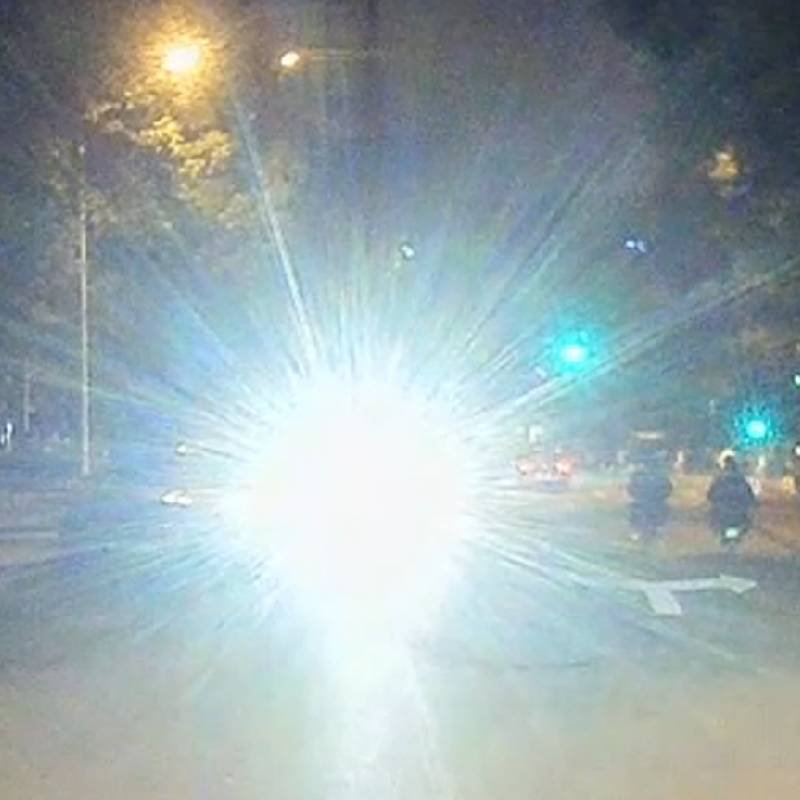
Suddenly, a blinding white light appears around the bend. It floods your car, and for a few seconds, you can’t see anything. Your heart pounds. You slam the brakes and grip the steering wheel, praying you stay in your lane.
Sound familiar?
If it does, you are not alone. According to the National Highway Traffic Safety Administration (NHTSA), the fatality rate per vehicle mile traveled is three times higher at night than during the day. Poor visibility is a major cause, and dealing with high beams from oncoming traffic is one of the most stressful parts of driving.
But here’s the good news: you don’t have to suffer through this “temporary blindness” anymore. Modern thermal night vision technology offers a real solution. This advanced thermal night vision is no longer a luxury feature—it’s an accessible tool that can transform your night driving. <<<
This guide will uncover the truth about headlight glare and show you how a reliable thermal night vision system can be your eyes on the road, in any condition.
Ready to end the glare panic? Let’s get started.
Why Does That Light Make You “Go Blind”?
To solve a problem, we need to understand it. Why are high beams so powerful? It’s not just the other driver’s fault. It’s also about how our eyes are built.
Your eyes weren’t designed for driving.
Human eyes evolved over millions of years for life during the day. They have one big flaw: they are slow to switch between light and dark.
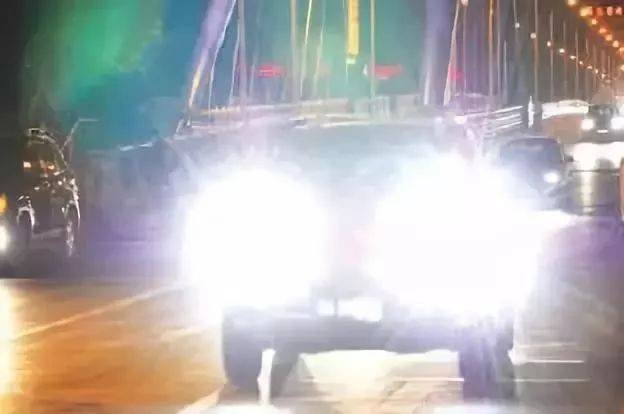
- From Dark to Light (When high beams hit you): In the dark, your pupils are wide open to let in more light. When a bright light suddenly appears, your pupils need a moment to shrink. In that instant, too much light floods in, and the receptors in your retina get “overwhelmed.” This causes that white-out effect known as “glare blindness.”
- From Light to Dark (After the car passes): Once the light is gone, your pupils need to open up again to adjust to the darkness. This process is even slower. It can take 10 to 30 seconds to fully regain your night vision.
Think about it. On the highway, even three seconds of blindness means you’ve driven the length of a football field completely blind. Any danger in that range—a deer, a pedestrian, a stalled car—you would miss completely. This is the fundamental problem that a good thermal night vision system is designed to solve. <<<
Have you tried these tricks? They only help so much.
We all know the standard advice, but it has limits:
- Flashing Your High Beams Back: This only works if the other driver is paying attention and cares. Often, they don’t.
- Using Your Anti-Glare Rearview Mirror: This is a great feature. But it only solves the problem of light coming from behind you. It does nothing for headlights from the opposite lane.
- Wearing Night Driving Glasses: These work by reducing all incoming light. The problem is, in an already dark environment, they can make everything harder to see, which might be more dangerous.
- Looking at the Right Side of the Road: This is the classic defensive driving move. It helps protect your eyes from the direct beam. However, it still doesn’t solve the core problem: For those few critical seconds, you have lost all ability to see what is ahead of you on the road.
This can feel frustrating. Is the only option to just endure it?
Absolutely not. It’s time to look to technology for help. This is where automotive thermal night vision comes into play.
The Solution: What Tech Can “See Through” Darkness and Glare?
Since our eyes have limits, we can use technology to extend them. There are a few main types of night-driving tech, but they are not all created equal.
1. Upgrading Your Headlights (The Active Approach)
Some luxury cars have Adaptive Driving Beams (ADB). This system can block parts of the light beam to avoid blinding other drivers. It’s fantastic, but it has two big downsides. First, it’s expensive and only on new cars. Second, it only controls your own lights, not anyone else’s. It’s just as helpless against another car’s high beams as you are.
2. Relying on Regular Cameras (The Limited Approach)
You might think, “My dash cam has night vision, it should help, right?”
Unfortunately, when it comes to bright lights, it’s often worse than your eyes. Standard cameras (and low-light night vision) work just like human eyes—they capture visible light. This means:
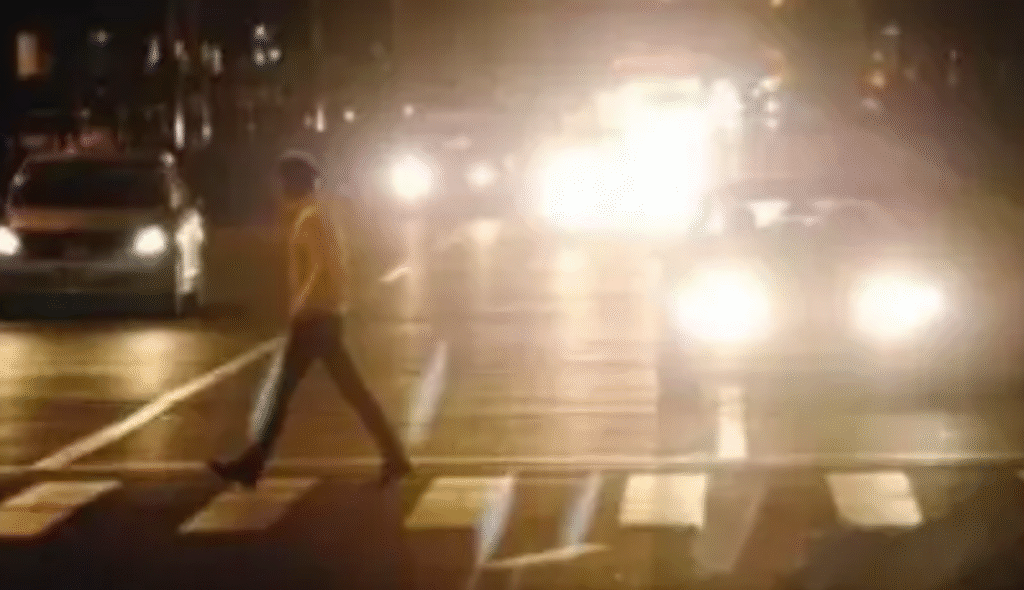
- In strong light, the video will look just like what you saw—a washed-out, white mess.
- In total darkness, low-light cameras need some ambient light to work. With no light, they are blind.
- In fog, rain, or snow, visible light bounces off these tiny particles. This creates a blurry, white screen effect.
So, a regular camera is better for recording what happened than for helping you see in a tough situation. It lacks the capabilities of a dedicated thermal night vision device.
3. The Ultimate Answer: Thermal Night Vision Technology
So, is there a technology that ignores visible light completely and gives you a clear picture no matter what?
Yes. The answer is thermal night vision.
- What is it actually seeing?
Imagine if you could see the world’s “body heat.” A thermal night vision device doesn’t need any light. It creates an image by detecting the infrared heat radiation that all objects and people naturally give off. - Why is it the enemy of high beams?
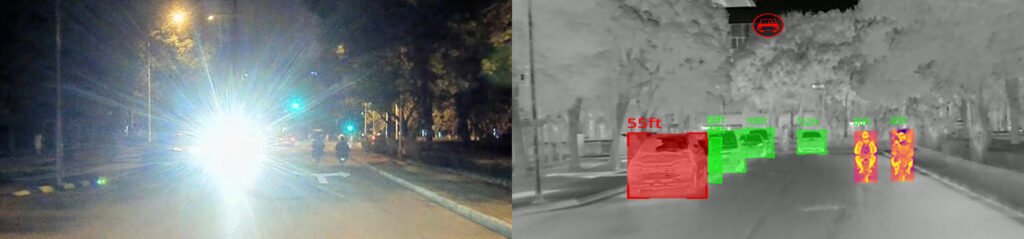
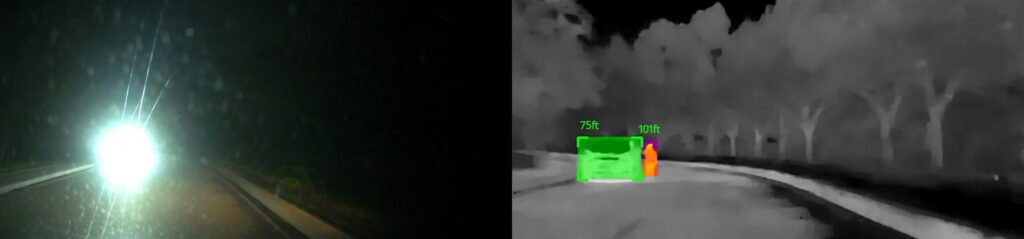
This is the most important part: Thermal sensors are completely “blind” to visible light. This means the glare from an oncoming car’s high beams simply does not appear as a blinding white spot on a thermal night vision screen. For the thermal camera, the light is almost invisible. You would still clearly see the heat outline of the car ahead and the heat signature of a person or animal on the roadside. - The Three Big Advantages of this Thermal Night Vision:
- It Defeats Glare: It solves the problem of high beams, city lights, and other blinding reflections.
- It Sees Through Bad Weather: Fog, rain, and snow don’t block heat radiation as much as they block visible light. Therefore, a reliable thermal night vision system performs far better in nasty weather than any optical device.
- It Spots Living Things: Warm objects like people and animals glow bright white against cooler backgrounds like roads and trees. This lets you spot them from hundreds of feet away with a clear thermal night vision display.
In short, thermal night vision gives you a completely new way of seeing, independent of the world of visible light. It moves you from being a “passive victim of glare” to being an “active master of your environment.” Investing in a quality thermal night vision setup is a decision for safety.
Your Personal Night Vision Expert: A Smart Choice
By now, you might think this sounds like advanced tech for military vehicles or super-luxury cars. It used to be. But not anymore.
Now, consumer products like the Robofinity InsightDrive have made professional thermal night vision for cars accessible to everyone. You don’t need a new car to get this top-level safety feature.
So, how does it specifically tackle the problems we talked about?
- Oncoming High Beams? No problem.
The InsightDrive’s thermal night vision camera doesn’t need light to work. When an oncoming car’s high beams turn your world white, its screen continues to show a clear outline of heat sources ahead. You can instantly tell if there’s a car, a person, or an animal, instead of guessing in a panic. This is the power of a dedicated thermal night vision system. - Rain, Fog, or Pitch Black? You see more.
Thanks to its high-resolution thermal core, it can see through mist and rain. It provides a clear thermal night vision view of the road up to 656 feet (200 meters) ahead, even in total darkness. This distance is much longer than a typical safe stopping distance in the city. - Smart Warnings, Not Scary Alerts.
It’s more than just a camera; it’s an AI co-pilot integrated into a thermal night vision device. Its smart algorithm can tell the difference between a car, a pedestrian, and a cyclist. It then gives you a color-coded highlight on the screen (like outlining a person in red) and a calm, clear voice prompt. Based on our testing, this is very different from a sudden, jarring collision alert. It gives you advanced warning, so you can react calmly without the added stress.
Sounds complicated? It installs in 5 minutes.
You might worry that installing professional gear is a hassle. With the Robofinity InsightDrive, it’s not. It’s designed for a simple plug-and-play setup for your thermal night vision solution. You just plug it into your car’s 12V power outlet (cigarette lighter), attach it to the included mount, and you’re done. No wiring, no modifications, and it works with almost any vehicle—sedans, SUVs, and trucks alike.
According to user reviews, the companion smartphone app is also straightforward. It lets you customize alert distances and update the system firmware easily, making it a user-friendly thermal night vision tool.
Frequently Asked Questions (FAQ)
Q: Does a thermal night vision device work during the day?
A: Yes, it does. Thermal night vision works just as well in daylight, giving you a unique heat-based perspective that can sometimes spot things a regular camera would miss.
Q: Will installation void my car’s warranty?
A: No, it will not. Because it only uses the standard 12V power outlet and doesn’t require any cutting or splicing of your car’s factory wires, installing a thermal night vision device like this will not affect your vehicle’s original warranty.
Q: Can it really help me avoid hitting a deer?
A: Absolutely. This is one of the best uses for thermal night vision for cars. Deer and other animals have a strong heat signature. They show up as a bright white shape against the cooler background of trees and brush, allowing you to see them long before they step into the road. A reliable thermal night vision system provides this critical early warning.
Q: Does it record video?
A: Yes. The Robofinity InsightDrive supports real-time video recording onto a Micro SD card. This is great not just for security, but also for capturing unique thermal night vision views from your drive.
Your Safety Shouldn’t Depend on Other Drivers
Your safety at night should not be a gamble. You can’t rely on every other driver to always do the right thing. When your safety depends on someone else’s behavior, you’ve given up control.
Now, you have the power to take that control back with modern thermal night vision technology.
Don’t just read about the solution—experience it.
Click here to see the Robofinity InsightDrive in action with demo videos and see why it’s the top-rated thermal night vision solution for everyday drivers.
It’s time to upgrade your vision with a powerful thermal night vision system and embrace true freedom for night driving.
